
 Membership
 Donate
 Shop
Shop



















The Other Centennial Year
From the rejected winter olympics to objections to bicentennial commercialism to the American Freedom Train, an undercurrent of skepticism ran through Colorado in 1976.
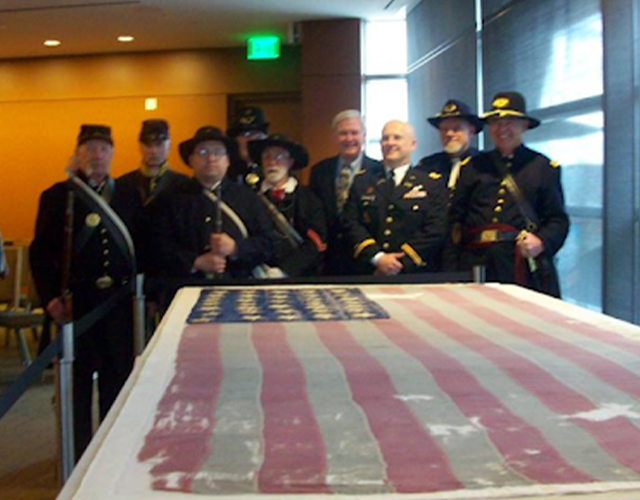
Colorado’s commemoration of its Sesquicentennial (150 years since statehood) and of the nation’s Semiquincentennial (250 years since the Revolution) is here. The recent appearance of the Freedom Plane’s historic documents at History Colorado called to mind an appearance of a similar document-bearing vehicle fifty years ago when the nation’s Bicentennial similarly coincided with the State’s Centennial. And that led, in turn, to an exploration of an alternative history—a “what could have also happened” here during that eventful year of 1976, and the contrasting roles then played by two influential, but vastly different, Coloradans: Dick Lamm and Rodolfo “Corky” Gonzales.
The “could-have-been” event that was intended to coincide with Colorado’s Bi-and Centennial celebrations was the 1976 Winter Olympics, which had been awarded to Denver and the Colorado mountains. Local supporters of the Games expressly promoted the attractiveness of that coincidence. The Colorado Olympic Commission, chaired by then-Governor John Love, placed newspaper advertisements listing its beliefs: “We believe in Colorado. We believe in our Centennial in 1976. We believe in our Nation’s Bicentennial in 1976. We believe [in] the Winter Olympics, [to be] held in Colorado in 1976.”
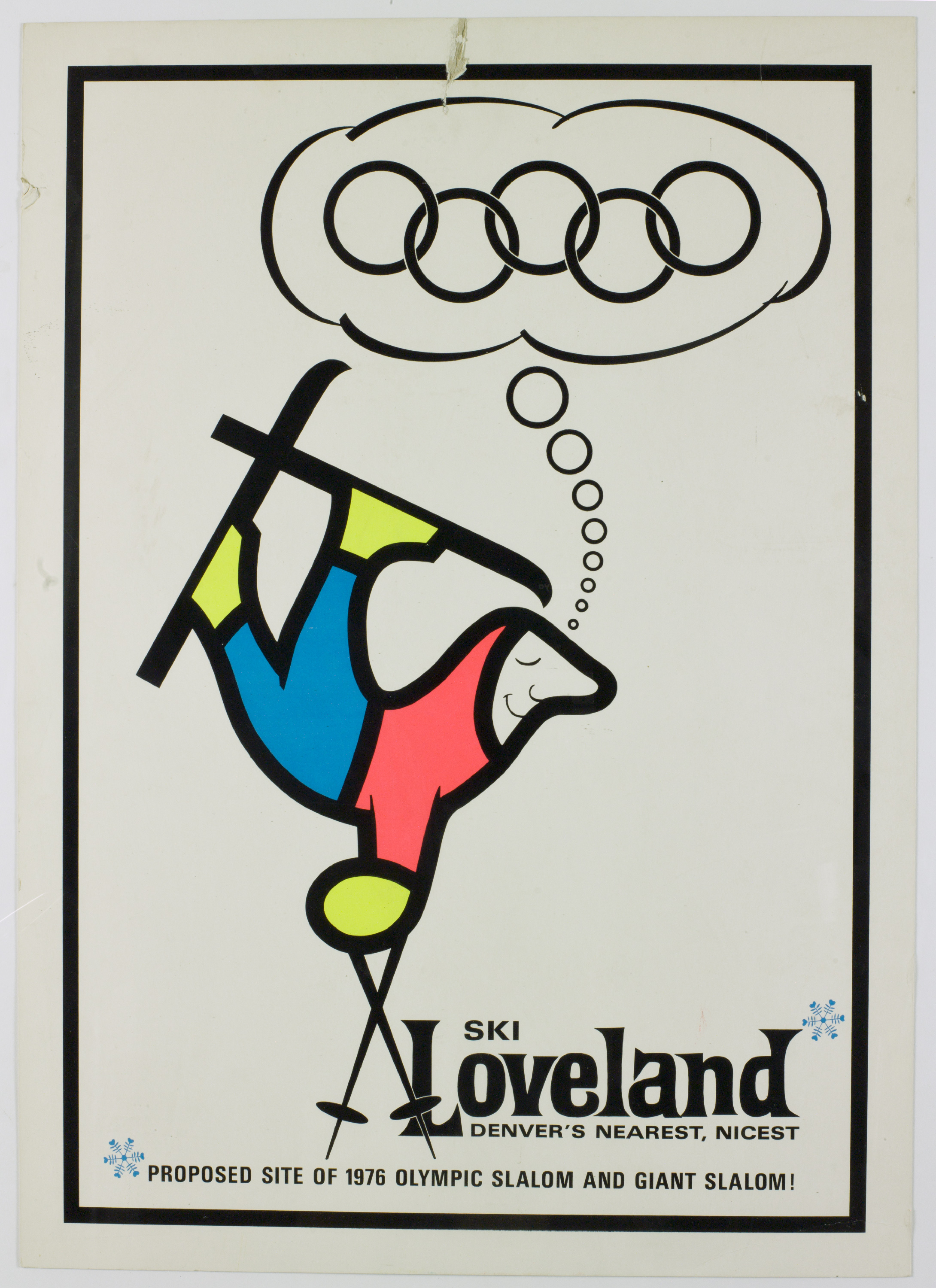
A poster advertising Loveland Ski Area, focusing on the connection to the planned Winter Olympics. Illustrated by Gene Hoffman
But those supporters faced an unexpected backlash. Early opponents emerged from Denver’s Black and Chicano activists, who protested the lack of minority representation in the Games’ planning and insisted that the Games must be preceded by the building of affordable urban housing. Rodolfo “Corky” Gonzales, a leader in Denver’s Crusade for Justice, called for a rejection of the Games unless Denver’s Chicanos “get a piece of the pie”: conversion of abandoned buildings in Denver’s Chicano barrios to schools and public places.
A more politically entrenched group of Olympics opponents was led by a thirty-six-year-old state representative named Richard “Dick” Lamm. Although much of these opponents’ focus was on the economic and environmental impacts caused by all the infrastructure requirements and visitors, there was a growing perception of a fundamental lack of transparency in all the planning. In the words of CSU History Professor Michael Childers, “Colorado voters grew increasingly disillusioned at…an elitist organization of business interests making decisions behind closed doors, decisions that greatly affected the economics and environments of their communities throughout the state.” The Olympics quest ended in 1972 when Colorado voters rejected public funding for the Games.
When Colorado entered its Centennial year in 1976, former Representative Lamm was then Governor Lamm. When he addressed the Colorado Legislature in January of 1976, at its newly-convened “centennial session,” he brought forward and expanded the themes that he had used in opposing the Denver Olympics. His pronouncement that Colorado, “this seasoned, old weather-beaten and well-loved commonwealth of free men and women,” was sound, was followed by some ominous warnings:
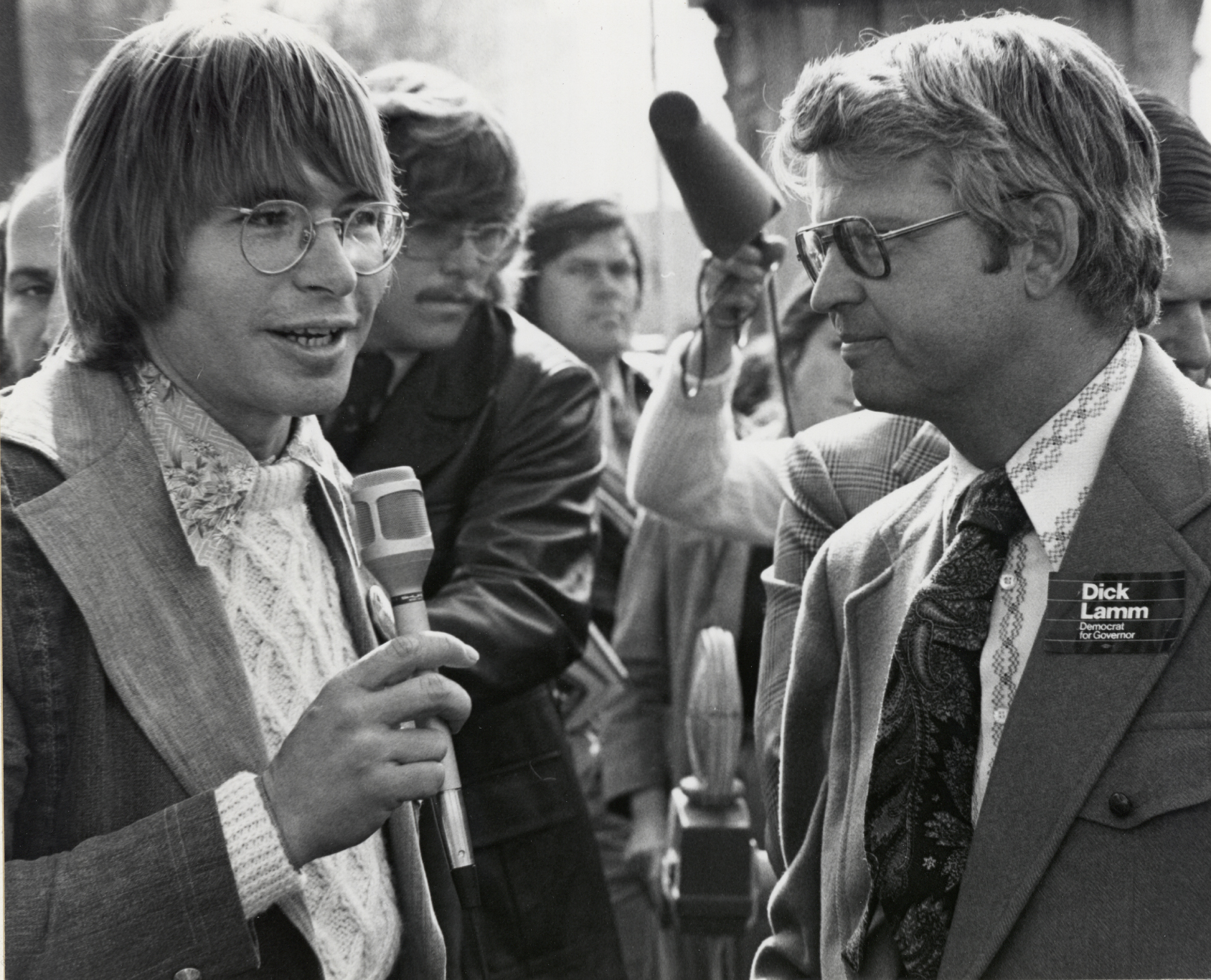
John Denver (left) and Dick Lamm (right) during Lamm’s campaign for governor in 1974.
“The first century of Colorado history was the century of unlimited growth. The century ahead must be one of managed growth.…Colorado must think of growth in new terms and re-examine some of its earlier assumptions.”
Colorado legislators heard a slightly different version of this warning two months later when they were addressed by author James Michener, who spoke at Lamm’s invitation. Michener had just recently published his novel of historic fiction, Centennial. Like Lamm, he also implored the legislators to keep pace with the state’s unprecedented growth. “The time will come when if one wants to see the glories of Colorado he will have to go to Wyoming,” he said. At the time of Lamm’s and Michener’s warnings of imminent statewide growth, the total population of Colorado was about 2.6 million, only about 40 percent of its current six-million figure.
But Michener was also then a member of the national Bicentennial Commission and addressed that upcoming event, which he said would be clouded by the aftermath of both Watergate and the Vietnam War, and by a general “heart-searching” over what should be the nation’s values: “In the midst of all this we’re being asked to hold a barn dance.”
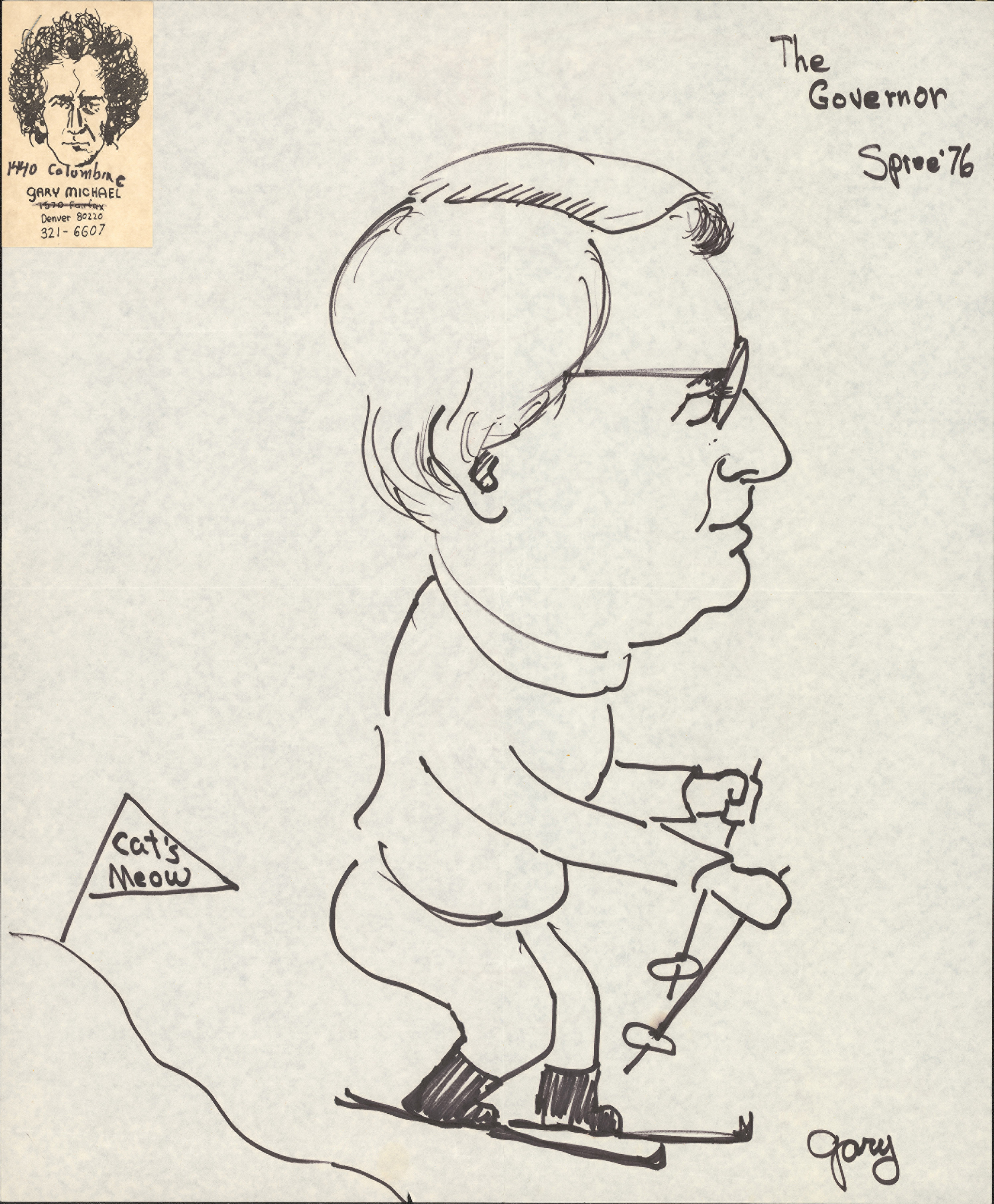
A caricature of Dick Lamm skiing, titled “The Governor Spree ’76.” Illustration by Gary Michael.
As the state’s sitting governor about to preside over a host of statewide Centennial events, Lamm was in no position to offer similar concerns or criticism. But Corky Gonzales occupied no such conflicted position. His Chicano Crusade for Justice organization joined forces with the American Indian Movement (AIM) and other Native activists to protest what they viewed as skewed presentations of national and state history. On July 4, 1976, Gonzales delivered a speech in Colorado Springs attacking the commercialized and consumerist thrust of the “Buy-Centennial.”
Later that month, AIM issued a statement addressing the Colorado Centennial celebration specifically, noting that Native people wanted to know: What is there for them to celebrate, given that massacres and forced removals were part of Colorado becoming a state?
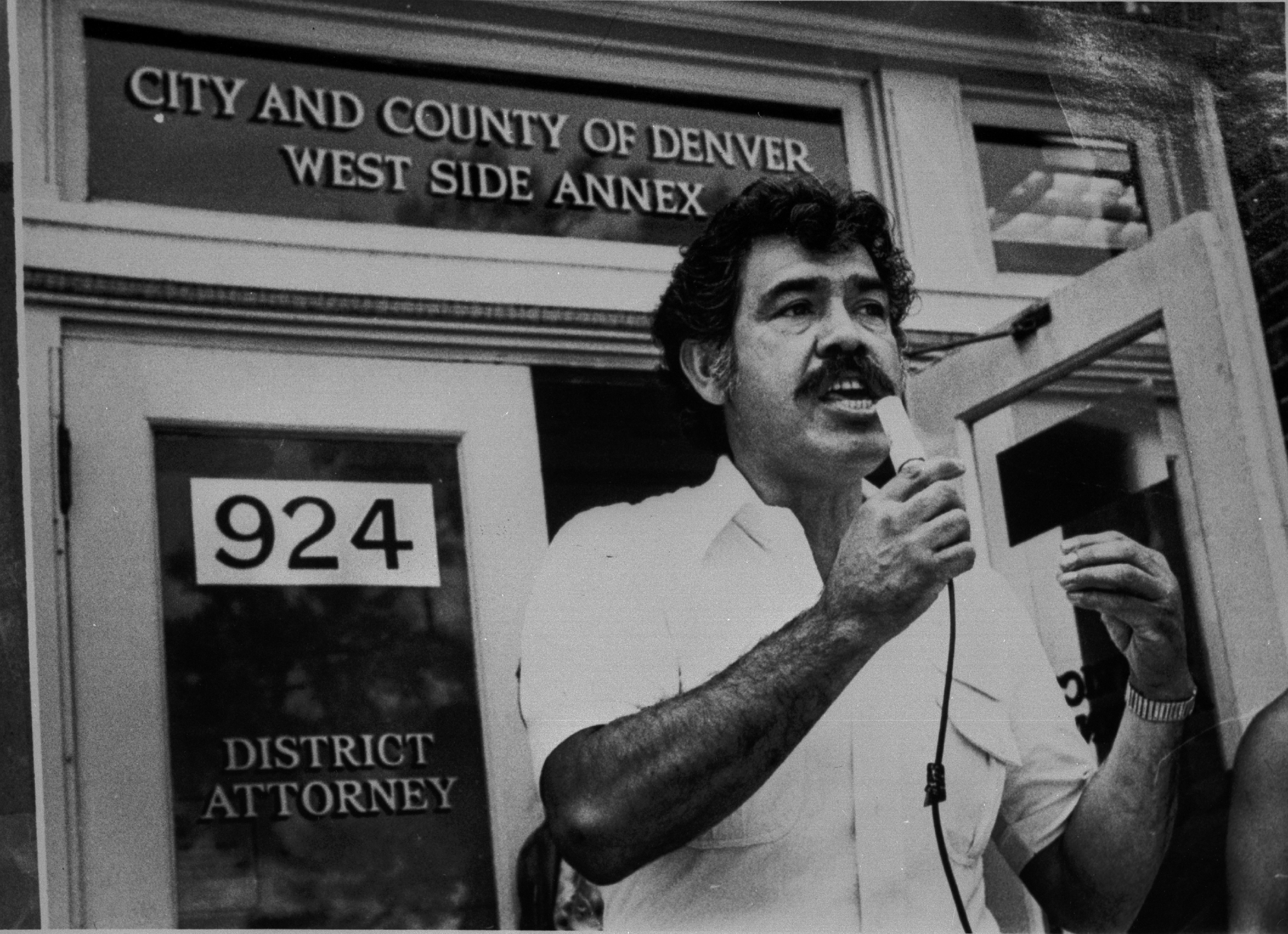
Corky Gonzales speaking outside a City and County of Denver building, photographed in 1980 by Dave Buresh for The Denver Post.
On August 1, 1976, the centennial anniversary of statehood—Colorado Day—Gonzales and other Chicano, Native, and Black activists held a protest rally on the State Capitol grounds. Just a few dozen yards away, Governor Lamm read aloud from the 1876 Colorado Constitution and passed out servings of a Colorado birthday cake. Nationwide opposition to the commercialization of the Bicentennial, led by the People’s Bicentennial Commission, objected to the kitschy schlock some saw as a crass attempt to commercialize and profit from patriotism. When the American Freedom Train, a traveling ten-car exhibition of historic documents and cultural artifacts, arrived in Colorado Springs (Denver officials having declined to pay its expenses), the PBC announced plans to protest it, largely because it had been subsidized by large, national corporations.
While it’s important not to overstate the level of widespread distrust Coloradans had for the 1976 Bicentennial (especially in comparison to the fierce opposition to the ’76 Olympics plans), it’s impossible to deny the undercurrents of public skepticism towards these large events in those years. A lesson, even if a small one, Coloradans may want to look back on in this, our Sesquisemiquincentennial year.
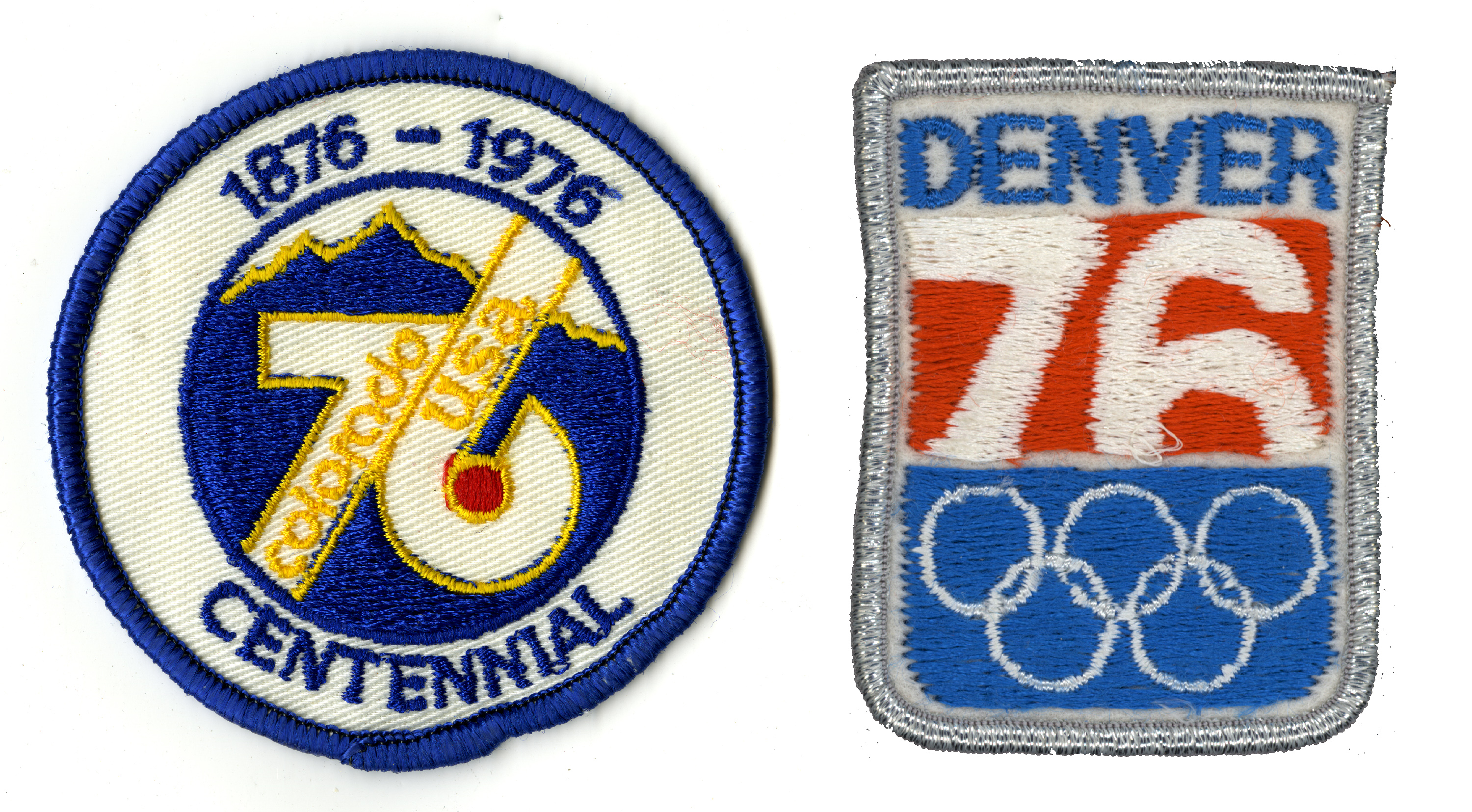
Left, a Colorado Centennial patch from 1976. Right, a 1976 Denver Olympics patch, made to celebrate games that were never held.