
 Membership
 Donate
 Shop
Shop

















Westword Movement
Patricia Calhoun covered fifty years of Denver history as it unfolded.
“Denver loves an underdog that has good ideas,” explains Patricia Calhoun, describing the iconic mayoral victories of Frederico Peña’s “Imagine a Great City” and Wellington Webb’s “Sneaker Campaign.”
An underdog with a good idea also happens to be the perfect description for Denver’s fifty-year affection for Westword, the alt-weekly newspaper Calhoun has edited, owned, and gifted to her chosen city. The first Westword was printed on September 1, 1977, and only a few weeks later, the Rocky Mountain News declared it “debatable” whether the newspaper novices “will be publishing a year from now.” But, in 2026, Westword persists both online and in print form, is locally owned, still has an office in downtown Denver, and can be picked up at about 2,000 physical distribution points across the metro area.
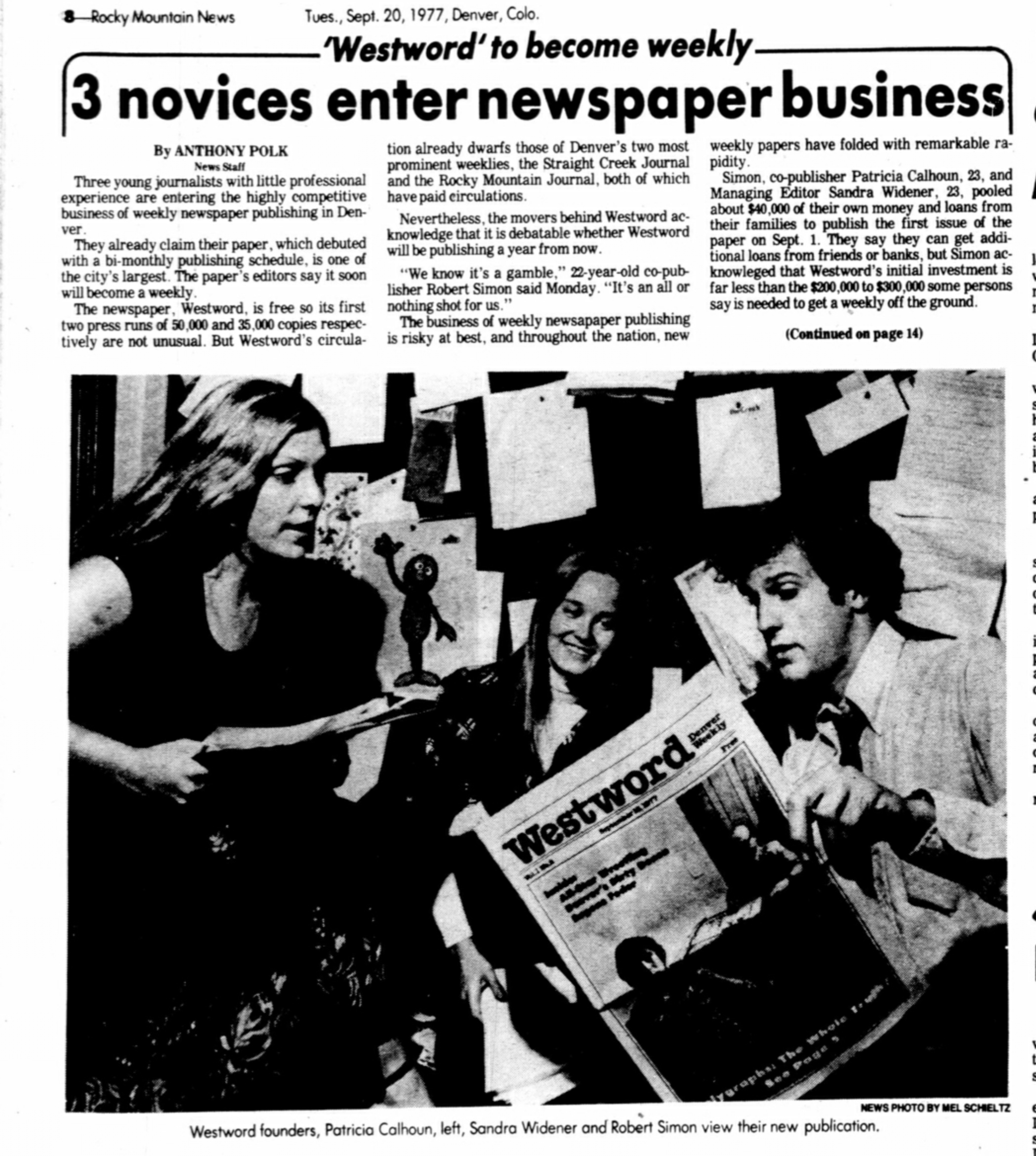
A Rocky Mountain News article about the founding of Westword.
Journalism is known as the first draft of history. And, a sense of Colorado history—with equal parts timing, geography, and swagger—helps explain the longevity of Westword. Calhoun, with early partners Rob Simon and Sandy Widener, pooled 40,000 dollars of their own money and some borrowed funds from friends and family to launch a free newspaper in late-1970s Denver. Undercapitalized, unaware, and unfettered enough to go for it. They ended up with most of the first issues undistributed in Calhoun’s garage, but there was enough grace in the economy and enough hustle in their business plan to figure out what they needed to learn. They also had the gift of timing.
The 1970s were an amalgamation of economic fractures, supersized generational shifts, and evaporating cultural norms. Colorado had an influx of new youthful adventurers lured by the lyrics of John Denver and, according to Calhoun, impressed by the state’s anti-growth audacity when it spurned the Olympics. (Hard to ignore the irony of anti-growth energy attracting new residents.) She explains, “There’s like an influx of people and it’s not like people are coming here because the Chamber of Commerce is luring them. It’s not like their tourism campaigns. People are just coming here because they hear how beautiful it is. A lot of people were inspired. And it did help us: the whole turning-down of the Olympics. Dick Lamm made it an interesting state.”
With bravado enough to match their baby-boomer demographics, younger Denverites—both locals and newcomers—were carving their own pathways, culturally and economically. The larger 1970s economy was infamously stark and inflationary. But as Calhoun describes, in spite of or maybe because of it, there were “so many new businesses starting up. Young people starting businesses, and just creating their own. Their own economy, you know?” The new energy was optimistic, inclusive, and undaunted by entrenched rules and hierarchies. Consider the other creative endeavors founded around this same Denver moment, such as Su Teatro and Cleo Parker Robinson Dance, which also recently celebrated fifty years.
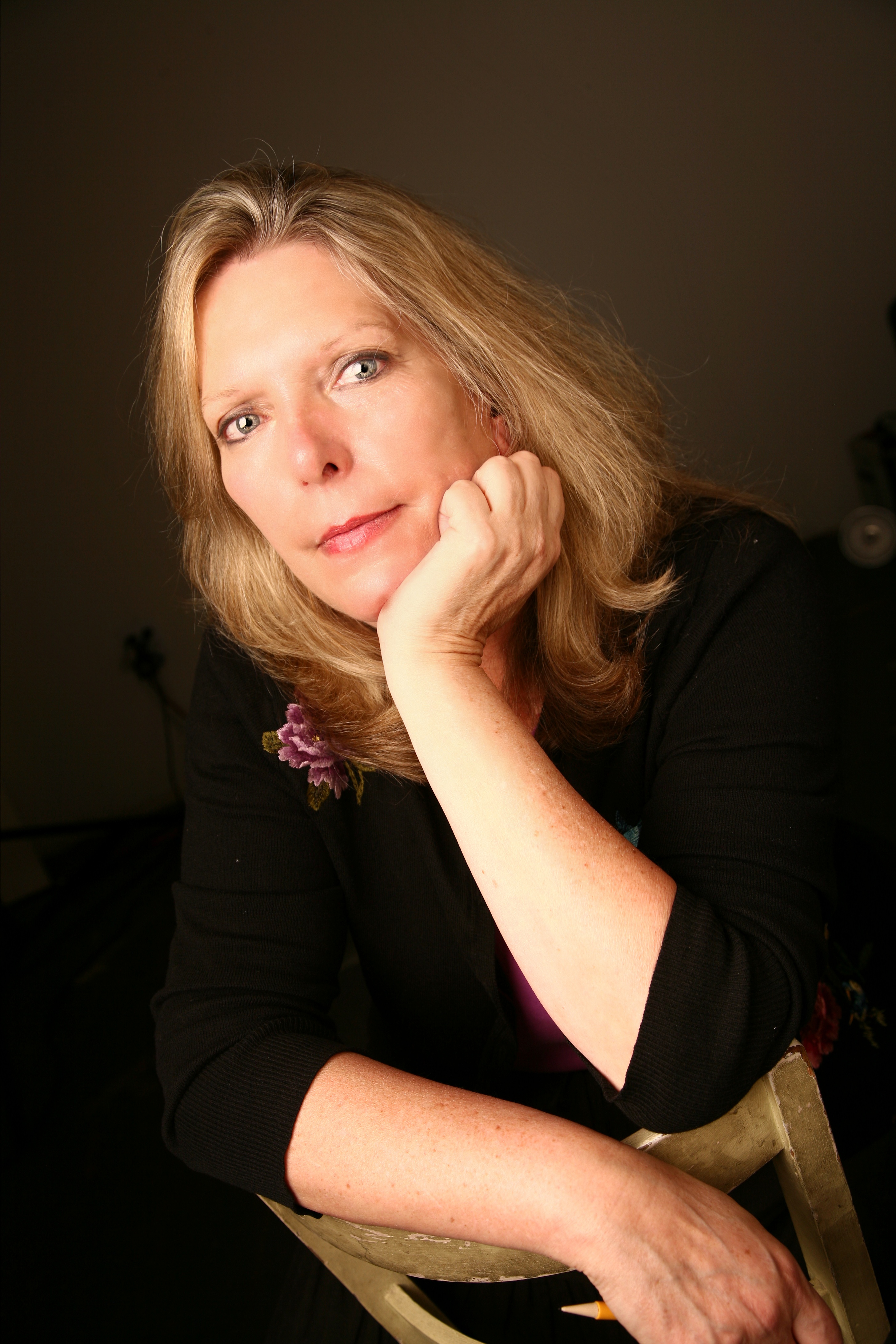
Patty Calhoun.
According to Calhoun, the “old silk stocking Post” wasn't going to report on the entrepreneurial endeavors of this younger generation. “The Post and News wouldn't write about gay clubs. It was pretty easy to see your market, let’s just say that,” and Calhoun continues, “It was a fun partying town but it was also an underground economy. It was just that the other news wasn't paying any attention.”
Westword met the moment and economic opportunity by being the newspaper of this new economy, reporting on the cultural and event news and the bar and club scene. They made sport out of reporting on the local media standards. And, they also became the preferred spot for respective advertising of their generation, including commercial advertising, classifieds, and personal ads. As an alt-weekly they weren't breaking the news, but over the years, Westword honed two of their specialities: “Holy S---t Stories” and “Magnificent Obsessions.”
According to Calhoun, the Holy S---t Story hopes to have everything: “corruption that is affecting you and probably your money and may even have sex and public officials.” She cites one such story, in September 1992, when Westword broke the “The Secret Story of the Rocky Flats Grand Jury,” launching decades of reporting of the Justice Department cutting a secret deal with a Grand Jury. But, she notes that Westword readership found that “just as important was the Magnificent Obsession story, which is: people who have a dream and really want to do something cool in Denver.” One such Magnificent Obsession story was a man who believed he didn't need food to live, just needed to breathe—a breatharian.
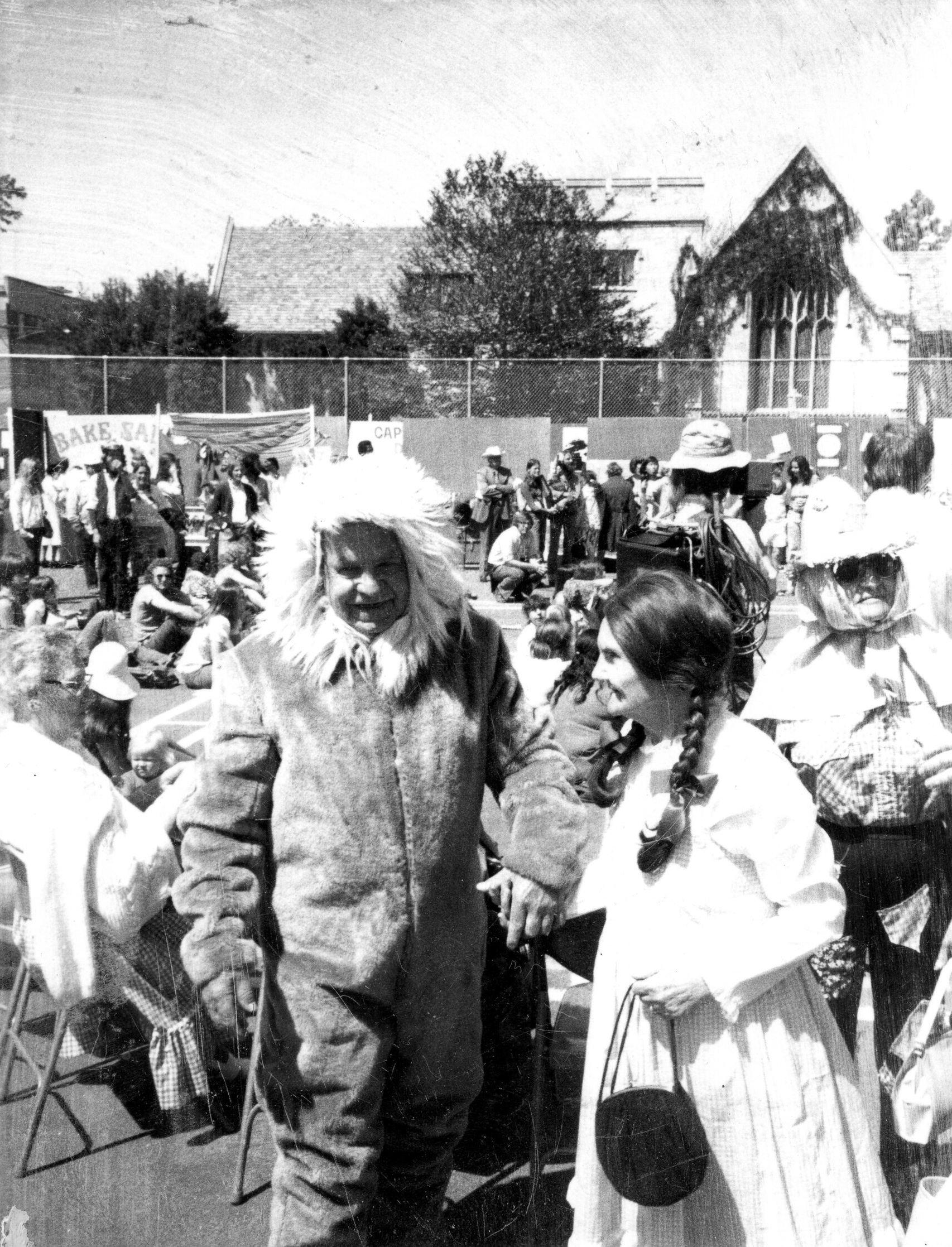
A group dressed as characters from The Wizard of Oz at a late-70s People’s Fair in Denver. It was this kind of alternative scene that Calhoun and her partners at Westword knew that the “silk stocking” Denver Post wouldn’t write about.
Calhoun carved a path sometimes by writing the stories that others wouldn't, breaking longstanding unspoken rules around things you shouldn't print. She broke some taboos around reporting scandals involving sex and powerful men and scandals involving fellow journalists. She honed an intuitive ethical framework to weigh her journalistic obligations and options. And, while she didn't break the Gary Hart Monkey Business story (the 1987 scandal that ended the frontrunner’s presidential run and involved rumors of adultery, a luxury yacht named Monkey Business, tabloid news photos, and a Colorado candidate), she notes how after that, the overall mainstream media landscape became less protective of the powerful and their transgressions.
In its fifty years, Westword has met economic evolution with adaptation. Interestingly, being a free print newspaper protected them from a number of the wounds that standard papers faced from online news. Westword had a website as early as 1992 and Calhoun appreciates that the Internet offered a way to report breaking news for the weekly print paper.
The Internet didn't hit their core business hard until Craig's List took over as the de-facto place for personal ads. Alt-weeklies, like the Village Voice, were well known for the personal ads that filled their back pages with a safe, inclusive, countercultural dating community, and also were a reliable funding stream. Within the teetering boom-and-bust dating technology, answering machines and voicemail caused the personal ad business to soar just before the Craig's List crash. “All that stuff disappeared, and then people had to figure out how to really sell ads,” Calhoun states, “because you still weren't getting department stores. You weren't getting big money.”
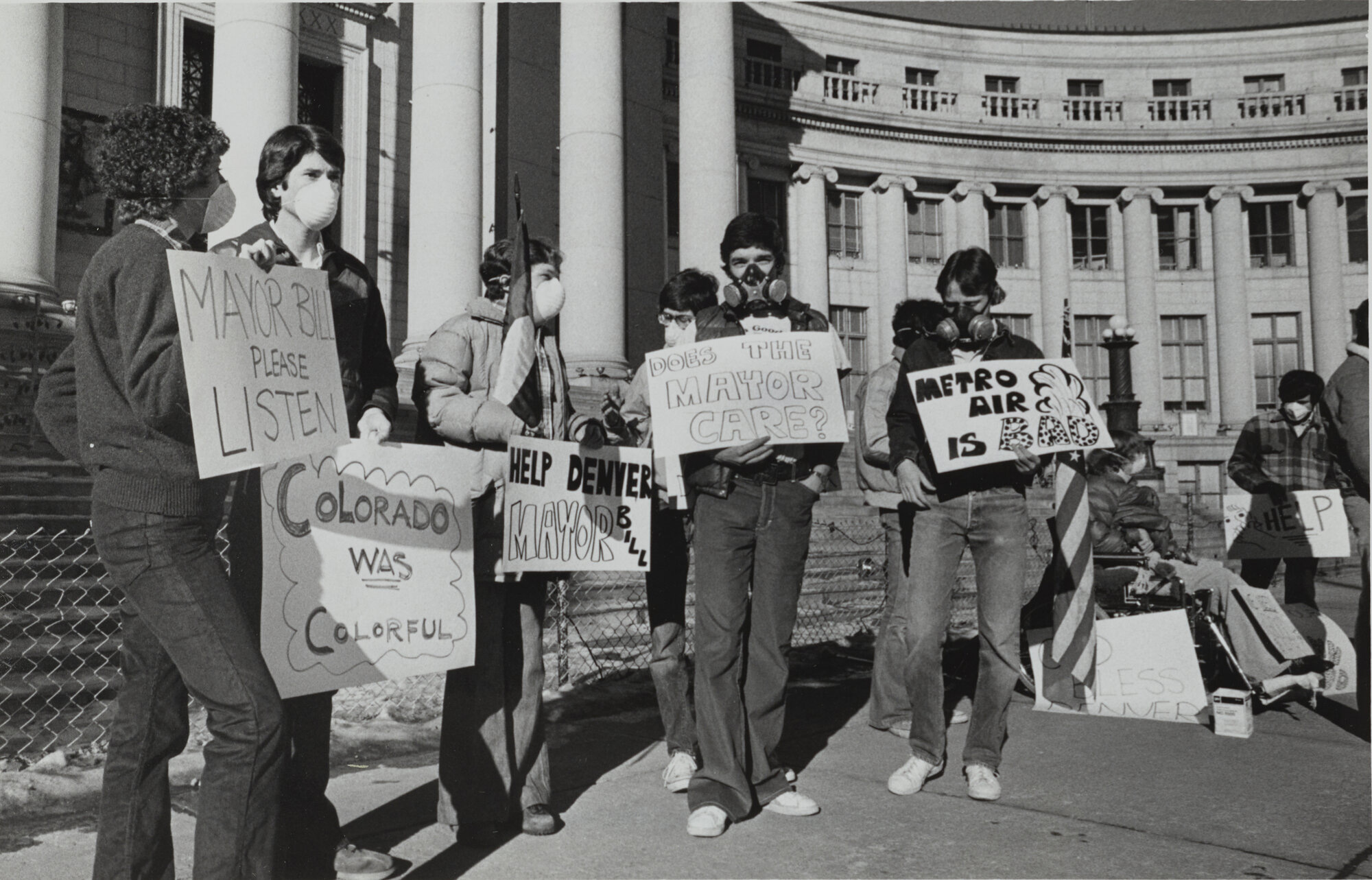
A group of environmentalist students protesting Denver's air quality outside the State Capitol in 1978. Even in the post Vietnam era, mainstream news sources didn’t often cover the issues younger Americans felt were the most important.
The legalization of medical marijuana in Colorado in 2000 and then ultimately the full legalization of marijuana in 2012 softened the economic blow from tech volatility. (A strange side note befitting Westword: Joe Rogan, famed podcaster, once applied to be the paper’s weed reviewer.)
History’s First Draft
Calhoun has had a front-row seat to history as it was made. She is the perfect primer of foundational Denver knowledge—at least for its last fifty years.
While she will be retiring-ish from the business and editing parts of her job, she will continue to write for Westword or exercise her bigger writing muscles with her new found time. She aims to focus on telling those stories, historical background, that explain our world today—but with all the nitty-gritty details that only come from lived experience.
One such story is: “No one knows why we have DCPA” (Denver Center for Performing Arts), which is also local media history. Donald Seawell, longtime lawyer of Helen Bonfils (Denver Post owner and fellow theater buff), helped Bonfils defend the Post from hostile takeovers for more than a decade. She appointed him as the Post’s president and CEO, and eventually chairman and publisher; Seawell carried the newspaper forward after Bonfils’s death in 1972. With the threat of takeover, a wobbly economy, and languishing new business, Seawell sold the paper for 95 million dollars to the Times Mirror in 1990 and ensured the legacy funding of DCPA, the second-largest performing arts center in the nation.
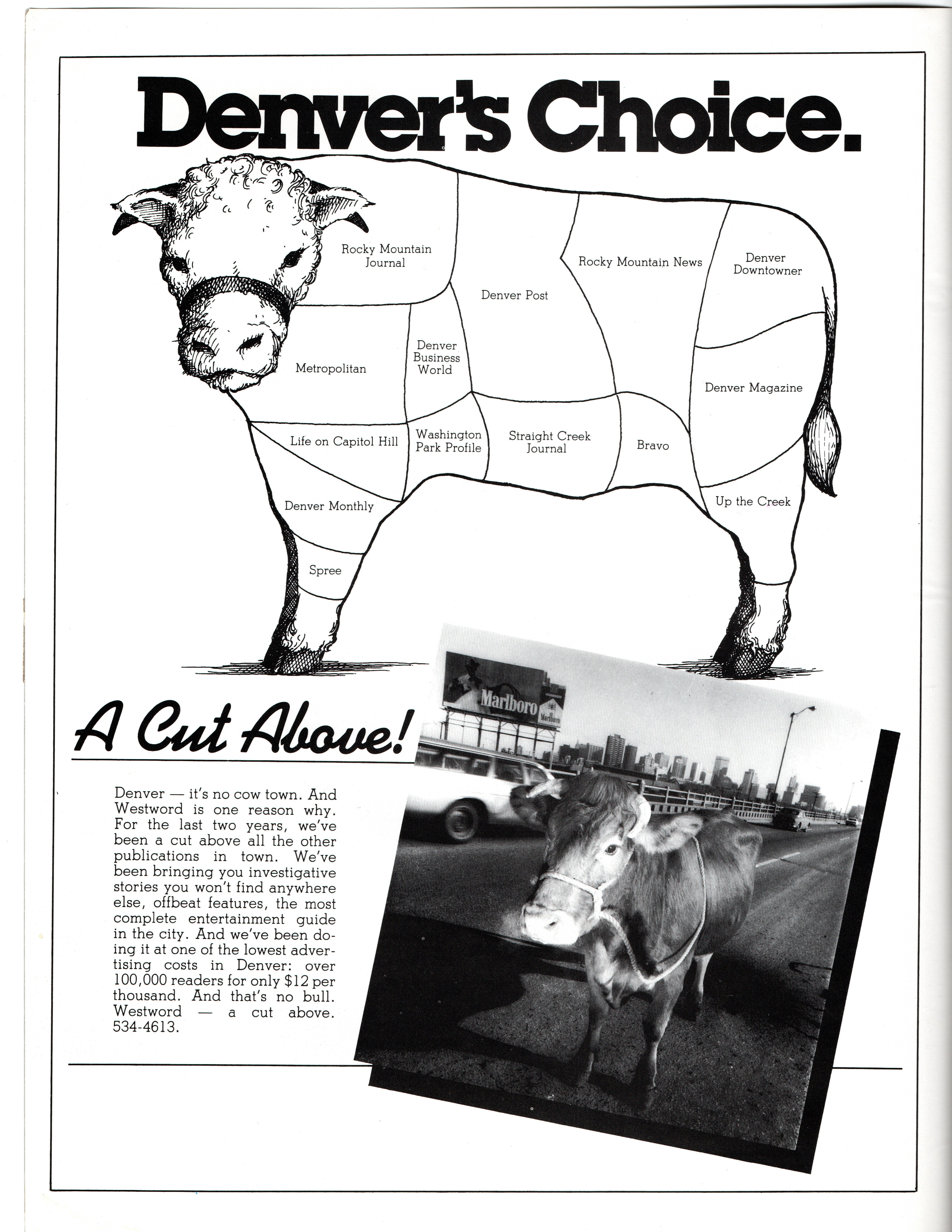
A 1979 ad for Westword in The Mountain States Marketing Review.
Other core Denver or Colorado knowledge she plans to write and share: TABOR, gambling, Rocky Flats, Coors Field, Denver International Airport, Dana Crawford and preservation, Columbine, Olympic rejection, Cherry Creek Mall, the Democratic National Convention, and the Poundstone Amendment, just to name a few. If you really want to know what happened, Calhoun is exactly the colorful time-travel tour guide you want.
Her passion for journalism, media, and the reason for its existence is palpable in both her power-punching stories and in what she calls her Magnificent Obsessions: She notes Velvet Elvis, a local impersonator who performed for over a decade, or Jim Bishop, the one-man builder behind the spectacular Bishop's Castle in Custer County.
More Magnificent Obsessions fill Calhoun’s headspace, including the World’s Wonder View Tower in Genoa on the Eastern Plains that she has worked to resurrect with other creative preservationists. And she loves to buy handmade arts and crafts pieces in prison gift shops created by incarcerated people, who earn income from the sales.
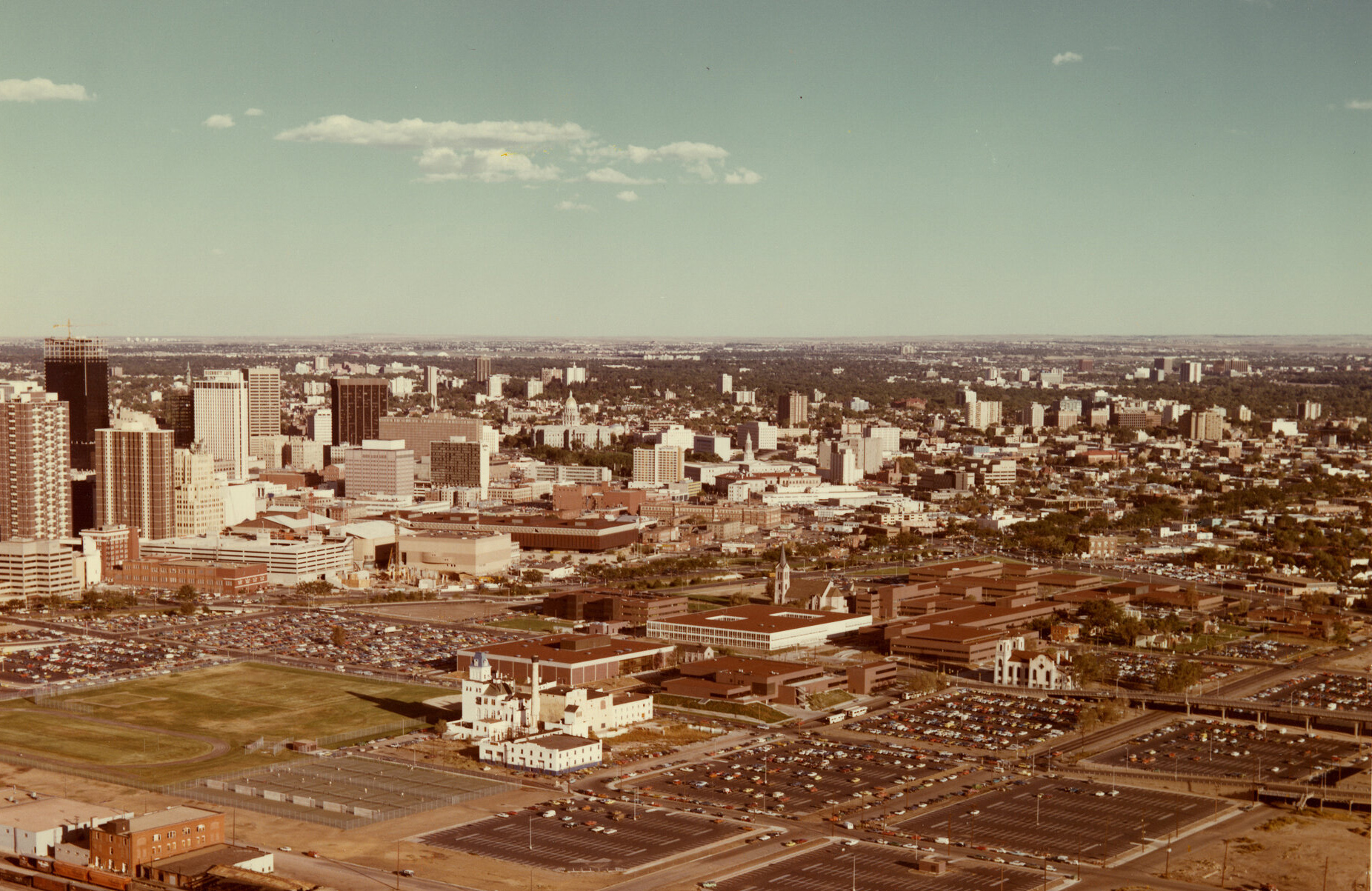
An aerial view of Denver with the Auraria Campus in the foreground, taken in 1977.
But mostly, Calhoun's truest co-obsessions have been her chosen city of Denver and Westword. She is a believer. Her close study of journalism’s evolution over the last fifty years isn't just meta media navel-gazing as the shifts are and have been consequential. For example, Calhoun notes that when she started there were more than 600 reporters across two newspapers in Denver and now there are less than fifty.
The alt-weekly news medium, Calhoun mourns, really only held strong in the media market for a few decades. It was born, in form and content, to antagonize authority while bringing people together through personal ads, event listings, and sometimes political organizing. While she will still have a byline, Westword will continue without Calhoun at the helm and hopefully continue to defy the disappointing trends of megacorporate media consolidation, fraying protections of a free press, and misinformation. In this 250-year anniversary of our nation, Americans are often reminded that a healthy democracy requires an authority-resisting news media that is more locally based and helps to connect us to each other.
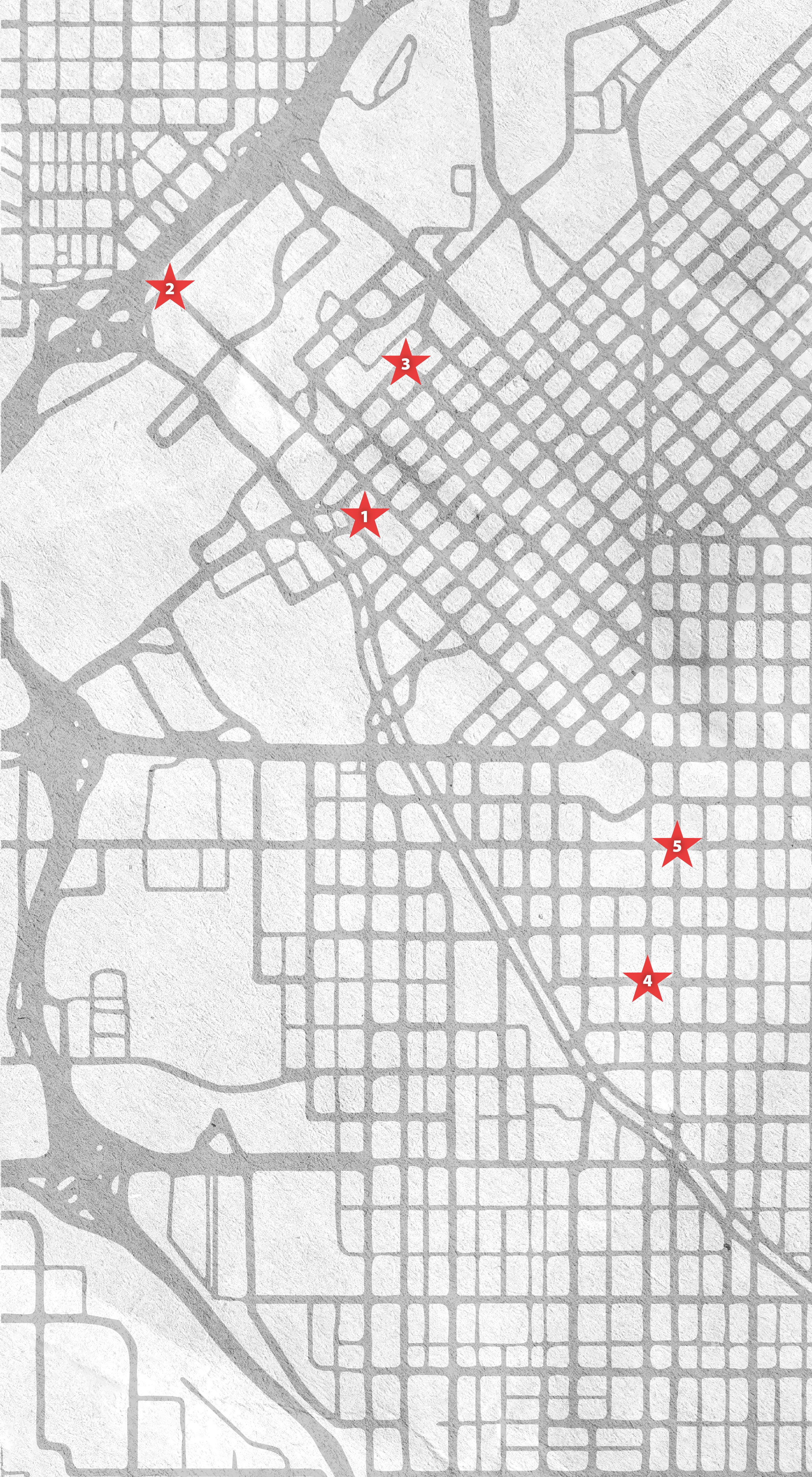
Eras Tour
You can map the trends of a city by where creatives locate—on the edge of where things are happening but that they can still afford. Westword’s geographic movement overlaid with the different eras of the last fifty years, defined by Calhoun, weaves together a fascinating spatial storytelling of Denver.
1: 1977–1984:
Colorado—best-kept secret for creatives, entrepreneurs
Westword geography: basement of rental on South Gaylord, 1439 Market Street, 16th and Wazee (above Wazee)
2: 1985–1991:
Incubator for imagining a great city
Westword geography: 15th and Platte
3: 1992–2007:
Becoming a great city, sometimes despite itself
Westword geography: 18th and Wynkoop
4: 2008–2019:
After the 2008 Democratic National Convention, the secret's out
Westword geography: 10th and Broadway
5: 2020 to today:
Incubator for navigating hazards of success
Westword geography: 13th and Lincoln (moved during Covid)