
 Membership
 Donate
 Shop
Shop


















Forging a Future Pueblo Deserves
A tribute to the Koncilja family at the 2026 Dana Crawford Awards ceremony, given by History Colorado President/CEO Dawn DiPrince
As many of you know, my name is Dawn DiPrince and I serve as the President/CEO of History Colorado and the State Historical Preservation Officer. There is an interesting poetry to this moment as I think about the times I sat with Dana Crawford at the B Street Cafe, talking about preservation in Pueblo. She deemed me a member (like her) of her brown hen society—which is how she framed the people, generally women, who really know how to get things done. It's a pure honor to stand here to celebrate her legacy by recognizing a family who is beloved by many Puebloans—the Konciljas.
When you are from Pueblo, there is a lovely rhythm that you can find embodied within the old neighborhoods—an alchemy of ritual and people and place that connect us to each other. Rituals like my family, after early Sunday Mass at Sacred Heart, eating breakfast at the B Street Cafe, where we would see Joe and Tallie. In the spring, we would take prom pictures in the glow of Neon Alley and attend graduation parties at Union Depot. In the evenings, I would walk by the empty St. Patrick's Church—sometimes with my kids and sometimes alone—saying my preservation prayers that someone would bring it back to life. These are just a few examples of how Koncilja-family preservation projects are so hardwired into the daily DNA of Pueblo.
Most of our families came to Pueblo to work in blast furnaces, coal mines, coke ovens, lime quarries, smelters, wire mills, rail yards, and the related labor that fueled the manufacture of steel for Colorado Fuel & Iron (CF&I). In the early twentieth century, workers from hardscrabble locations across the globe came to work for Colorado’s largest private employer. Three of those ethnicities became rooted in the area and continue to generationally define Pueblo—Mexican, Italian, and former Yugoslavian.
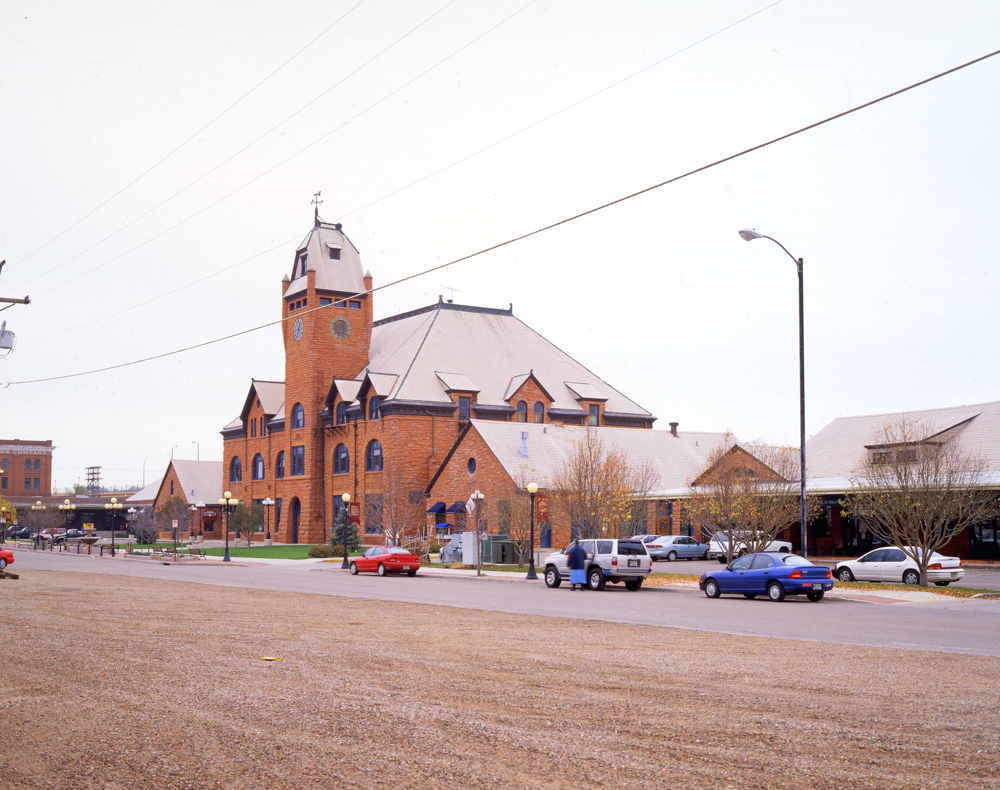
The Union Depot in downtown Pueblo was built in 1889. It’s one of the many original nineteenth-century buildings in the city. Photographed by John Fielder in 1998.
The Koncilja family can trace their roots to Capracotta, Italy, a mountain town, not far from the roots of my own family. Antonio Paglione came to Pueblo in 1906 at the age of fifteen and Lucia Ditella came three years later, age eighteen, as part of a marriage arrangement. They built a life in Bessemer in the shadow of the steel mill and raised their family; Antonio worked in the wire mill until he was injured and then worked as a janitor. The Koncilja side of the family came from Slovenia and owned a slaughterhouse in the Bessemer neighborhood. Their son, Felix, worked hard (sometimes double shifts) at the steel mill and married Anna Marie Paglione, who was a nurse and the night supervisor at St. Mary Corwin, the hospital close to the Konciljas’ growing-up home.
Felix and Anna’s children, Frances, Joseph, and James, grew up with the influence of Bessemer: the hardworking immigrant neighborhood, the work ethic of their family, extra time with their Grandma Lucia, St. Francis Xavier Catholic Church, Catholic school, and Central High.
The Pueblo neighborhood of Bessemer is named for the steelmaking process and, because most of our families came to Pueblo to work for Rockefeller’s CF&I, the company shaped everyone’s lives in such all-encompassing ways that continue to resonate today. In addition to the harsh and dangerous working environment, CF&I’s Sociological Department, run by Dr. Corwin, created social and living conditions designed to build a steady stream of workers for the company. This was different from the lives of management and their families up north in Colorado Springs. The progressive-era leadership of Dr. Corwin lasted nearly forty years, but the socialization became embedded in ways that led many of us to believe that we were not good enough or deserving enough and that there was shame in our poverty, our lack of education, our foreign names, our speech, and the industrialized pollution—and even smell of our town.
I share so much of this background so you can understand why it matters so much to me and to so many of us what the Koncilja family has done in Pueblo. They have beautifully and unabashedly preserved so much of this place that is rooted and inextricable to who we are. Their love and their investment in the places and buildings that make Pueblo special is the opposite of shame. It has been a decades-long lesson that Pueblo—our place in the world—is worthy, which means that we must be worthy, too. Our brave, brilliant, and hardworking ancestors built our city with grit and it is a gift to be cherished.
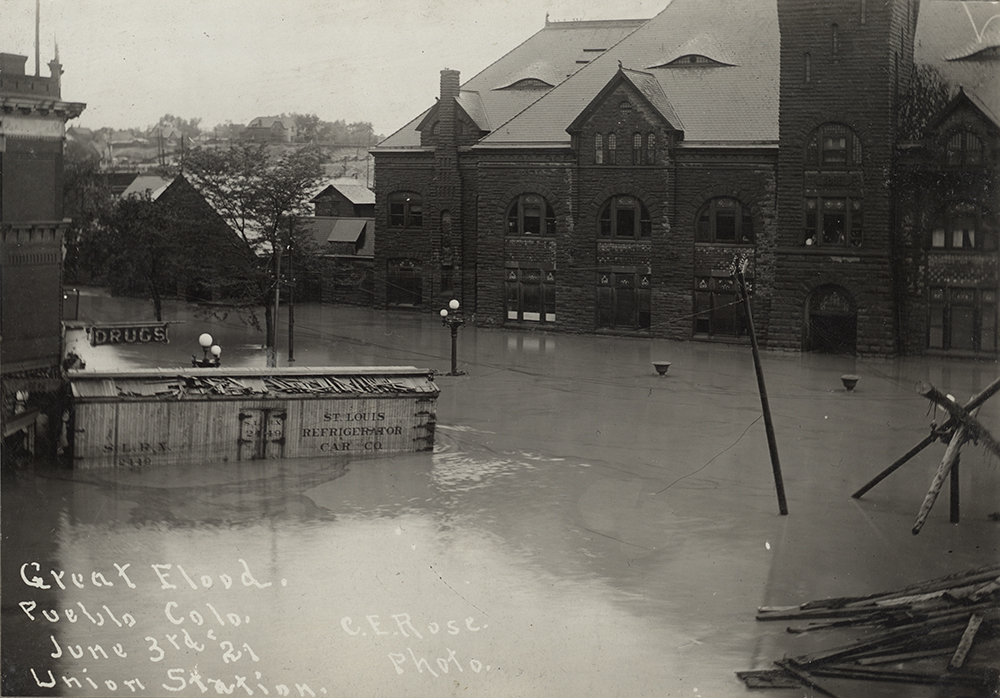
The Pueblo Union Depot during the Great Flood of 1921, in which much of Pueblo was damaged or destroyed.
The Koncilja family has matched the audacity of our ancestors by preserving the places that have formed us—such as, of course, the iconic Union Depot, its neighboring Union Avenue Historic District, the Orman Mansion, St. Patrick's Church, the Coronado Motel. When the Branch Inn exploded from an underground natural gas leak, Jim and Joe immediately rebuilt their damaged properties on Union Avenue and memorialized the young woman who died in the explosion. When people thought we needed something shiny and new for future rail development, they hired architects to demonstrate that, with a few modifications, the same Union Depot that welcomed our ancestors to Pueblo could greet Pueblo’s future too.
The heart-filled and hearty preservation energy of Jim and Joe, and now the next generation of the Koncilja family, has prevented Pueblo from being one of those beige, amorphous and unremarkable places that dots the American landscape. Instead, they have stood against such mainstream mediocrity with recognition that we do not need to start from scratch to build a beautiful future. There are some who think economic viability means Paneras and parking lots, and then there are those who understand the irreplaceable value of Zoelsmann's Bakery and Union Avenue Historic District. Do we choose the inherent value in a WPA-era bathhouse built by our grandfathers in the Civilian Conservation Corps or some new shapeless standard fare? One has character and connects us to who we are, and the other could be anywhere.
One of the best things about southern Colorado is that we have long resisted—for all sorts of cultural, economic, and geographic reasons—assimilation into the mainstream. Preservation is a physical manifestation of that fortitude. The Koncilja family has demonstrated what is possible when we preserve what matters most and the strength we build from honoring who we are.
I was raised in an old-school way and taught the value of knowing where you come from. In fact, it is one of the best compliments you could say about a person. Joe and Jim, you epitomize this value. You could have done a lot of things in this wide world but you chose to do what I always lovingly call “home work”—returning and reciprocating your talents and your gifts to the place that made you.
As a Puebloan and preservationist, I want to share my personal and deep gratitude to Joe and Jim and your beautiful famiglia: for all of the ways you taught me and have shown all of us that we are worthy, that Pueblo is special, and that we deserve the gifts that our ancestors have left for us written throughout the neighborhoods and streets of our beloved Pueblo.
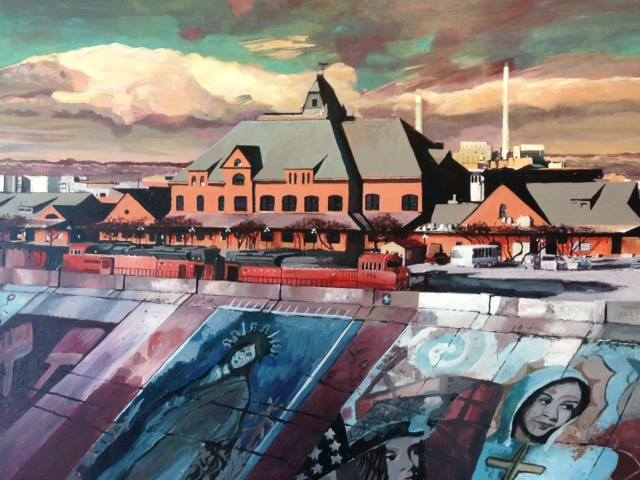
Union Depot - Colorful Colorado, an art piece by Dan Levinson showing the Union Depot from the rear (south) and the old Arkansas River Levee mural.