
 Membership
 Donate
 Shop
Shop





















Inheritance of the Revolutionary War in Colorado
The History Colorado Collection is full of items whose stories go beyond their ties to Colorado and sometimes you find a “Revolutionary” gem of an item that deserves its story to be rediscovered.
Few of the artifacts in History Colorado’s Collection have direct ties to the Revolutionary War. In fact, much more of the collection consists of settler-era memorabilia. But one gown in particular stood out in this, America’s 250th anniversary year, for the way it connects Colorado to our nation’s quest for independence.
Carefully housed by the collections team throughout its time at History Colorado, I was intrigued by its story from the moment I came upon it. Handed down through the women of a Rhode Island family who lived through the revolution and who subsequently made Colorado their home, the dress and the story of its caretakers reveal the long threads that tie our western state to the events of 1776.
At first the story of who wore the dress and when they wore it wasn’t quite lining up with confirmed historical information, but after much investigating the story became clear. We learned of these family histories through the women who held onto the memories and heirlooms of their ancestors; while they were historically not always the family members of note, they were the ones keeping these memories alive.
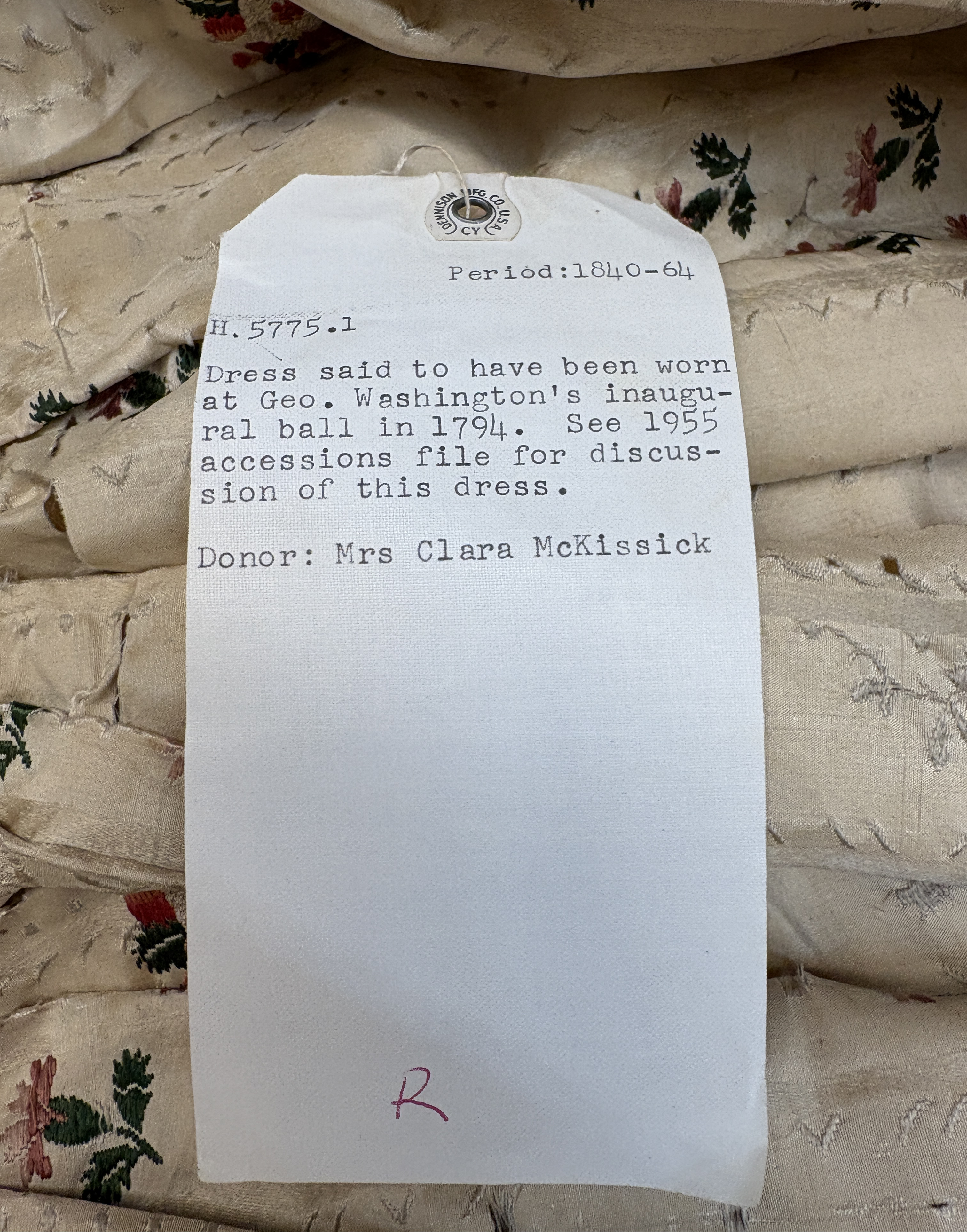
Close up photograph of the dress which, when it was donated, included this tag explaining its history.
The Family
When an artifact comes to a museum collection, usually there is documentation explaining the who, why, when, and how the object came into the collection. The history of the dress was found within the collection files and typewritten by Dr. Stephen J. Hubbell, who was a Colorado pioneer. The story he wrote came from his wife, Agatha Clarissa Allen, who inherited the gown.
Who was Dr. Hubbell? Born in 1834, Dr. Stephen J. Hubbell came to Colorado in 1859 and set off for Pikes Peak. He was a recent graduate of the Jefferson Medical College of Philadelphia and town doctor of Wheeling, West Virginia before making the trek west.
Like many men, he initially set out for Pikes Peak sometime in 1858 before making his way back east, settling in Springfield, Missouri in 1859 to own and operate a drug store. It was common for people who initially settled in the Colorado territory to decide to journey back east for a variety of reasons. With the outbreak of the Civil War in 1861, Hubbell made his way back towards Richmond, Virginia, where he served with the Confederacy in the Civil War. He was severely wounded by a bullet in 1863 at the Battle of Brandy Station, but was able to stay in the military working at a hospital and moved up the ranks to become a Captain (and assistant surgeon) before surrendering in April 1865. His next few years aren’t clear, but in March of 1868, he married Agatha Clarissa Allen of Virginia.
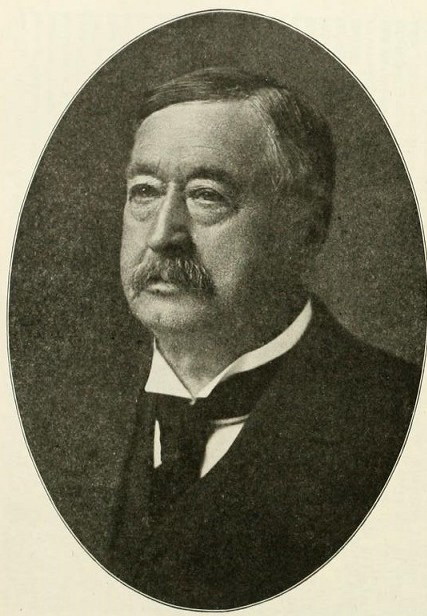
Family photograph of Dr. Stephen Hubbell, patriarch of the Hubbell family, and Colorado pioneer. It was his written information on the dress that we have in the collection, which was passed to his daughter Clara McKissick.
Agatha was the granddaughter of William Simons (1785–1845) and Clarissa Gardner (1787–1826). In Rhode Island, William Simons was an assistant editor of the Providence Patriot and editor of the Republican Herald until his death in 1845. Clarissa died in 1826, and William remarried one Mehitable Green in November 1827. It appears that Mehitable must have taken an active interest in William’s children with his first wife, Clarissa, and was considered the maternal figure to the children. The dress in our collection was identified as Mehitable’s and ultimately passed on to her step-daughters. Dr. Stephen Hubbell provided a typewritten note when the dress was donated to the (then) Colorado Historical Society in 1955, stating that the dress was worn to a grand ball “given in honor of the Marquis de Lafayette’s visit to New Port, where our own General Washington danced the minuet with Miss Mehitable Hopkins, the daughter of General Hopkins.”
This story became both tricky to track down and an interesting journey of Revolutionary War figures. From the perspective of ensuring authenticity and documentation on behalf of the museum collection, there were conflicting dates and times concerning the people in Dr. Hubbell’s account. I was determined to hone in on who wore this dress and when.
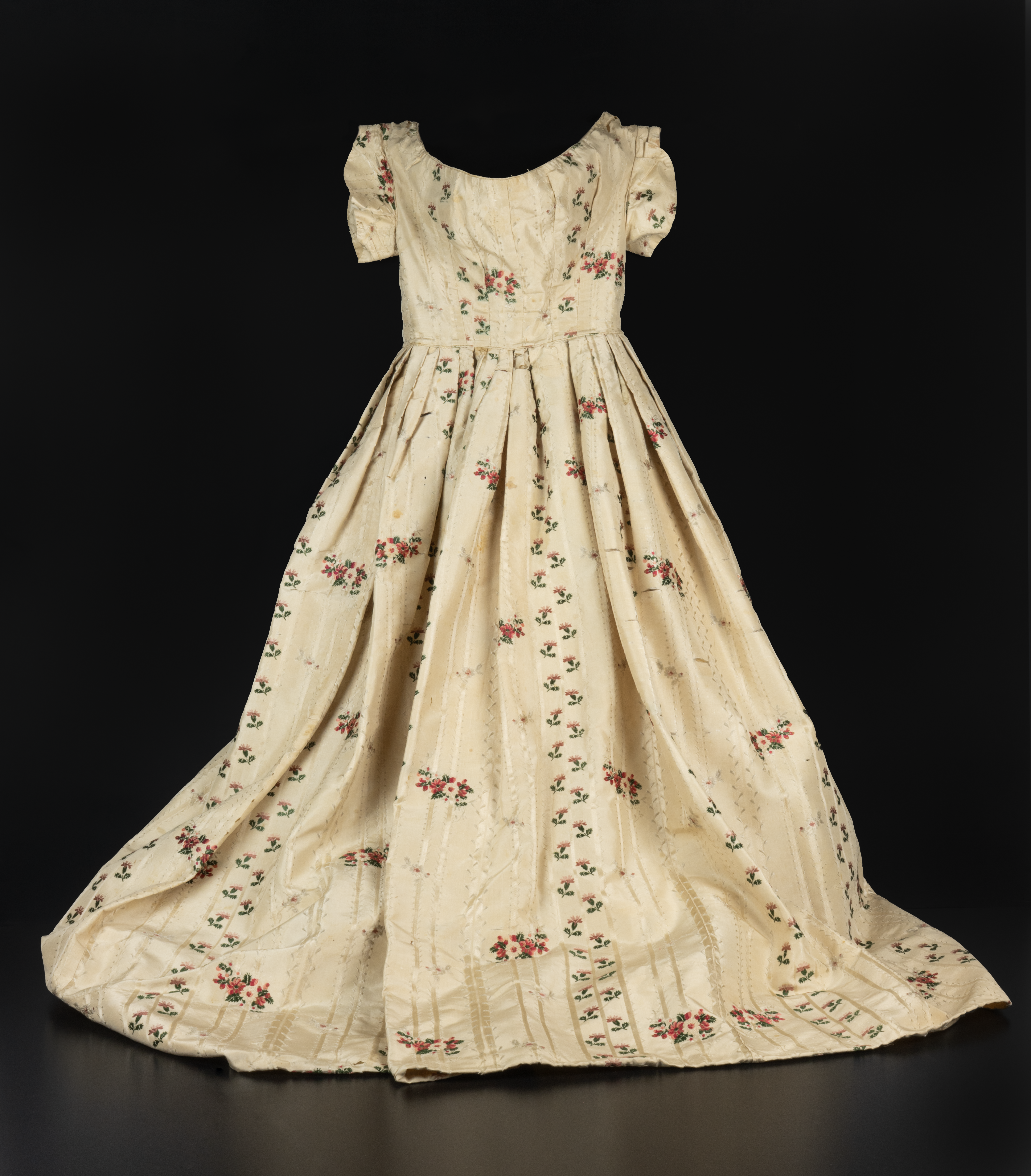
Mehitable Green’s dress—an object whose full story was uncertain for years before Collections Access Coordinator Jori Johnson unraveled the mystery.
The Conundrum
The name Mehitable Hopkins and her connection to the Rhode Island Hopkins family wasn’t easy to untangle since there was no obvious way to identify Mehitable Hopkins. Whereas the family lore written by Stephen in February 1915 states that Mehitable was the daughter of General Hopkins, a Rocky Mountain News article from October 23, 1955 states that Mehitable was the niece of “Commodore Stephen Hopkins, Governor of Rhode Island and a signer of the Declaration of Independence.”
Stephen Hopkins was a multi-term Governor of Rhode Island between 1755–1766. While the newspaper article reads that he was a commodore, he was in fact a merchant beyond his political career. Due to the plethora of Hopkins brothers having distinguished careers during the Revolutionary War era, it comes as no surprise there seems to be some misidentification on which brother did what during that time. A brother of Stephen’s, Esek Hopkins (1718–1802), was known as the Commodore, and he had a well-documented history of his escapades at sea. The story already had some plot holes. Neither of them had a daughter called Mehitable.
But there was a glimmer of hope: Her name was Hope Hopkins, their sister, and she had been married twice. Hope’s first husband, Henry Harris, was the father of Sarah Harris Hopkins (she married a first cousin on the Hopkins side). Hope married again, this time to Dr. Job Hawkins, (because adding another “H” last name to the family tree to make it hard for historians to research them was a part of their grand plan) and had another round of children. One of the children from her second marriage was named Mehitable Hawkins, born 1757, and another was named Catharine. Based on my research, I believe Mehitable was the woman who wore the dress. She was, in fact, a niece of those involved and was a Hopkins on her mother’s side, even though she was born a Hawkins. The other sister Catharine is listed as having a daughter named Mehitable Green, born in 1775.
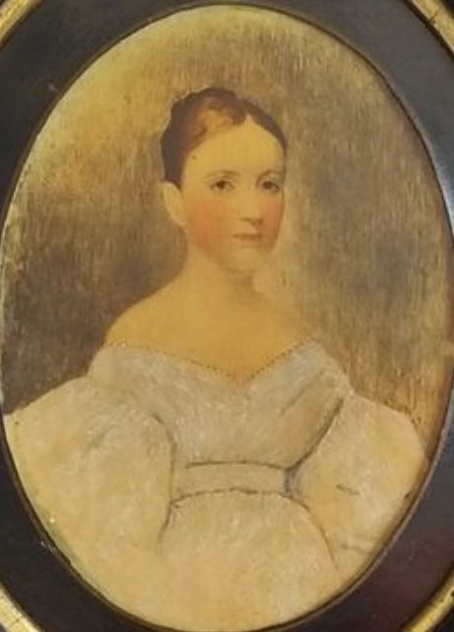
Portrait of Agatha Clarissa Gardner Simons, the step-daughter of Mehitable Green, and the woman whose family line moved to Colorado and held on to Mehitable’s dress.
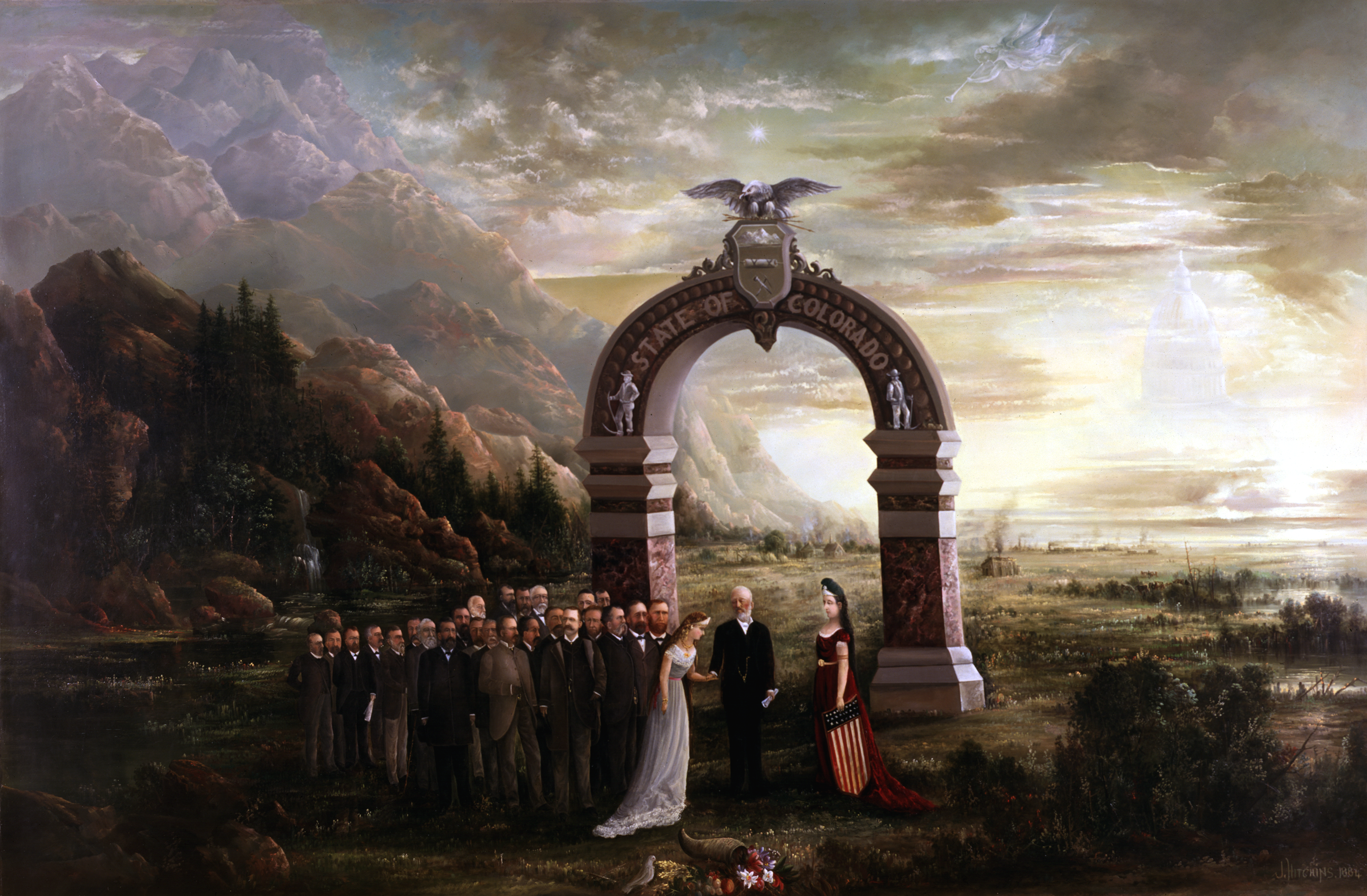
Joseph Hitchins, Admission of Colorado to the Union, 1884. Dr. Stephen Hubbell and his family came to Colorado before it became the 38th state.
Additional information regarding a niece called Mehitable and the Hopkins siblings, as well as the connection to the Simons family, comes from an article in the Providence Evening Press, February 17, 1868. The article, reporting on an antique coffee pot that was on temporary exhibition at Gorham Co. & Brown’s, had an interesting history of ownership:
[H]aving been at one time the property of the famous Commodore John Paul Jones…. The Commodore being a harum skarum (sic) fellow, and a bachelor after a while gave it to his particular friend Commodore Hopkins, who bequeathed it to his brother John Hopkins, who, in his turn, bequeathed it to his wife. At her death, it became the property of her niece and adopted daughter, Miss Mehitable Greene, who married Mr. William Simons, for many years the editor of the Republican Herald, in the city. Mrs. Simons, dying before her husband, left it by will to him, and he gave it to his daughters, who are now living, and to whom this rare and invaluable antique relic now belongs.
This coffee pot was put up for auction at Sotheby’s most recently in 2004, where their staff confirmed this information, further lending credence to the fact that items were bequeathed to the daughters of William Simons from his second wife, Mehitable. This also confirms the relationship between the Hopkins family and the Simons/Hubbell family tree.
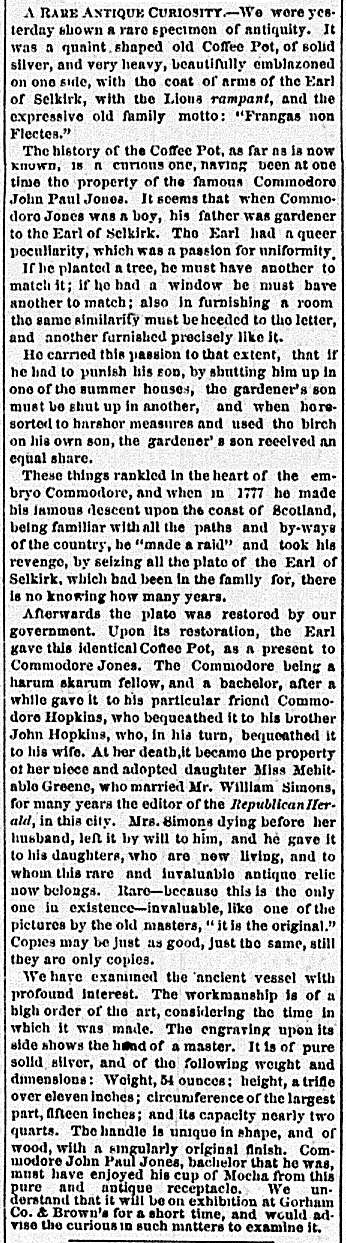
Newspaper clipping from the Providence Evening Press published February 17, 1868, in which the coffee pot and the family history are discussed.
Furthermore, Mehitable Green is listed in Sarah Harris Hopkins’s will in 1824. I believe that the Mehitable who was listed in her aunt Sarah's will and who married into the Simons family was the niece of the person who wore the gown, adding another generation (and Mehitable) to the list of women who passed down and preserved this dress, unbeknownst to the Hubbell descendants.
However, other sources of documentation used to confirm the dances and attendees were not aligning with the story based on the information the family provided, presenting contentions and areas of confusion. As mentioned earlier, the story in History Colorado’s accession files notes that Mehitable Hopkins wore the dress to a ball in honor of the Marquis de Lafayette, where she danced the first dance of the evening with George Washington. That the dress was worn at the “Belle of Newport” ball in Rhode Island in 1784 is documented in an October 23, 1955 Denver Post article; our catalog cards in the accession files list the ball as being held in 1794. However, also in the accession files, a note from the Rhode Island Historical Society to Dr. Stephen Hubbell states that the date of the ball was March 7, 1781.
Yet, according to Rhode Island Historical Society’s Quarterly Publication from January 1926, a detailed account of Lafayette’s visits to the state of Rhode Island do not align with the 1781 ball. The publication details the second visit, taking place in the summer of 1780, which included a trip to Newport from July 25 to July 31 and also included Comte de Rochambeau and Washington as guests to the city—but no ball is mentioned. This same account also lists a visit by Lafayette in 1784, suggesting that he had a day trip to Newport on Monday, October 25, 1784, but that he returned that evening to Providence, where “an elegant dinner” provided at Mr. Rice's Tavern took place. He was accompanied by the Chevalier De L’Enfant.
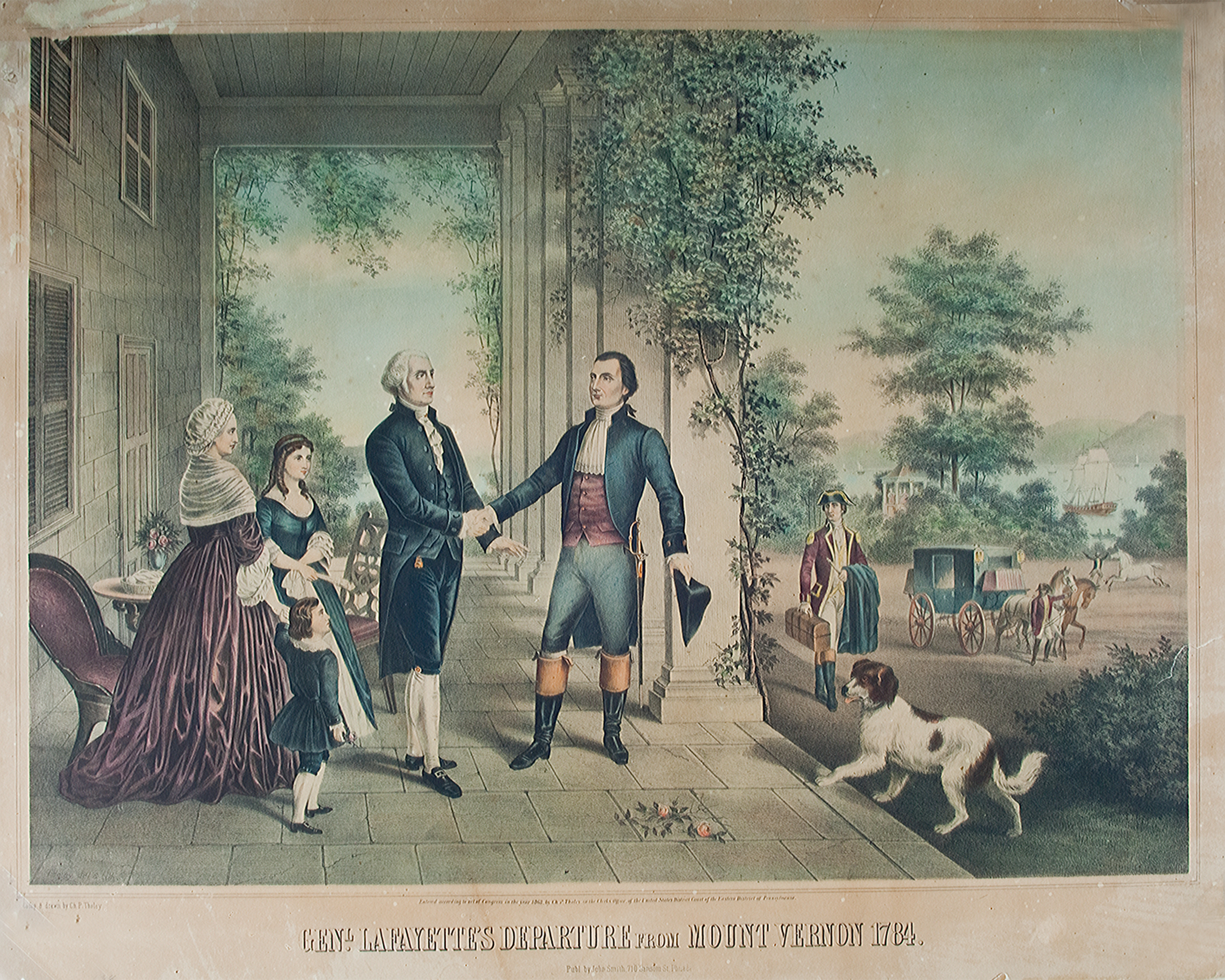
A mid-1800s colored illustration showing the Marquis de Lafayette and George Washington bidding each other farewell at Mount Vernon, during the Marquis' 1784 visit to the United States. It was on this trip that Lafayette also visited Rhode Island.
While the account does say that distinguished guests and “respectable Inhabitants” were there, it does not allude to a ball given, whether Washington was again a distinguished guest, or other such key words. Having been born in 1757, Mehitable Hawkins’s age would match up with the correct time of the gown being worn to a ball, giving more credibility to the fact that she is the Mehitable who wore the gown—but confirmation of the exact date of the dance with Washington remains elusive to this day.
Dating the gown’s fabric has been easier than verifying the dates it was supposedly worn. The Rocky Mountain News detailed the composition of this dress in a story published on October 23, 1955, describing it as “made of cream-colored French silk taffeta brocade with red, white, lavender, and purple flowers and green leaves.”
One element of the dress that is glaringly obvious to fashion historians is that the silhouette does not reflect late-eighteenth-century dress styles. The striped fabric was known to be easy to repurpose and the silhouette appears to be from the 1840s, so the dress could have been altered by Mehitable’s step-daughters after her death. Very similar dresses and examples of this fabric live in different collections throughout the world. Other garments of similar cloth and needlework can be found in the collections of Colonial Williamsburg, the Sykesville Gatehouse Museum, and the National Museum of Oslo. We can guess as to how the original dress looked when Mehitable wore it on the night she danced with George Washington; the fabric informs us that fashions in the United States were on par with their European counterparts, and probably had a very standard 1780s silhouette.
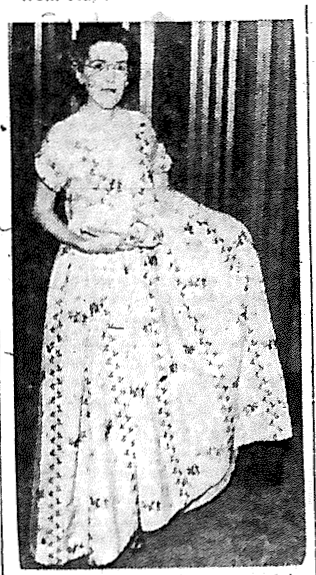
The confirmed last time this dress was worn was at a Greeley DAR event in February 1954, which means the dress had been worn for approximately 175 years at events in the United States. Greeley Tribune article included in the accession files for the dress.
The Last Generation
It was Mehitable’s step-granddaughter Agatha who inherited the dress. This makes the transportation of this dress to Colorado very unique and special. The paper trail established that both Agatha and Stephen were back in the Colorado Territory before their fourth child was born in 1874—indicating that this dress made the same arduous journey that the pioneers and settlers themselves made, without easy access to transportation or the luxury of bringing extraneous items to the new territory, if not for exceptional reasons.
Stephen and Agatha settled down and raised their family in Fort Lupton. Stephen died in 1922, with the death notice in the Greeley Tribune calling him “a ‘59’er” and highlighting his pioneer nickname. Clara, the oldest of their five children, was born in Virginia in 1871 but remained in Fort Lupton, having married a man from there called John McKissick. She was very involved in her community, and newspaper documentation indicates she was part of her Daughters of the American Revolution (DAR) chapter for decades. She was active in her local church and was proud of her Hubbell and Simons heritage.
It was Clara, though, and her interest in the history of the dress, that made the garment a local legend. One Greeley Tribune news report from February 22, 1954 reads “Mrs. McKissick wears her great-grandmother’s 170 year old dress for the Greeley DAR chapter.” So this tells me the dress was not only still being shown off, but it was still being tried on and worn out and about for events, well into the 1950s.
White House letter to Clara McKissick dated September 20, 1955, part of the dress accession files.
Somehow, this dress and its remarkable history was even told to the First Lady of the United States at the time, Mamie Eisenhower, who grew up in Denver and still had family ties here. The First Lady found out about the dress and Clara had even decided that the dress would be donated to Mrs. Eisenhower when the time came. While a letter sent from Mrs. Eisenhower at the White House confirms this story, the First Lady helped make arrangements with the Colorado Historical Society to take the dress from Mrs. McKissick in October 1955.
To have a tangible collection item such as a dress, and to know that a person wore it—moved in this dress, danced in the dress, had shared history with many prominent Americans including a signer of the Declaration of Independence and a Commodore fighting alongside John Paul Jones—gives a depth to the story that artifacts such as this can only help augment.
There are still questions that I haven’t been able to answer. We cannot verify if the fabric is French or English; nor do we know what the original gown looked like, even though we can assume the style, based on other museums’ collection items. And the definitive date of the ball to which the gown was worn remains unconfirmed. What the evidence says, though, is that the dress was a very dearly cherished heirloom—one that was subject to five generations of history being re-told by each generation, losing tidbits along the way, but the heart of the story maintained throughout by the women caring for their family histories—a true American tradition. We look forward to telling this dress’s history for another 250 years!