
 Membership
 Donate
 Shop
Shop


















Seventeen Years to Statehood
Colorado almost wasn’t the Centennial State. People and communities not included in four failed statehood attempts became as consequential as those who were.
Denver celebrated loudly on July 4, 1876. Voters had approved the Constitution for the new State of Colorado on July 1, almost exactly 100 years after the signing of the Declaration of Independence. Colorado was about to become the Centennial State, and celebrations were combined with 4th of July festivities. Thirty-eight guns, marking Colorado’s entrance to the Union as the thirty-eighth state, were fired into the sky. “Sleep was out of the question after daylight,” observed the Denver Daily Times.
Thousands of people crowded Denver’s streets, jostling for the best views of a grand parade. Bells rang and whistles blew as an enormous number of groups filed by: mounted police; thirty-eight women representing each of the states; the Governor’s Guard; Denver Turnverein dancers; the Denver Typographical Union; Masons; early gold miners; French Americans wearing powdered wigs; firefighters; politicians; Knights Templar; Scandinavians; Irish Americans; a temperance society; a German social club; and singing members of the Handel and Haydn societies advanced through the streets.
Not to be outdone, cities from Pueblo to Boulder hosted their own large celebrations and parades. “Everybody was happy,” remarked The Rocky Mountain News on July 6, 1876. “Twice happy, in fact. It was a double festival…the nation’s centennial and the birthday of the Centennial State.”
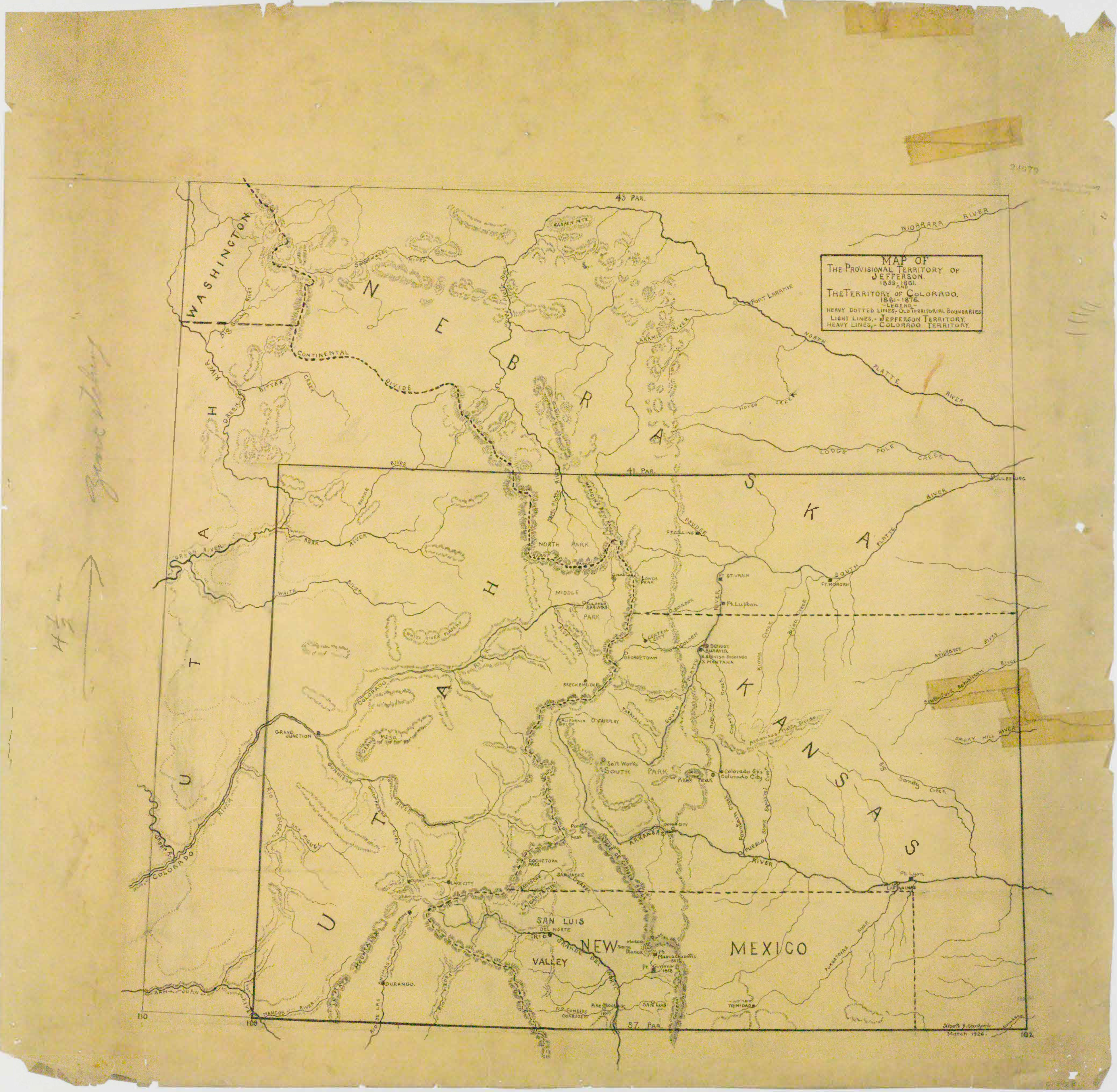
Map showing the boundaries of Jefferson Territory and Colorado Territory, 1920.
And across that thirty-eighth state, thirty-nine men watched the festivities with relief. They spent eighty-six days, from December 20, 1875, to March 14, 1876, drafting Colorado’s Constitution. They weighed public petitions and debated potential laws for this new state of Colorado. The constant reminder of past failures loomed over every minute of the proceedings. Colorado had already tried four times between 1859 and 1876 to become a state, and each attempt had failed. Now, voters had to approve a constitution by July 1876.
The statehood those soon-to-be Coloradans celebrated was only possible due to a convergence of interests coming together at a pivotal moment in the history of the American West. Against the backdrop of the Civil War and Reconstruction, complicated federal politics played a role in statebuilding. But Colorado also needed its people to support statehood. From the Front Range and the Eastern Plains to the San Luis Valley and the Western Slope, diverse voices spoke for or against each attempt at statehood, raising questions of representation, voting, taxation, and power. Thirty-nine men wrote our Constitution, but the true authors of our statehood story were the people living in Colorado who fought at every step along the way to be heard and represented.
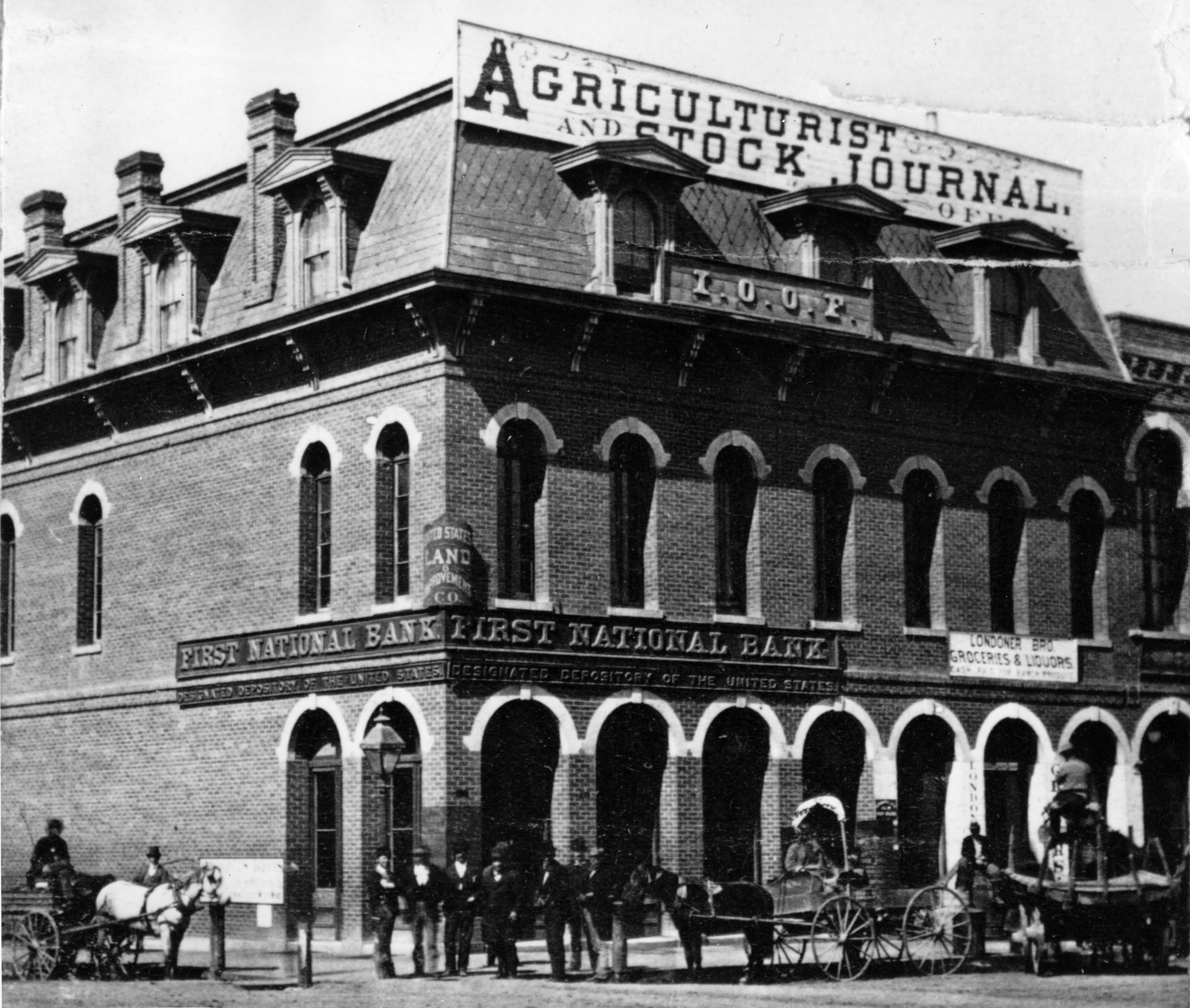
The third floor of the First National Bank of Denver building housed the 1876 Constitutional Convention.
Forming a Government
Anselm Barker, the 1876 Convention’s security officer, remembered the first time statehood failed. He was there. Born in Ohio in 1822, Barker moved to Nebraska in 1857 and opened a dry goods store. The Panic of 1857 (a financial crisis caused by failing banks and railroad speculation) was sweeping across the United States. Thousands lost farms, jobs, and homes. Then, one day in 1858, Barker read a newspaper announcing William Green Russell and his party discovered gold in what was then called the Pike’s Peak Country.
Barker and over 100,000 hopeful prospectors flooded what became Colorado’s Front Range between summer 1858 and late 1859. After arriving on October 24, 1858, Barker began mining and helped establish the town of Auraria. But the newspapers exaggerated the reports of gold. Thousands of goldseekers returned east with empty pockets.
Those, like Barker, who stayed faced scarcity and ridiculously expensive prices for basic goods. But one even bigger problem quickly emerged: No one knew who was in charge.
When gold was discovered in 1858, most of the Front Range was part of far-western Kansas Territory. Technically, Kansas’s territorial government governed the region. But the northern part was in Nebraska Territory, the Western Slope was part of Utah Territory, and southern areas were in New Mexico Territory. Even if Kansas Territory was in charge, communication with Kansas-based officials took weeks.
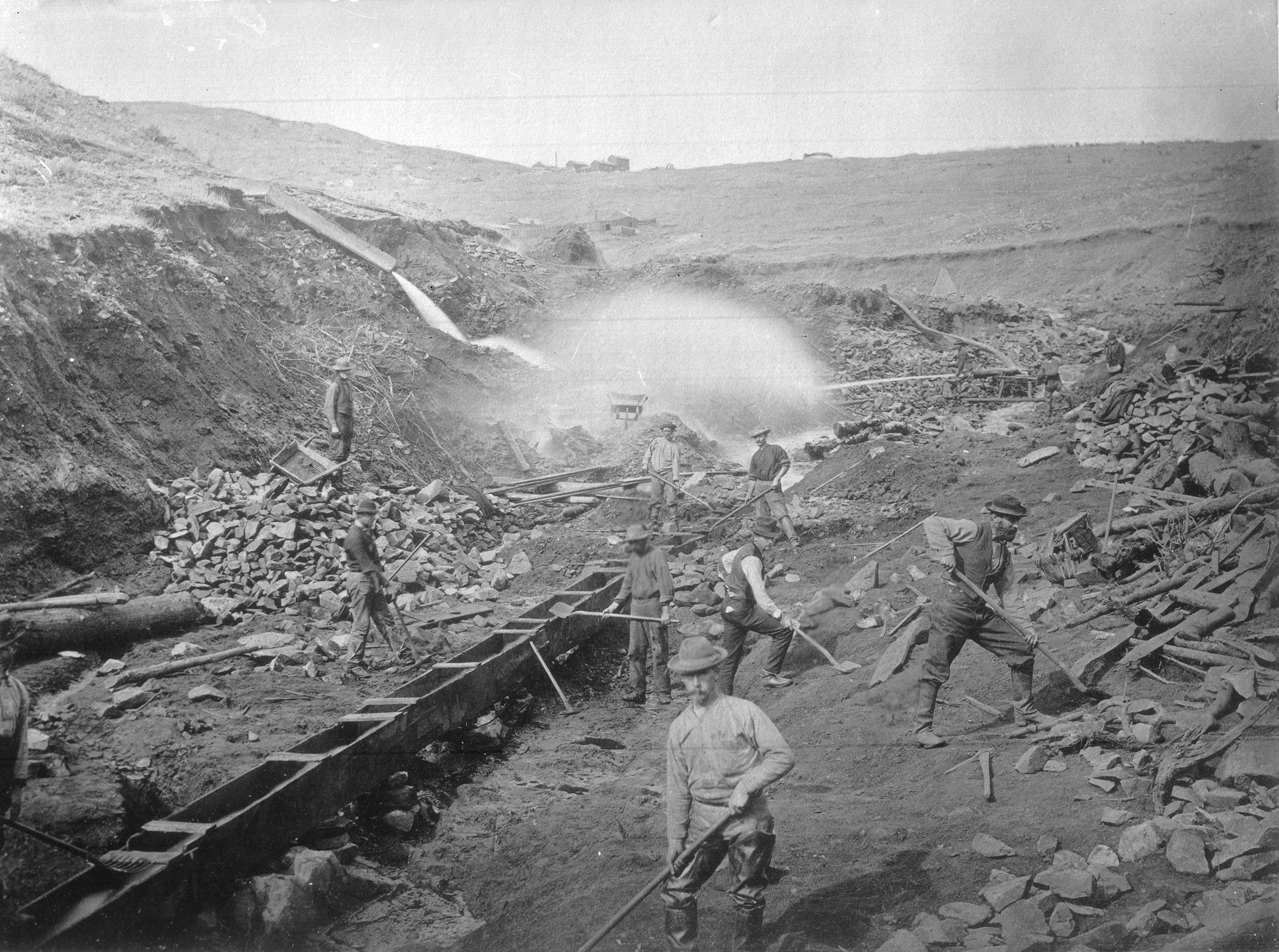
Mining in Gregory Gulch near Black Hawk and Central City, 1859.
So in an attempt to fill the power vacuum, miners soon established their own laws and courts, causing mass legal chaos: Something that was illegal in one mining town might be legal in another, or a sentence for a crime might be more severe in one district than in another.
Seeking a central government, civic infrastructure, and a standardized system of law, some men began to take action. William Byers, founder of The Rocky Mountain News, used his first newspaper to advocate for statehood on April 23, 1859. “A new State will be organized west of Kansas and Nebraska ere this year is closed, with a hundred thousand inhabitants,” declared Byers. It was a grandiose vision for what was then just a loose collection of men whose ability to make a living was as yet a matter of prophecy. Nevertheless, a Constitutional Convention, consisting mostly of Denver residents, formed in summer 1859. But how would they achieve statehood? And why become a state instead of a territory?
There are few rules guiding the admission of states to the Union. Article IV, Section III of the US Constitution states only, “no new State shall be formed or erected within the Jurisdiction of any other State; nor any State be formed by the Junction of two or more States, or Parts of States, without the Consent of the Legislatures of the States concerned as well as of the Congress.” The Northwest Ordinance of 1787 specified that a territory should have 60,000 free adult men before it could become a state, but Congress sometimes waived this requirement for political reasons.
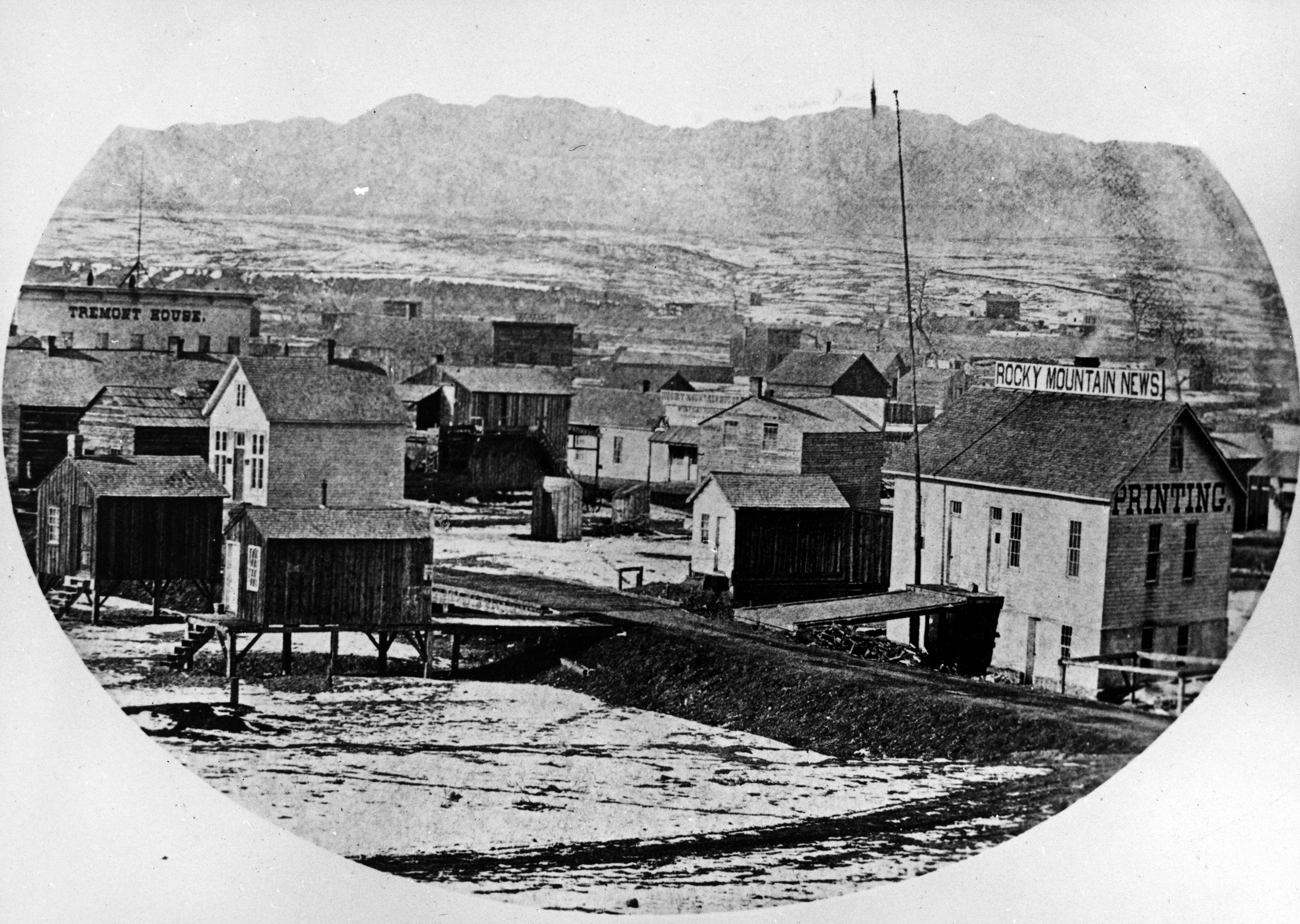
Denver, about 1864.
Generally, a place became a territory before becoming a state. One exception was California, which experienced such a huge population explosion after the 1849 Gold Rush that it became a state in 1850, bypassing territorial status.
With California in mind, the 1859 Denver convention believed direct statehood was feasible. The men named their new state “Jefferson” because Thomas Jefferson had brought about the 1803 Louisiana Purchase, of which the Pike’s Peak Country was part. They established boundaries for Jefferson and drafted a constitution.
Now, the vote for statehood was in the hands of miners like Anselm Barker. But mining was hard, and the golden dreams of many prospectors had not panned out. Miners, struggling to survive, resisted the idea of higher taxes for a state government.
Worried, the convention placed two options on the ballot: becoming a state, or becoming a territory. On September 5, 1859, voters overwhelmingly rejected statehood in favor of becoming a territory. The first attempt at statehood had failed, and the men in power quickly organized Jefferson Territory instead.
Jefferson Territory enacted civil and criminal laws, created ditches and roads, and regulated wills. But Jefferson’s leaders also took action on another issue: They knew they were living on the land without any legal right to be there.
The Homelands of Native Nations
Over fifty-one Native Nations, including the Cheyenne, Arapaho, and Ute Tribes, call the land that is now Colorado home. For generations, Indigenous peoples survived and thrived across this land. The 1848 discovery of gold in California changed everything.
In 1848, the US government began to negotiate with Tribes for travel rights across what would become Colorado. Faced with encroaching settlement, some Ute leaders signed the 1849 Treaty of Abiquiú, which promised Ute people reparations if they allowed US forts, trails, and peaceful travel on their land. However, the US government did not keep the promises contained in the treaties.
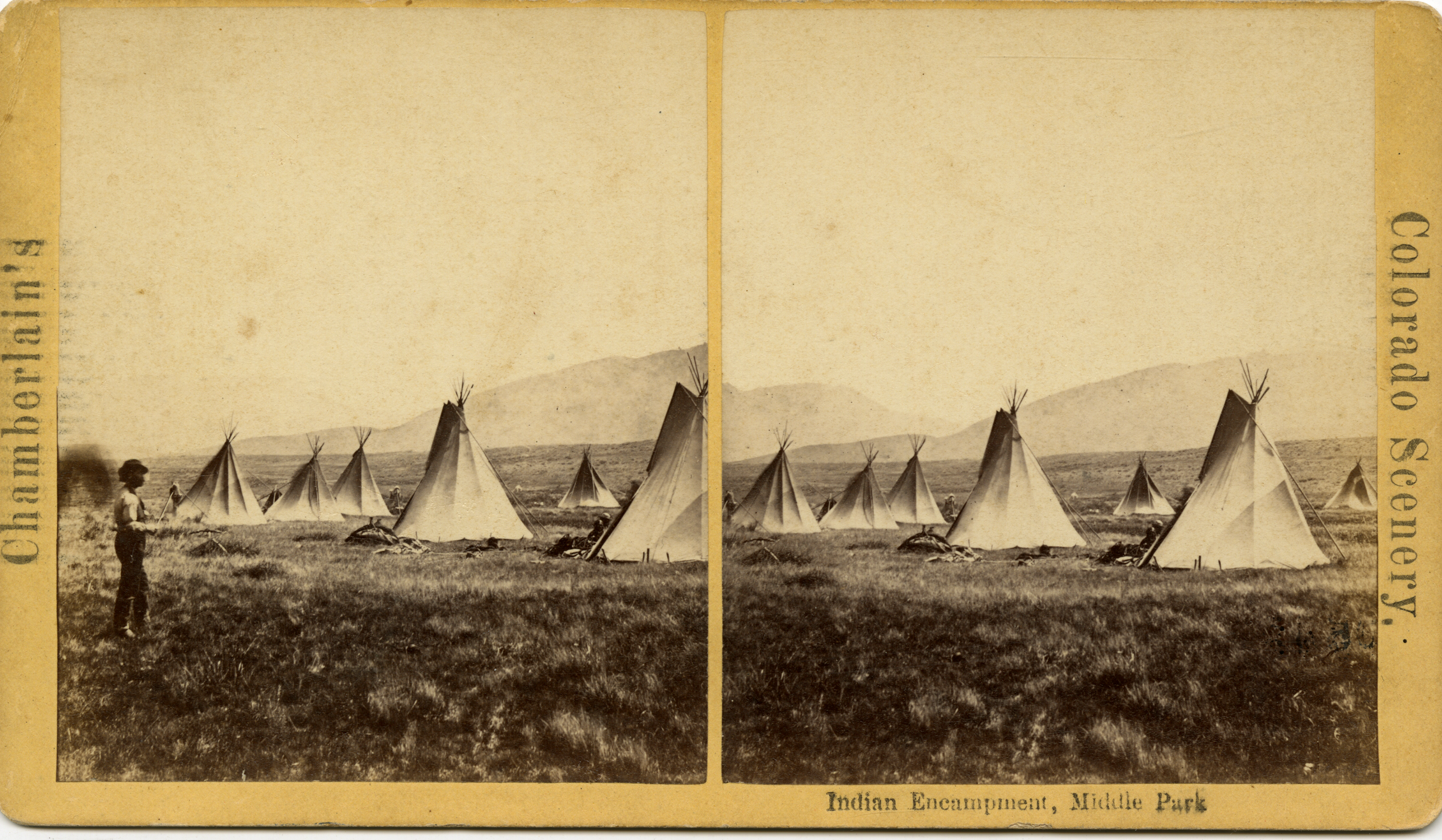
Native American camp in Middle Park, Colorado. Unknown date.
Then in 1851, the US government authorized a treaty council to negotiate with Native Nations who lived across the West. Over 10,000 Indigenous people, including members of the Cheyenne, Arapaho, Crow, Assiniboin, Mandan, Hidatsa, and Oglala and Brule Lakota Tribes, gathered near Fort Laramie in Wyoming to negotiate with the US government.
The Treaty of Fort Laramie guaranteed legal title to specific lands for each Tribe, but did not restrict movement, preserving the Tribes’ rights to freely travel, hunt, and fish across their homelands. The treaty declared that much of modern-day eastern Colorado was Cheyenne and Arapaho land. In return, like the Treaty of Abiquiú, the Tribes would allow construction of US forts and roads and give settlers safe passage.
The Fort Laramie Treaty gave the Cheyenne and Arapaho legal title to much of the land that would become Colorado. Early miners and settlers knew this. One of Jefferson Territory’s first actions was to issue a petition to Congress to unilaterally remove Native title to the land without Tribal consent or agreement. “We would further call your attention to the importance of extinguishing the Indian title to the lands in the vicinity of the gold mines,” the Territorial representatives wrote in a petition to Congress in 1859, “as you are well aware that in cases of this kind emigration can only be regulated, not checked.”
To the residents of Jefferson, the extinguishment of Native title seemed inevitable. In other states and territories, the US government had negotiated treaties with Tribes that freed land for settlement. Congress soon began appropriating funds to hold treaty negotiations in this new region. “The future of Jefferson Territory—soon to be a sovereign State—is glorious with promise,” wrote The Rocky Mountain News on November 10, 1859. But the newspaper was wrong.
Congress, embroiled in national political debates, never recognized Jefferson Territory. As Jefferson’s hopeful leaders cobbled together a government, Congress was divided over whether slavery should be allowed in western territories. Northern states led by Republicans wanted to stop the spread of slavery, while southern states led by Democrats wanted to expand it. The 1820 Missouri Compromise had outlawed slavery in northern territories, including most of the proposed Jefferson Territory. This was repealed by the 1854 Kansas Nebraska Act, and the 1857 Dred Scott decision held that slavery could not be prohibited in western territories. Admitting Jefferson as an official territory would add to the debate, so Congress never recognized it.
Unauthorized, Jefferson Territory was left without authority or funding. Its struggling legislature charged a poll tax of one dollar. Hundreds of miners signed a petition rejecting the tax and voted against becoming counties of Jefferson Territory. Some miners insisted they would answer only to the Kansas Territorial government. Others argued they were still in “Indian Territory” and refused to follow any laws. Legal chaos ensued once more. Becoming a state had failed, but pushing for a territory seemed to have had little tangible impact.
Reorganizing for Recognition
After its failure to become either a state or a federally recognized territory, Jefferson struggled along until 1861. Then, South Carolina seceded from the Union on December 20 of that year. Congress suddenly found itself faced with financing a war and became concerned about controlling the western goldfields. Federal political and military control would be imperative if the US was going to hold the gold, so it created the Colorado Territory out of portions of Kansas, Nebraska, Utah, and New Mexico on February 28, 1861.
Congress wanted the new territory’s boundaries to be straight. At the time, the northeastern edge of New Mexico Territory included a notch that raised into the new territory. Congress wanted to cut off this notch and place it into Colorado to follow the thirty-seventh parallel and create a smooth southern boundary.
New Mexico’s territorial representative to Congress, Miguel Otero, protested. Many residents of the notch were in Spanish-speaking communities of Hispano people, who traced their heritage and roots to early Spanish colonists. Originally part of Mexico, the land had become part of the United States with the signing of the Treaty of Guadalupe Hidalgo at the end of the Mexican-American War in 1848. Under that treaty, Mexican citizens became US citizens overnight and were placed into New Mexico Territory. They were accustomed to New Mexico’s laws, measurements, and systems of trade. Cutting them out of New Mexico would be removing them from a familiar system and language and placing them under the jurisdiction of the Denver government far to the north. “I cannot sit here quietly and see the people of that Territory, who, as I have said, are a homogenous people, cut in pieces, and a portion of them transferred to another jurisdiction, when I know it is against their wishes,” argued Otero.
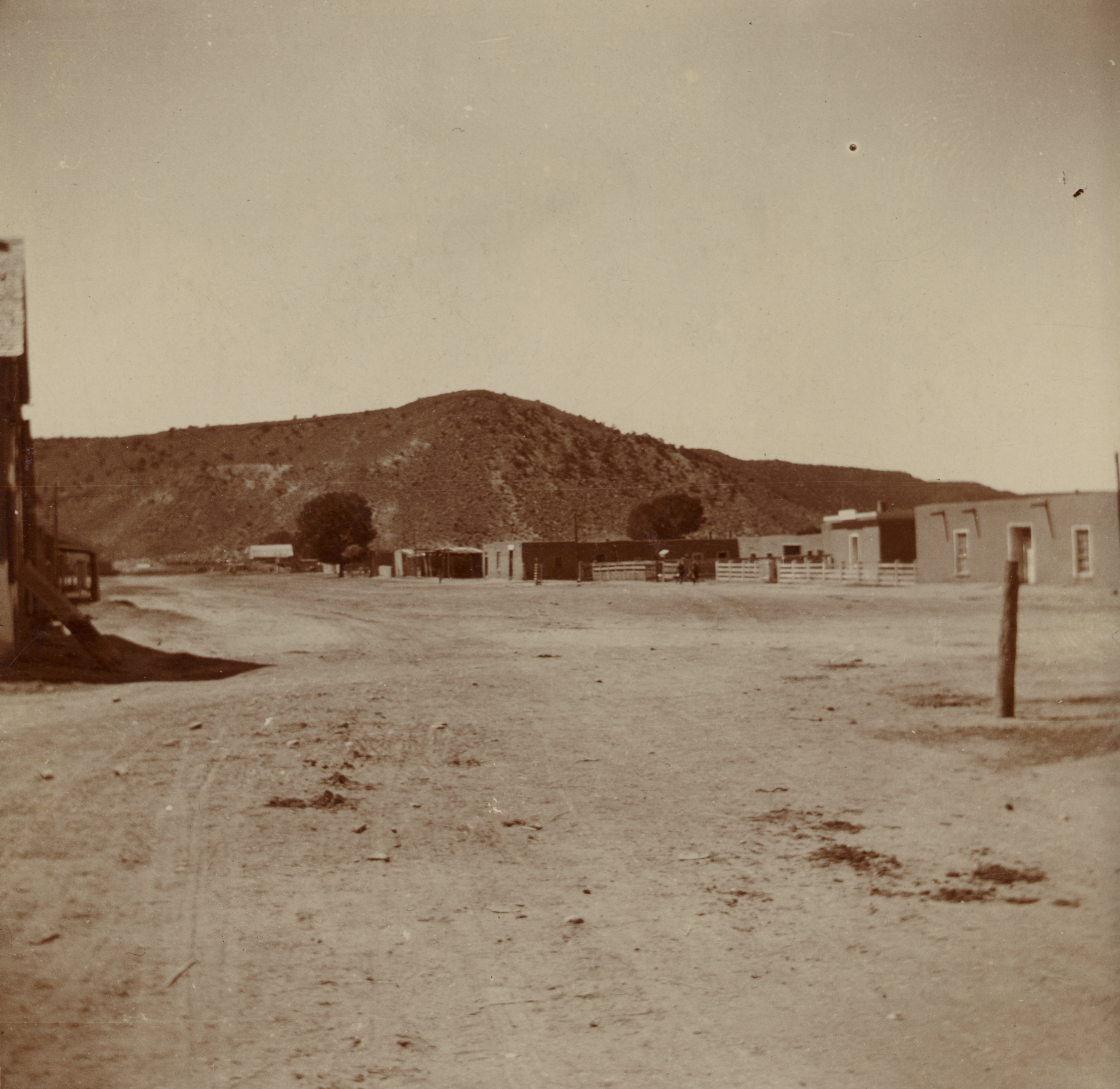
San Luis, 1899.
But Congress ultimately decided to cut off the notch. “Geography requires it shall be done,” insisted Galusha Grow, speaker of the House of Representatives. Today, Colorado’s boundaries give it the appearance of a rectangle on a map, although early surveying errors mean the state actually has 697 sides. The decision to place the notch in the new territory would affect its statehood chances for years to come.
When naming the new territory, Congress rejected the name Jefferson, following its unofficial rule against naming states or territories after individuals except for George Washington. Congress nearly named the new territory Idaho, but on February 4, 1861, a representative argued that it should be named Colorado because “the Colorado river arose in the Territory, and there was a sort of fitness in it.” With that, Colorado Territory was born.
But powerful Denver men were not content with the territory. They knew that statehood would further their business interests, and this seemed like the time to pursue it. The early 1860s had seen the passage of federal acts and treaties that opened Colorado land for Euro American settlement and industry. The 1861 Treaty of Fort Wise reduced Cheyenne and Arapaho lands from most of the eastern third of the Territory to a much smaller portion, while the 1863 Conejos Treaty restricted Ute people from much of the Rocky Mountains. For each treaty, only a few Native leaders, facing the constant threat of US military hostility, signed. Still, the United States applied it to all members of those Tribes, who suddenly found their movements restricted. The Pacific Railway Act of 1862 allowed railroad construction across Native land, while the Morrill Land-Grant Act of 1862 enabled the government to seize and sell Native homelands to create land-grant universities. And the 1862 Homestead Act granted 160 acres to US citizens who could live on the land for five years.
For Native Nations, the acts meant removal from their homelands and a struggle for survival as the federal government broke treaty promises of goods and protection. For the powerful Euro American men in Denver, these acts presented endless economic opportunities. Now, the railroad seemed to have a clear path to Denver—if Colorado could become a state.
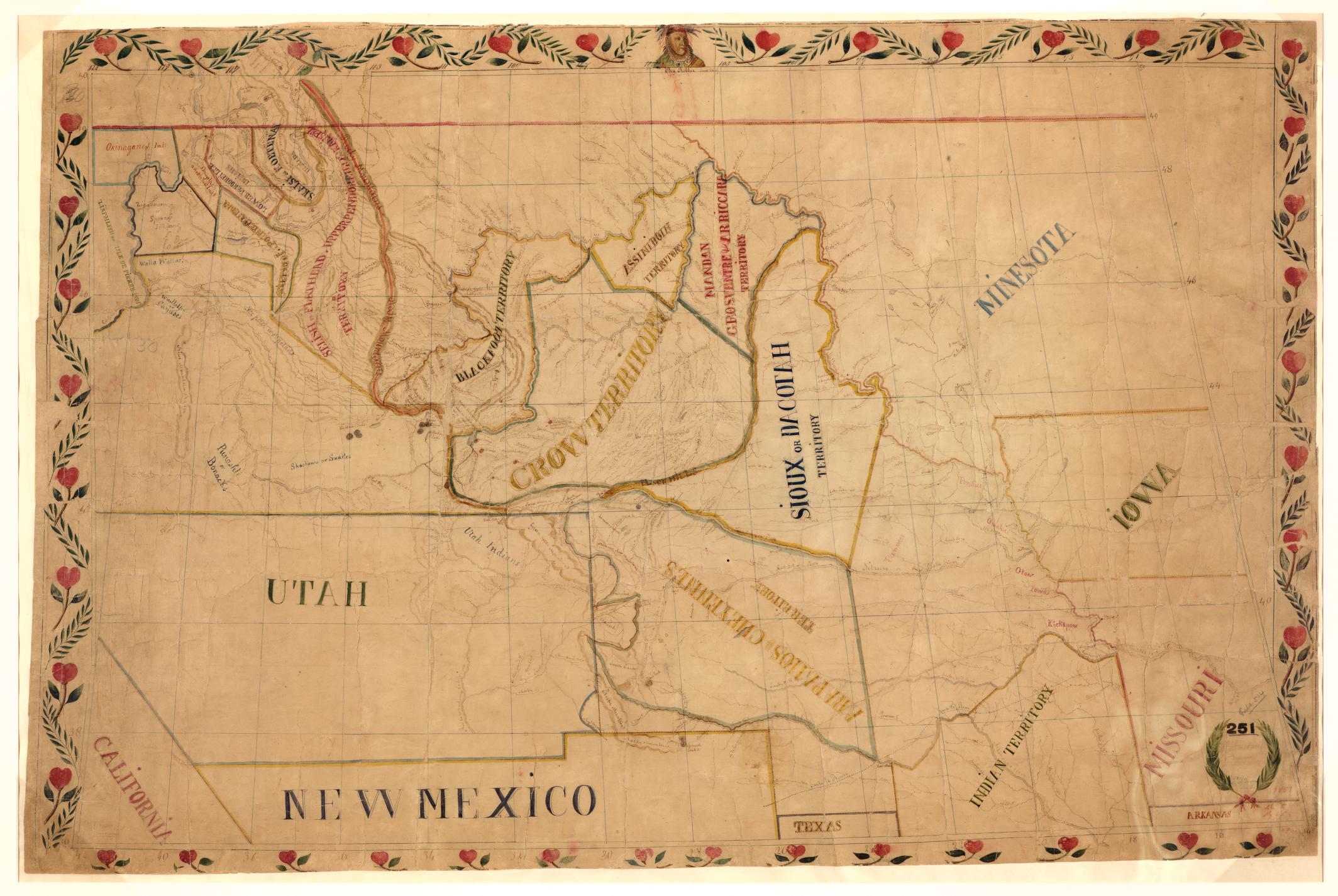
Father Pierre-Jean De Smet drew this map showing Tribal lands designated by the 1851 Treaty of Fort Wise.
Rings of Power
Denver men lobbied Congress for statehood again in 1864. These men, including Territorial Governor John Evans, Colonel John M. Chivington, Jerome Chaffee, and Samuel Elbert, became known as the Denver Ring. Congress actually agreed that Colorado should become a state and issued an act enabling statehood. The fall 1864 presidential election loomed, and Congressional Republicans wanted to ensure that President Lincoln was reelected. Since Colorado was a Republican territory, its statehood would provide more Republican votes.
A state Constitutional Convention convened on July 4, 1864. The Denver Ring had almost complete control of the proceedings, writing and approving a constitution by July 11. “There was a constant disposition upon the part of all to hasten and perfect their work,” observed The Rocky Mountain News. “Probably no State Constitution was ever before framed in so short a time, and we are vain enough to believe that none possesses a better one.”
But men in Golden and other mountain mining towns were concerned that the Denver Ring would enact laws and raise taxes that came at the expense of Colorado’s miners. A “Mountain Crowd” of mining leaders and businessmen sprang up in opposition. Ovando Hollister, the editor of the The Daily Mining Journal in Black Hawk, published scathing rebuttals against statehood and the Denver Ring. In June 1864, The Daily Mining Journal stated that statehood supporters were “doing their best to secure the ruin of the Territory for the temporary advancement of their private interests…everybody knows that the whole movement originated with Gov. Evans.”
Many miners also believed state taxes would be too high. Life was tough and expensive in Colorado Territory in the 1860s. Residents complained that eggs cost two dollars per dozen, equivalent to fifty dollars in purchasing power today. Gold discoveries declined starting in 1862. Eastern speculators invested in mines that often did not produce any gold, making it impossible for miners to attract financial backing. Anselm Barker left the goldfields and began farming near Clear Creek. This did not seem like the right time for higher taxes, and becoming a state in the middle of the Civil War meant miners would be subject to the draft, which was highly unpopular.
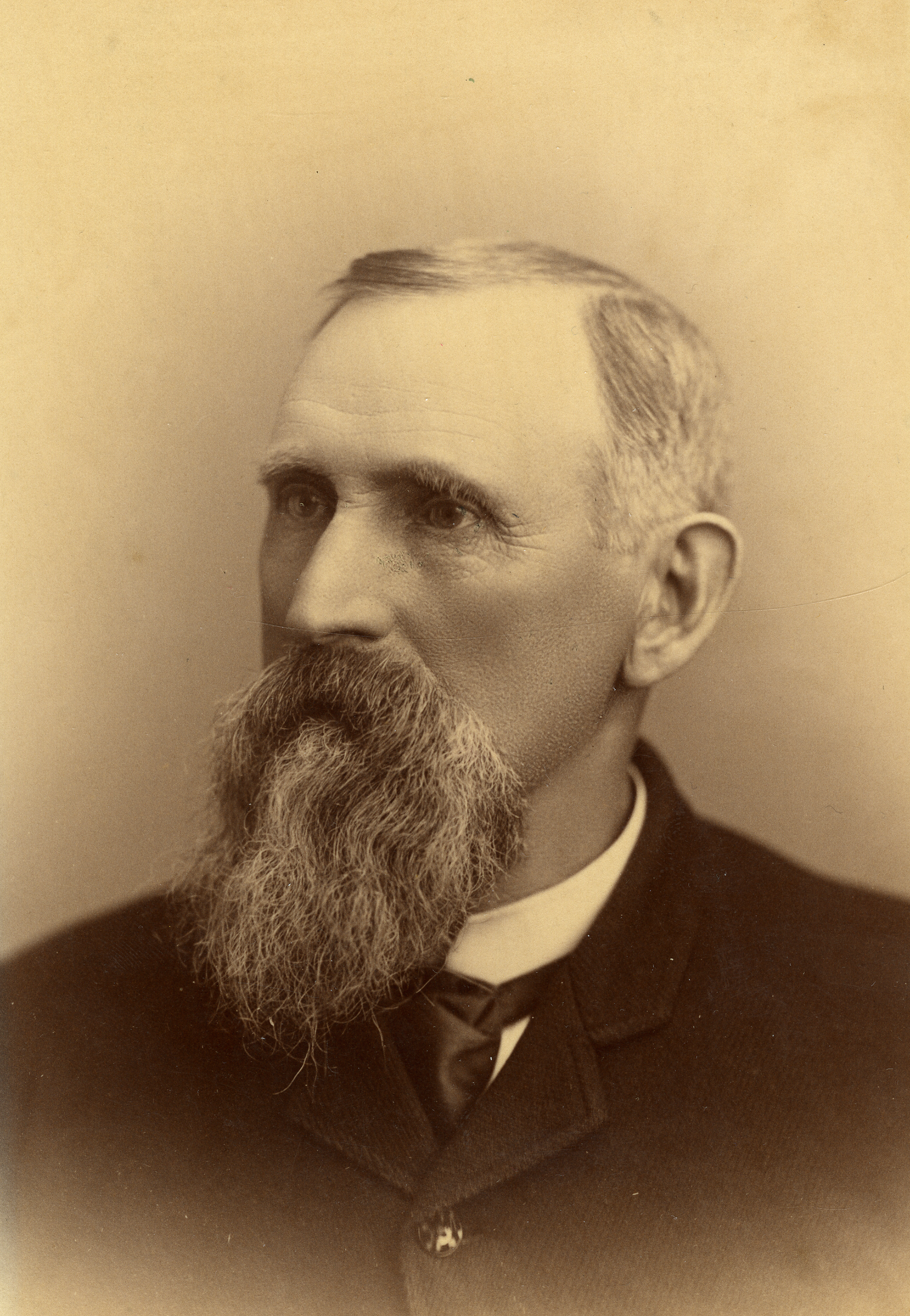
Anselm Barker, 1858.
To make matters worse, members of the Denver Ring placed themselves on the ballot for state government. Confident statehood would pass, the Denver Ring scheduled the election for state government on the same day as the statehood vote. Both actions confirmed the Mountain Crowd’s fears about the Denver Ring’s ambitions.
In southern Colorado, many Hispano residents also opposed statehood. Residents of the former New Mexico notch dealt constantly with unfamiliar taxes, laws, and language. The Colorado territorial legislature had claimed it would translate laws and proceedings into Spanish, but it often did not approve the funding to do so. Land speculators, including Colorado’s first territorial governor William Gilpin, purchased and divided land near San Luis, ignoring traditional land rights maintained by descendants of the people who had settled there in the 1840s. The Denver Ring wanted to consolidate power in Denver, and they weren’t overly concerned with the rights of people in southern Colorado.
Feeling underrepresented, some Hispano residents launched an 1862 petition for the notch to be placed back into New Mexico. The petition was debated in Congress but delayed by the Civil War, so as late as 1864, some Hispano residents believed it was still possible for them to be placed back into New Mexico.
Coloradans went to the polls to vote on the second statehood proposal on September 13, 1864. Immediately, the numbers showed that statehood was failing. The News refused to admit defeat or publish full election results until early November. “In the southern portion of the Territory the most of the majorities are against the Constitution,” bemoaned The Rocky Mountain News on September 20, 1864. The final vote was firmly against statehood, 4,672 to 1,520.
The powerful Denver men, including Territorial Governor John Evans and the influential Colonel John M. Chivington, had lost their chance at federal power, and they viewed Native Nations as a continued obstacle to their personal ambitions. Evans and Chivington went on to perpetrate the deadliest day in Colorado history: the Sand Creek Massacre. In November 1864, Cheyenne people and Arapaho people camped on reservation land along Big Sandy Creek in southeastern Colorado, trusting the treaties and Evans’s and Chivington’s promises they would be safe there. Cheyenne Chief Black Kettle flew a thirty-three-star US flag above his lodge, which the US government had given him in 1860 as a peace symbol. At sunrise on November 29, 1864, the US Army led by Colonel Chivington attacked the Tribal chiefs’ camp of mostly women, children, and elders. The soldiers murdered more than 230 peaceful Cheyenne people and Arapaho people. The Sand Creek Massacre broke any remaining trust in the US government and changed the Cheyenne people and Arapaho people forever.
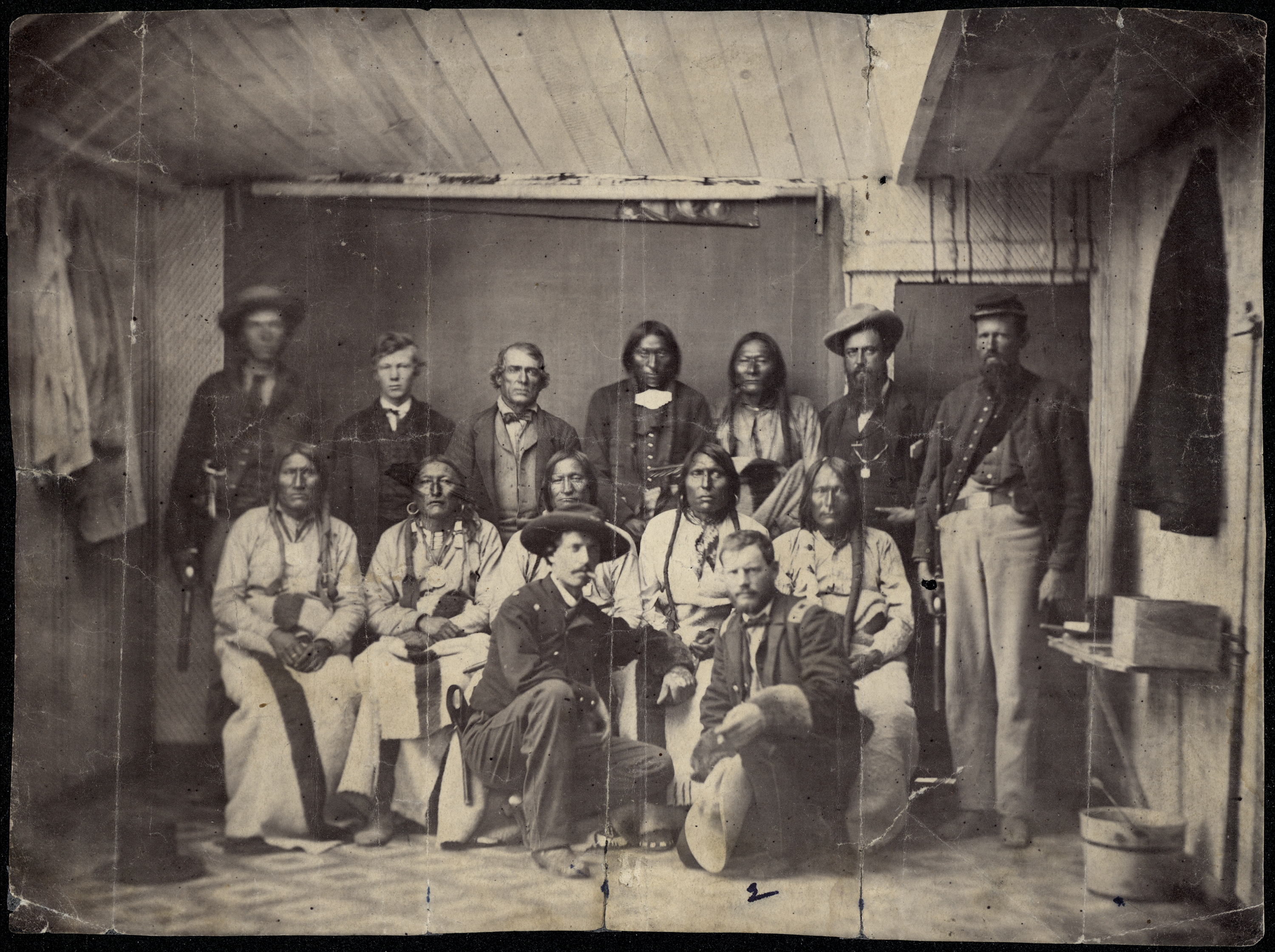
On September 28, 1864, a delegation of Cheyenne and Arapaho leaders met Colorado Territory officials at Camp Weld near Denver to negotiate for peace. This photograph shows the participants of the Camp Weld meeting. Identities are believed to be, from left, kneeling in front: Major Edward W. Wynkoop and Captain Silas Soule. Seated, first row, from left: Chief Neva (Arapaho), Chief Bull Bear (Cheyenne), Chief Black Kettle (Cheyenne), Chief White Antelope (Cheyenne), and Chief Na-ta-nee (Arapaho). Back row: unidentified; unidentified but possibly Dexter Colley, son of Indian agent Samuel Colley; US interpreter John Smith; Chief Heap of Buffalo (Cheyenne); Chief Bosse (Arapaho); unidentified but possibly Samuel Elbert, secretary of Colorado Territory; unidentified.
The Cheyenne and Arapaho people at Sand Creek were promised rations and safety, but instead they were betrayed and slaughtered. The massacre disrupted their political systems and family structures. But Evans and Chivington thought their actions were heroic and glorious, and newspapers claimed the massacre was justified. The US Army relentlessly pursued Cheyenne people and Arapaho people, chasing them from their homelands, ultimately leading to their removal from Colorado. Even today, there is no reservation for Cheyenne people or Arapaho people inside Colorado’s boundaries—a direct and enduring result of Colorado’s push for statehood and private ambitions for political influence.
Support for Statehood
Anselm Barker and others involved with the 1876 Constitutional Convention did not invite any Native Nations to attend. Native people were not considered legal citizens of the United States then, and they could not vote in any of Colorado’s statehood attempts. Prior to 1876, statehood attempts ignored the pleas of Hispano voters of southern Colorado, whose opposition was one of the main reasons statehood was defeated in 1864. Convention delegates in 1876 were concerned this might happen again. They knew they would need at least some Hispano votes for the constitution to pass.
Delegate Casimiro Barela, a Hispano justice of the peace from Trinidad, advocated for the translation of laws into Spanish. “We must ask that the laws be published in Spanish for a period of twenty-five years, and, in return, the people of southern Colorado will lend their support so that the Territory might be made a state,” he argued.
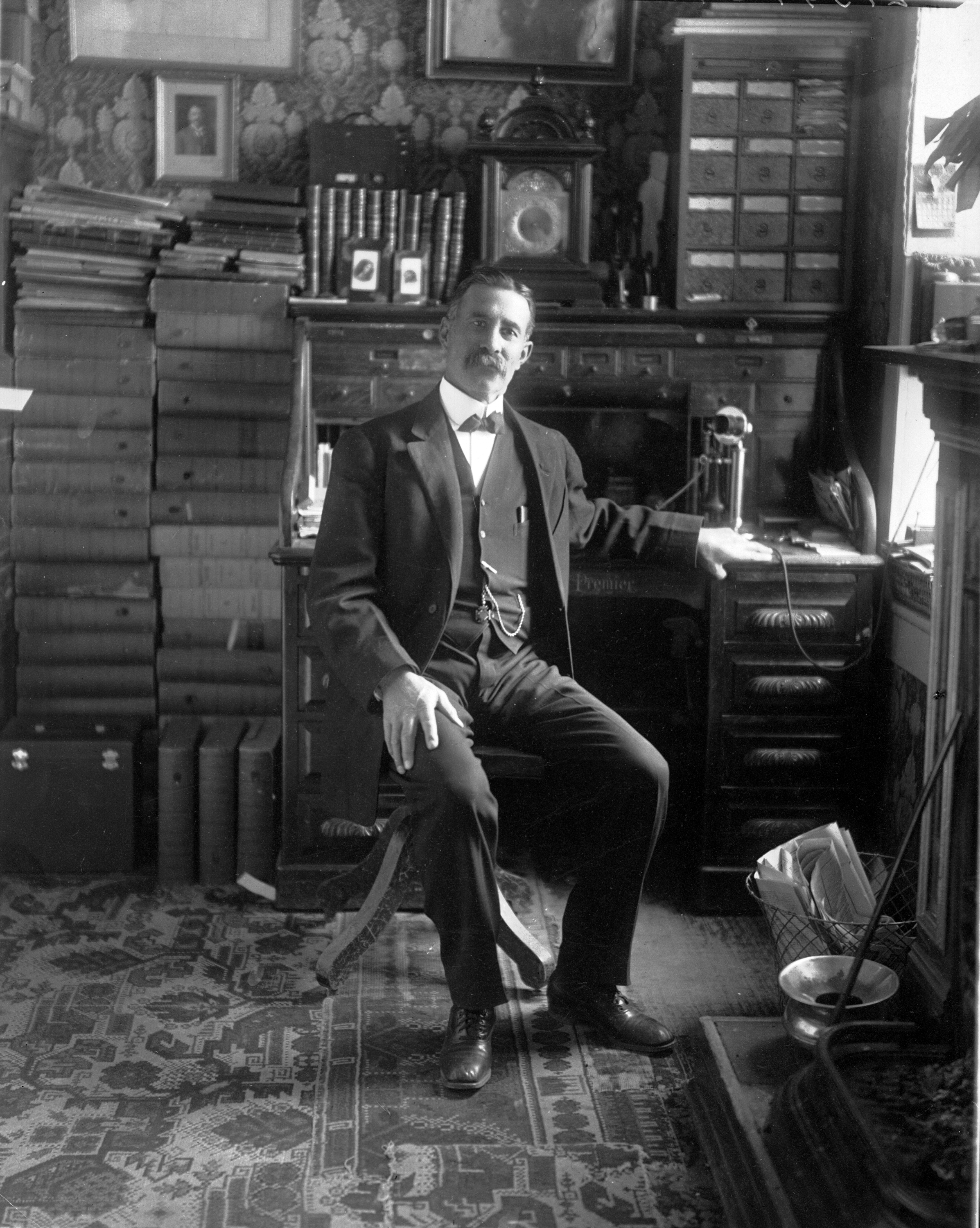
Casimiro Barela, about 1910.
The delegates agreed. Delegate Frederick Ebert, a German-born surveyor from Denver, advocated that the constitution should also be translated into German. The delegates decided to translate the constitution and state laws into Spanish and German “for the benefit of the portion of our citizens who speak that language.” After seventeen years, there was finally a concession to acknowledge the needs of the Hispano citizens of Colorado.
But this wasn’t the end of issues of representation in the 1876 Constitutional Convention. Women had been arguing for suffrage in Colorado since its earliest territorial days, and the convention presented an opportunity for them to gain the right to vote.
A group of women from across Colorado formed the Colorado Woman Suffrage Association in December 1875. They elected Alida Avery as president, the first woman licensed to practice medicine in Colorado. In their constitution, they declared that “women ought to enjoy the same legal rights and privileges as men” and that “so long as women are denied the elective franchise, they suffer a great wrong, and society a deep and incalculable injury.”
The women argued before the convention for the right to vote. They presented a petition with 1,000 signatures supporting their cause. Statehood would fail, they insisted, if the constitution did not include women’s suffrage.
This was not the first time voting rights had the potential to derail statehood. Local newspapers remarked on Colorado's third attempt at statehood in 1865—and how voting rights had contributed to its failure.
Third Time’s the Charm?
The end of the Civil War—and the end of the draft—in April 1865 began to persuade some residents that statehood might benefit them. Anselm Barker was now running a ranch and farm near Clear Creek, but it was difficult to make a profit when goods had to be shipped over rough, slow wagon roads. Having representation in Congress would mean more chances to bring the desperately needed railroad to Colorado. Statehood supporters in Denver sensed an opportunity and launched a third attempt. This time, the Denver Ring wisely left themselves off the state official ballot and included the Mountain Crowd. A new Constitutional Convention began on August 8, 1865, in Denver, with Ovando Hollister, the formerly anti-statehood newspaper editor, serving as the convention’s secretary. The convention reused the constitution from the year before and completed it in five days.
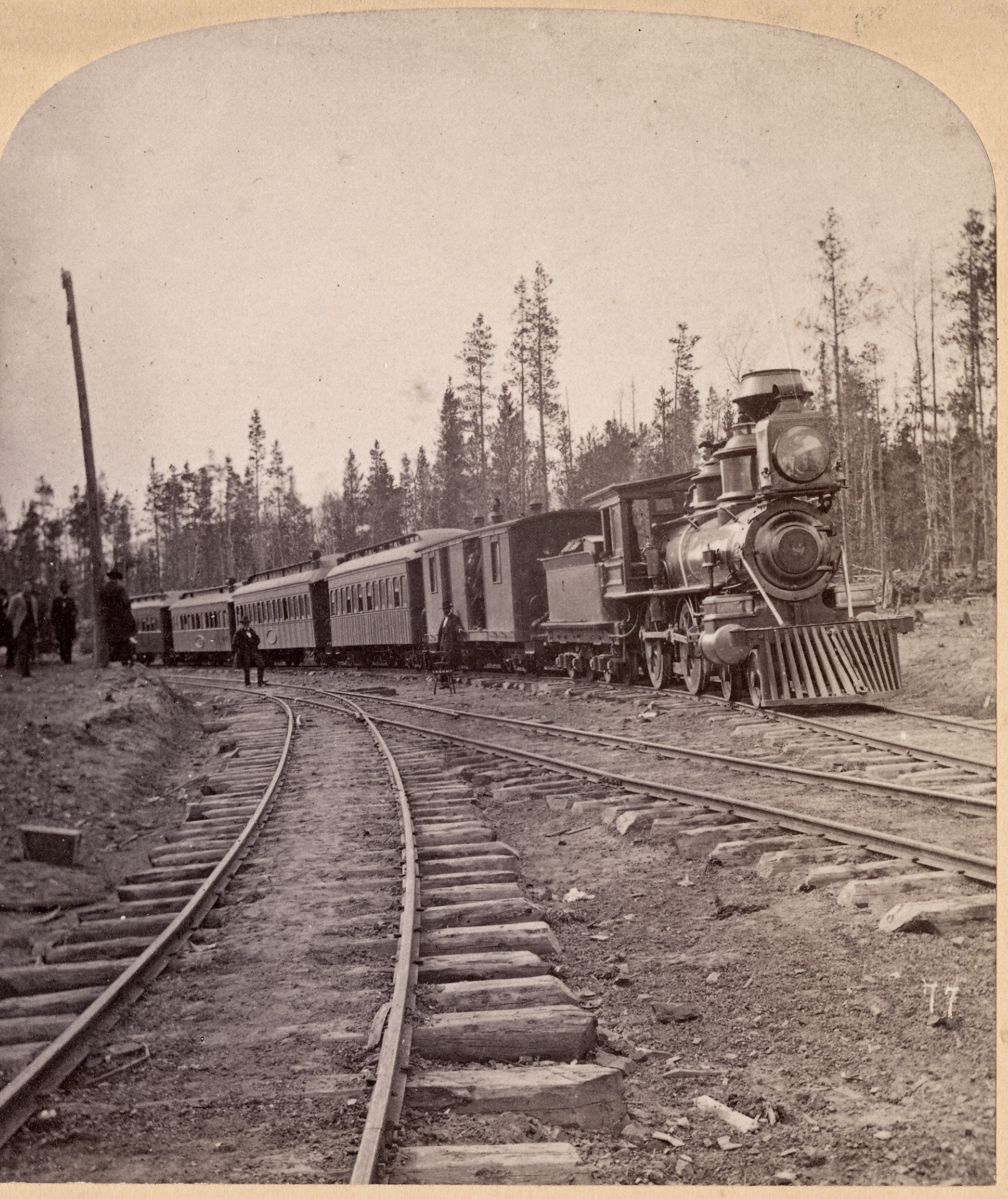
A train reaches the summit of Dump Mountain in Huerfano County, Colorado, about 1880.
With the draft ended, the Mountain Crowd included, and the pressure for a railroad looming, some miners decided to vote for statehood. But many Hispano voters were still against it, continuing to feel underrepresented and ignored by the government in Denver. Voters from Conejos and Costilla Counties refused to vote on the statehood question altogether. “This will give a large majority for the State, as the people of those counties were generally opposed to a State organization, and all voted against that measure last year,” concluded The Rocky Mountain News.
The vote was held September 5, 1865. It became quickly apparent that the large majority predicted by the newspaper had not come to fruition. Statehood ended up passing by fewer than two hundred votes.
For the first time, voters in Colorado had narrowly decided that Colorado should be a state. Now, Congress and the President had to make it official. Most Coloradans assumed that statehood would easily pass Congress. But Colorado’s new constitution had excluded Black men from voting in the new state.
Black businessmen and community leaders including William J. Hardin, Barney Ford, Henry O. Wagoner, and Edward J. Sanderlin immediately began to organize against statehood. They circulated a petition among Black residents of Colorado. One hundred and thirty-seven Black men signed the petition, which rejected statehood. The petitioners argued, “We are taxed by men who made the Constitution, and are allowed no representation….We ask for nothing but even handed justice.” The Black community leaders sent the petition to Territorial Governor Alexander Cummings, who supported Black suffrage. He forwarded the petition to Congress in December, 1865.
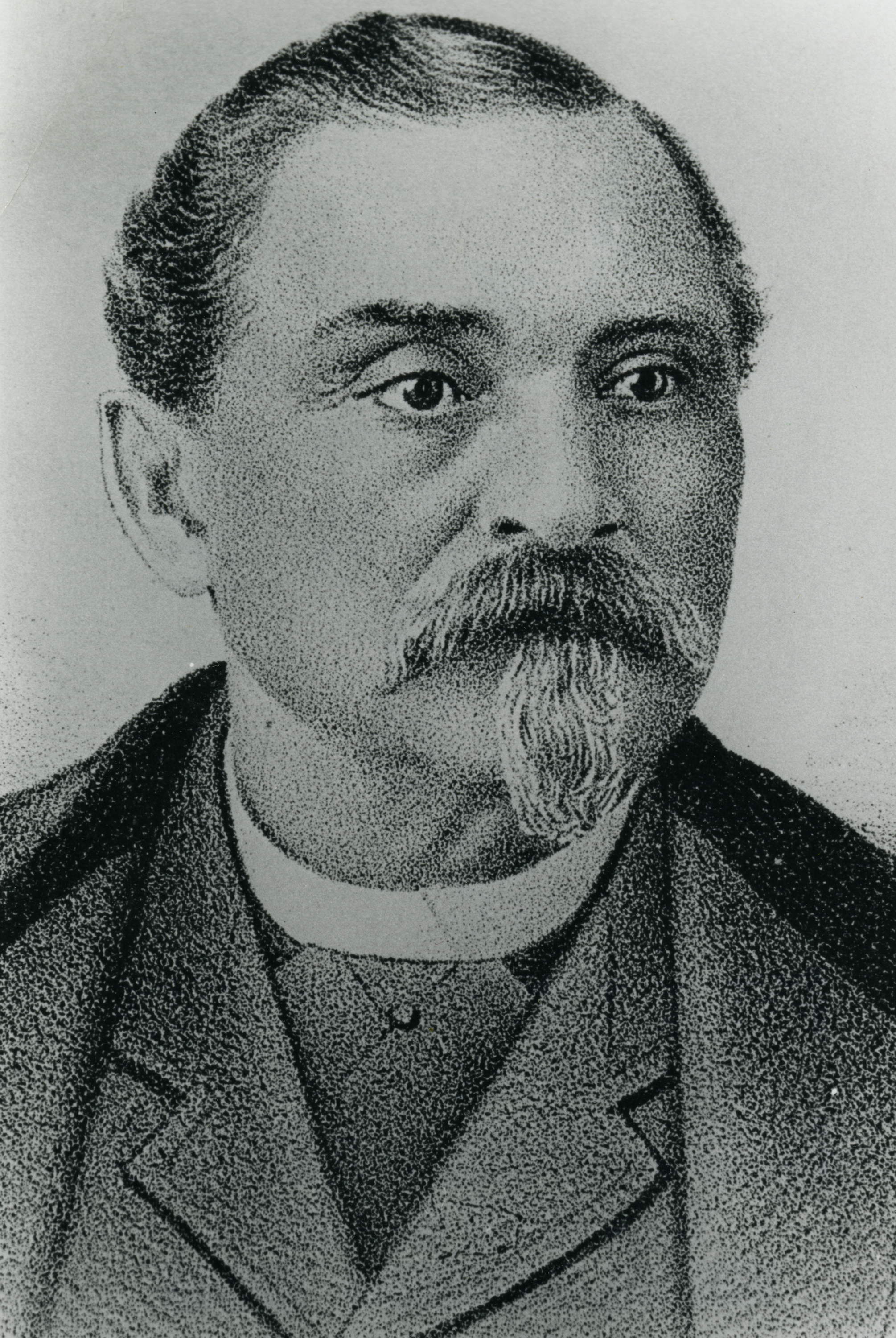
Barney Ford.
When news of the petition arrived in Colorado, statehood supporters were outraged. “This action on their part of petitioning Congress…is an act of treachery and ingratitude rarely exceeded,” The Rocky Mountain News declared. The paper called Territorial Governor Cummings “a piece of double concentrated scum.” But it was too late. Because of the petition, Congress debated and delayed statehood. Massachusetts Senator Charles Sumner proposed an amendment stating that statehood should not move forward.
But federal politics stepped in once more. Republicans in Congress were trying to advance civil rights initiatives and impeach President Johnson. They needed Republican votes, and the staunchly Republican Colorado would provide two more. Sumner removed his amendment. By early May 1866, both the Senate and the House approved Colorado statehood, and the bill was sent to President Andrew Johnson.
Johnson promptly vetoed it, claiming that Colorado’s population was too small. The third attempt at statehood had failed, a combination of local voting rights and federal politics stopping it in its tracks.
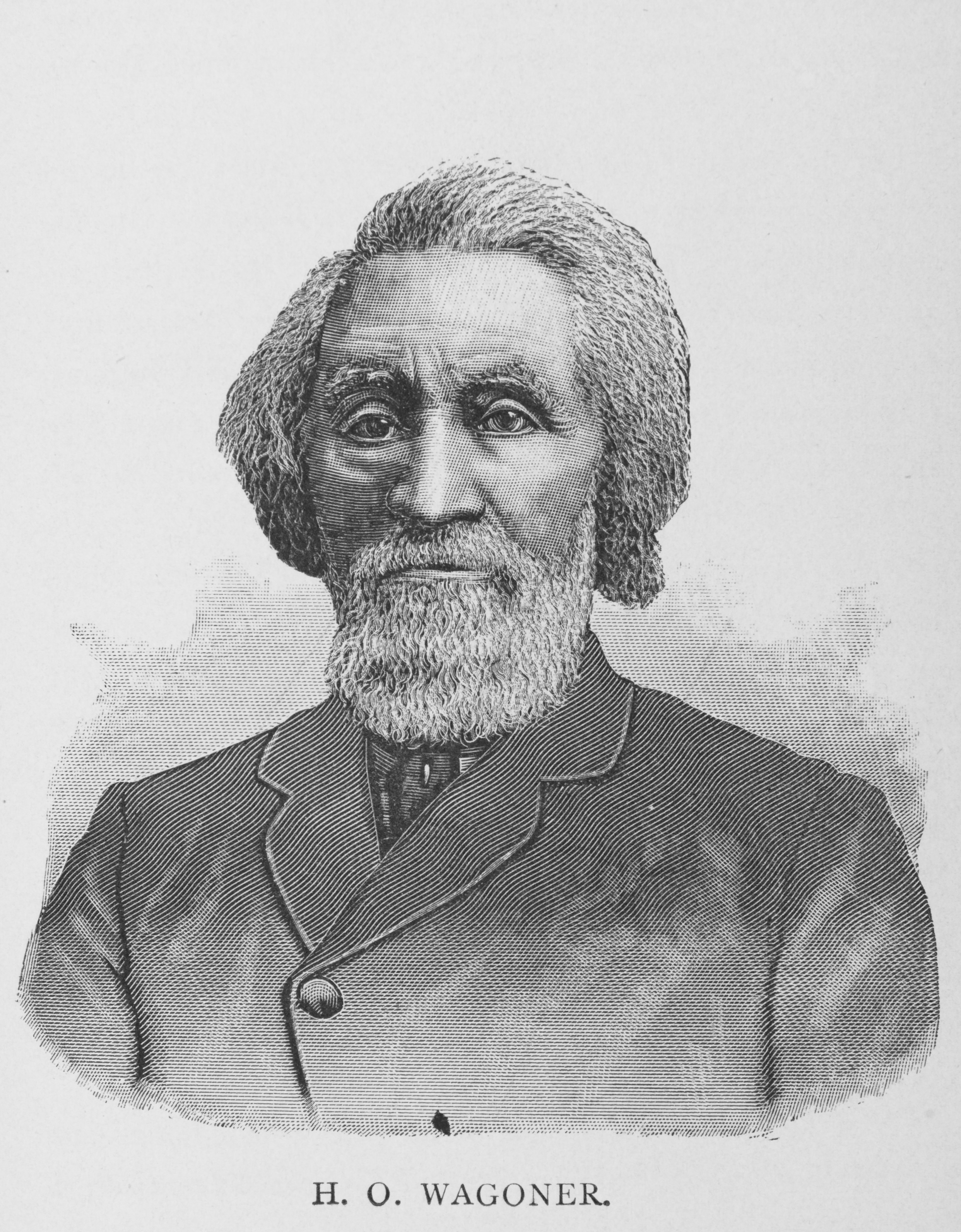
Henry O. Wagoner was born a free Black resident of Maryland, and from a young age became an ardent abolitionist. He participated in the Underground Railroad in Louisiana, Ohio, and West Virginia, and taught in a school for Black children in Chicago. In 1860, he moved to Denver to join the business prospects of his friend Barney Ford, and continued to be involved in civil rights for the remainder of his life.
Congress passed another statehood bill in 1867, still looking to add Colorado’s Republican votes. But Johnson vetoed it again, arguing that Colorado’s population remained too small. An 1868 attempt at statehood at the federal level died before it even started. It would be seven years until statehood seemed within reach once more.
Finding a Middle Ground
For Anselm Barker and other residents of Colorado Territory, change came swiftly with the arrival of the first train in Denver on June 24, 1870. The cost of transportation and goods immediately dropped. A bag of flour that cost twenty-five dollars in 1865 sold for two dollars and fifty cents in 1875. Then, the discovery of silver in the San Juan Mountains in 1871 launched a new mineral rush. New technologies, like Colorado’s first smelter built in 1868, enabled gold and silver processing in the territory. So much wealth was coming out of the ground that, when President Ulysses S. Grant visited Colorado in 1873, Central City residents constructed a silver brick sidewalk worth twenty-thousand dollars for the president to walk on.
With so much growth and investment, statehood sentiment was on the rise once more by the mid-1870s. Unlike the 1859 statehood attempt that had mostly featured Denver men, the 1876 delegates were elected from across Colorado. Three were Spanish-speaking Hispano delegates from southern Colorado. Over one-third of the delegates were lawyers, but others were bankers, judges, farmers, stock raisers, and miners. Their task was difficult: Congress had given them a deadline of July 1876, just in time for Colorado’s Republican votes to be added to the 1876 presidential election. The majority of voters, from the heads of corporations to residents in small towns, had to support the constitution the delegates were writing, or else Colorado would never become the Centennial State.
Voting rights for women quickly arose as an issue that could derail statehood like Black suffrage in 1865. The Colorado Woman Suffrage Association presented arguments and petitions to the 1876 Convention for the right to vote. The delegates listened to the women’s arguments, but they were concerned about the reaction of male voters. “A constitution granting suffrage to women would probably be defeated,” the Rocky Mountain News warned on January 12. Ultimately, the majority of delegates voted against putting women’s suffrage in the constitution. Still, two members, H.P.H. Bromwell and Agapito Vigil, a Hispano delegate from southern Colorado, argued in favor of women’s suffrage: “It is false that Woman is inferior to Man…each is part and parcel of the same humanity.” They proposed that women should at least be given the right to vote in school elections, which the convention granted.
And the delegates included a provision that paved the way for women’s suffrage in Colorado: the state could hold a popular vote on women’s suffrage in the future. Due to this provision, in 1893, Colorado became the first state to grant women the right to vote via a popular referendum of men. The 1876 efforts of the Colorado Woman Suffrage Association had not been in vain.
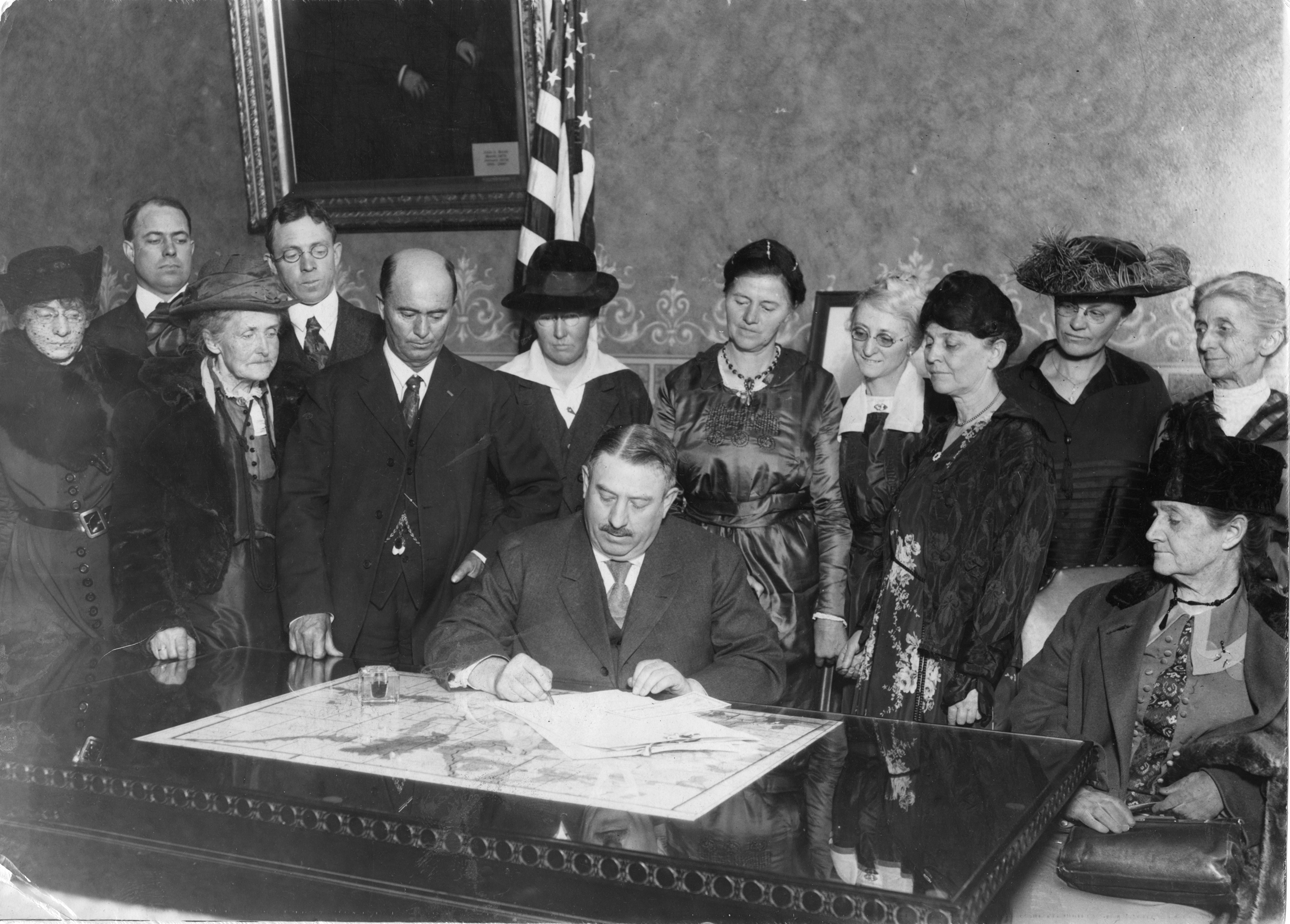
Governor Oliver Shoup signs Colorado's ratification of the Nineteenth Amendment to the United States Constitution surrounded by women’s suffrage leaders, some from the 1893 campaign. From left to right: Frances B. Wayne, Joseph E. Moorhead, Laura Holtschneider, James R. Noland, Senator Perry Dunlap, Dr. Margaret Long, Senator Agnes A. Riddle, Representative Mabel Ruth Baker, Representative Mary G. Bigelow, Mrs. James Crosby and Mrs. Harriet G.R. Wright. Seated at right is Mary C.C. Bradford, state superintendent of public instruction. December 16, 1919.
And the convention also considered what values should underpin the new state. Delegates enshrined the concept of schools open to all, writing, “nor shall any distinction or classification of pupils be made on account of race or color.” This provision would help lead to future school desegregation efforts in Colorado. In the 1914 Maestas vs. Shone litigation, Hispano people in southern Colorado used this Constitutional provision to successfully establish their children’s right to attend the nearest public school.
The convention also realized the importance of Colorado’s natural resources. Mining and agriculture had stripped forests across Colorado. “If we do not protect our forests against devastation,” one delegate argued, Coloradans would lose “the beneficial influences of our forests upon climate and vegetation.” The Colorado Constitution became the first in the US to provide for the protection of forests.
After eighty-six days of deliberation and writing, the delegates approved the constitution on March 14, 1876, with some signing the morning of the 15th. The delegates, recognizing the need to listen to people across the territory, had written one of the longest state constitutions ever produced.
On July 1, 1876, voters went to the polls. Results immediately showed statehood had passed. “TRIUMPH!” shouted The Rocky Mountain News on July 2. “COLORADO THE CENTENNIAL STATE!” A total of 15,443 votes had been cast for statehood, with 4,039 against. Huerfano, El Paso, Las Animas, and Pueblo Counties had voted against statehood, but all other counties voted for it. Coloradans celebrated the impending creation of the nation's only Centennial State, and President Grant declared Colorado the thirty-eighth state on August 1, 1876.
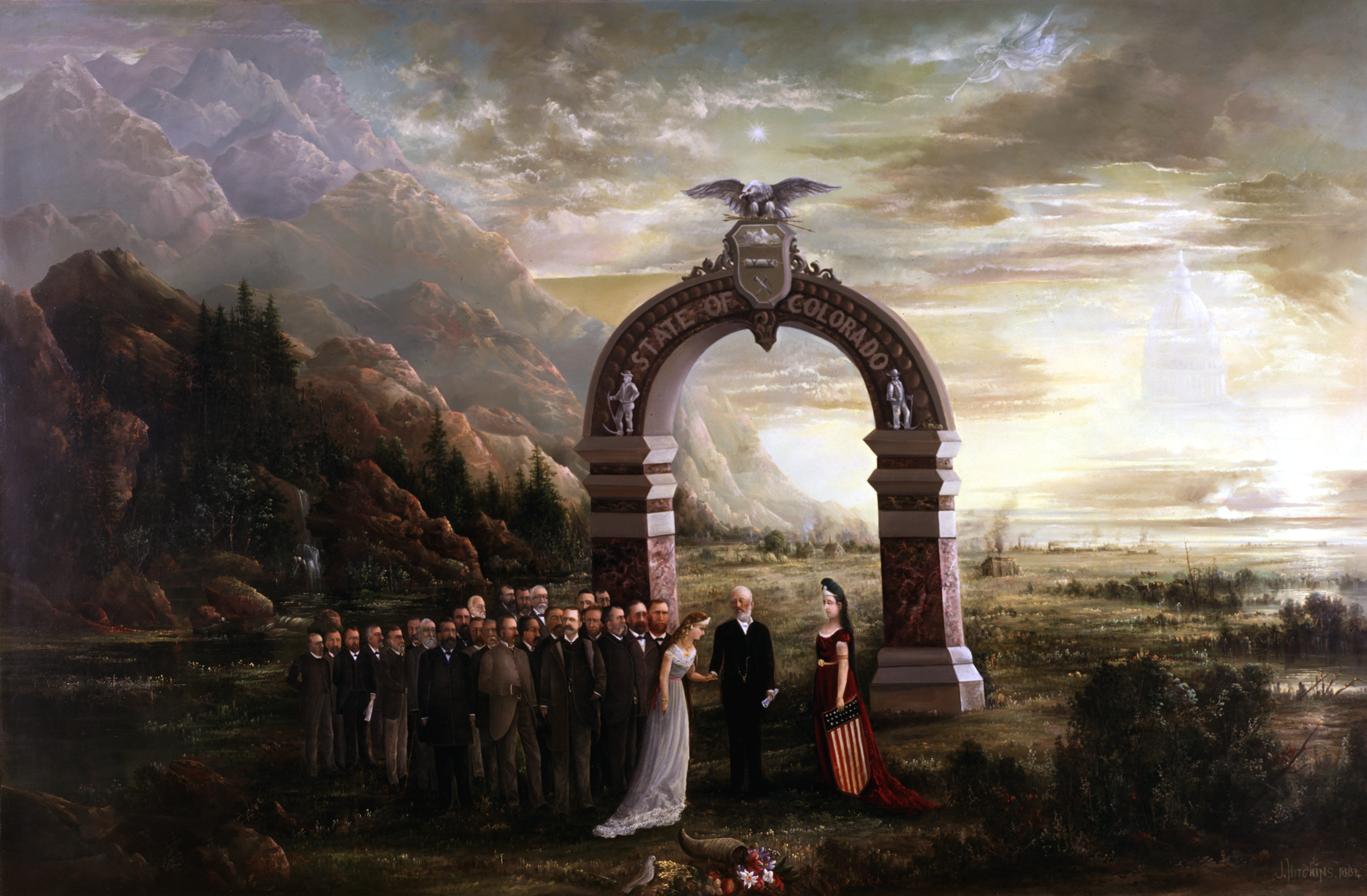
Admission of Colorado to the Union by Joseph Hitchins, oil on canvas 1884.
Colorado’s statehood had immediate ramifications beyond its boundaries. Adding a new state changed the balance of electoral power and influenced the result of the 1876 presidential race. Colorado’s three electoral votes went to Republican candidate Rutherford B. Hayes, and when the votes were tallied, the nation learned Hayes won by one single electoral vote. In exchange for Democratic recognition of his victory, Hayes agreed to end Reconstruction policies protecting the rights of formerly enslaved people, ushering in an era of segregation and legal discrimination.
And Colorado’s statehood forever affected the Native Nations who call this place their home. Though many Native people still live in Colorado, only the Southern Ute Indian Reservation and Ute Mountain Ute Indian Reservation are located within the state’s boundaries. The Ute Indian Tribe of the Uintah and Ouray have a reservation in northeastern Utah. The Northern Cheyenne Tribe is headquartered in southeastern Montana. Many Northern Arapaho Tribal members live on the Wind River Reservation in Wyoming. Members of the Southern Cheyenne Tribe and Southern Arapaho Tribe, today the Cheyenne & Arapaho Tribes, are headquartered in central Oklahoma.
Our Centennial Statehood
Becoming a state was not easy. The people and communities who were not included in the four failed statehood attempts became as consequential as those who were.
In the echoes of these past voices, we can recognize the state we live in today. Our statehood story didn’t just shape our boundaries or our nickname. It shaped our Colorado State Constitution, and through that document—which has been amended 176 times since 1876—the statehood process has shaped our state ever since.
And that brings us back to the parade winding through Denver on July 4, 1876. After seventeen years of trying, the moment of statehood was at hand. Colorado’s future lay ahead. When the parade ended, thousands of Coloradans flocked to Denver Park to watch fireworks. Anselm Barker may have been among them, as he lived in Denver until his death in 1895. And just like those spectators in 1876, this anniversary offers a shared moment to reflect on the people and forces that created our Centennial State, and to consider the impact we will have on our next 150 years.