
 Membership
 Donate
 Shop
Shop


















Finding Roots: Creating the Pueblo Chile
The Mosco chile is a staple of Colorado cuisine. But the story of its journey from Oaxaca to Pueblo reveals a deeper story of agriculture and migration that shaped the Colorado we know today.
Mike Bartolo had just started working for Colorado State University at the research facility in Rocky Ford in 1991 when he inherited a bag of chile seeds. His uncle, Harry Mosco, had passed away and Bartolo’s father was helping to clean out Mosco’s garage. He gave Bartolo a bag of seeds that he found in the process.
“I had no intention of being a plant breeder, but I just had room in my test plots that year and I grew out some of that seed,” said Bartolo. Those seeds were local chiles that grew upward, a strain known as Mirasol (“looking at the sun”). A single, unique chile plant stood out as he walked the rows of peppers in the test garden during the summer of 1992. The plant was a higher-yielding specimen, and the peppers were thicker and meatier than the Mirasol plants around it.
“It’s hard for me to describe it, just something about that plant I liked. I don't claim to be a plant breeder and I didn't really intend to go down that road, but it was just something that I saw,” Bartolo, who has retired to a status of "manager/research scientist emeritus" at CSU, said in late 2025. He added that there was a significant aspect of luck involved, as well. “If I would've not walked down that row that day, who knows what happens?”
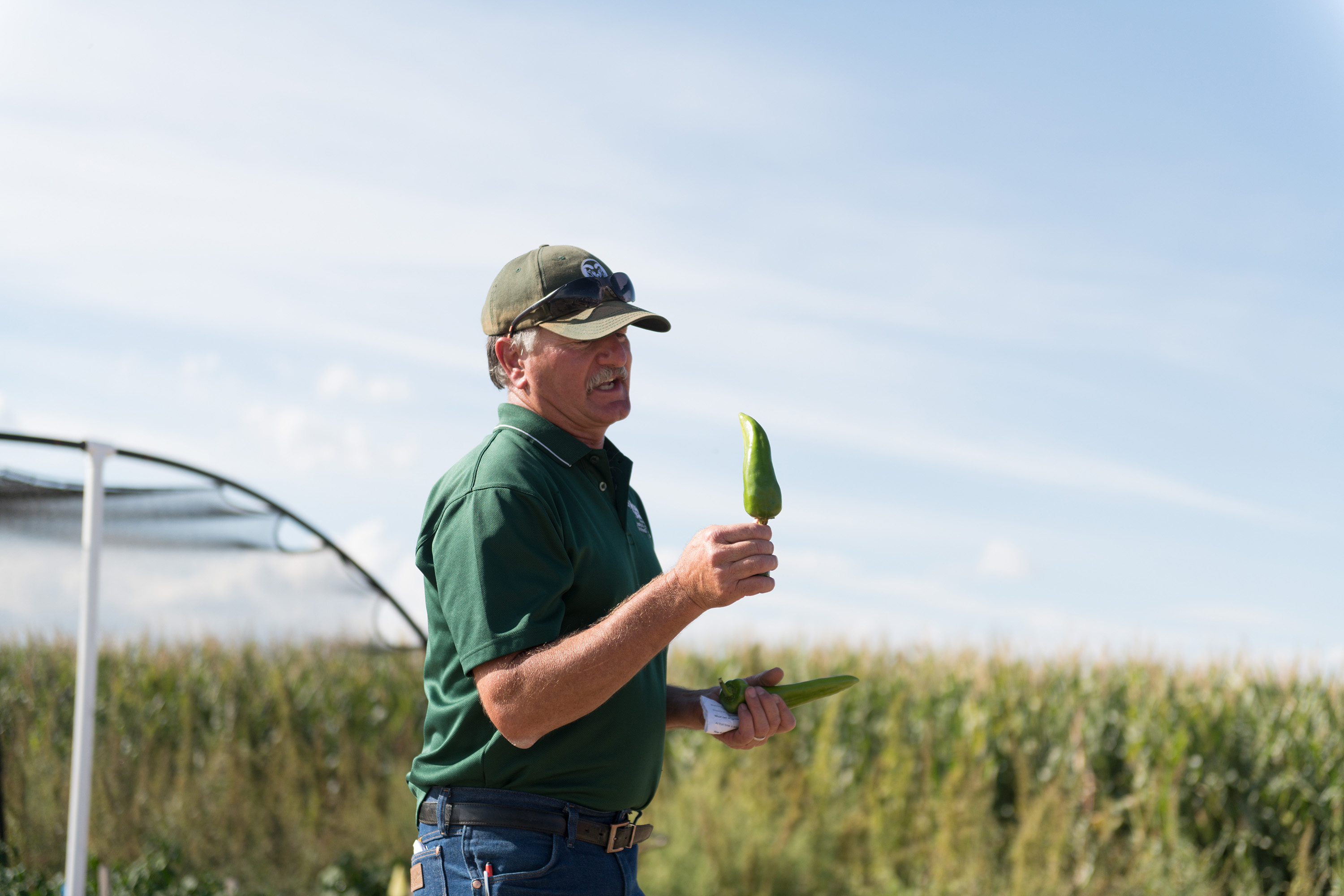
Mike Bartolo in a field holding a Mosco chile, in about 2022.
Out of curiosity, Bartolo saved the seeds from that plant and grew them next year—the beginnings of the same selection process that his family had been doing for several generations, choosing the best plants and collecting seeds from them for the next year’s crop.
“My dad describes my grandfather going out and he would tie a ribbon or a string around it and he'd tell everybody, ‘Do not pick this plant. This is a really full plant, we're going to save it for seed next year.’ And they would do that every year,” Bartolo said. “And so when you start doing that over, you know, thirty, forty, fifty years, then it becomes very in sync with your environment.”
It wasn’t just Bartolo’s family who did this, of course. Local farmers in Pueblo County had been selecting seeds this way since the early 1900s, gradually adapting the Mirasol into a local variety. This process of very localized selection leads to varieties of chiles and other plants that are adapted to a specific climate and location. These varieties, called landraces, will consist of a similar but not entirely homogenous genetic makeup, which encourages some variation from generation to generation, and the varieties that thrive in a particular combination of climate, soil, and other factors will be selected for seed the next year. Over generations and even centuries, these landraces can continue to diverge and become more unique the longer they are grown separately from other varieties of the same crop.
“Over time, you're always selecting the best and saving the best. And over time they become really super-localized and adapted to that particular region,” Bartolo said.
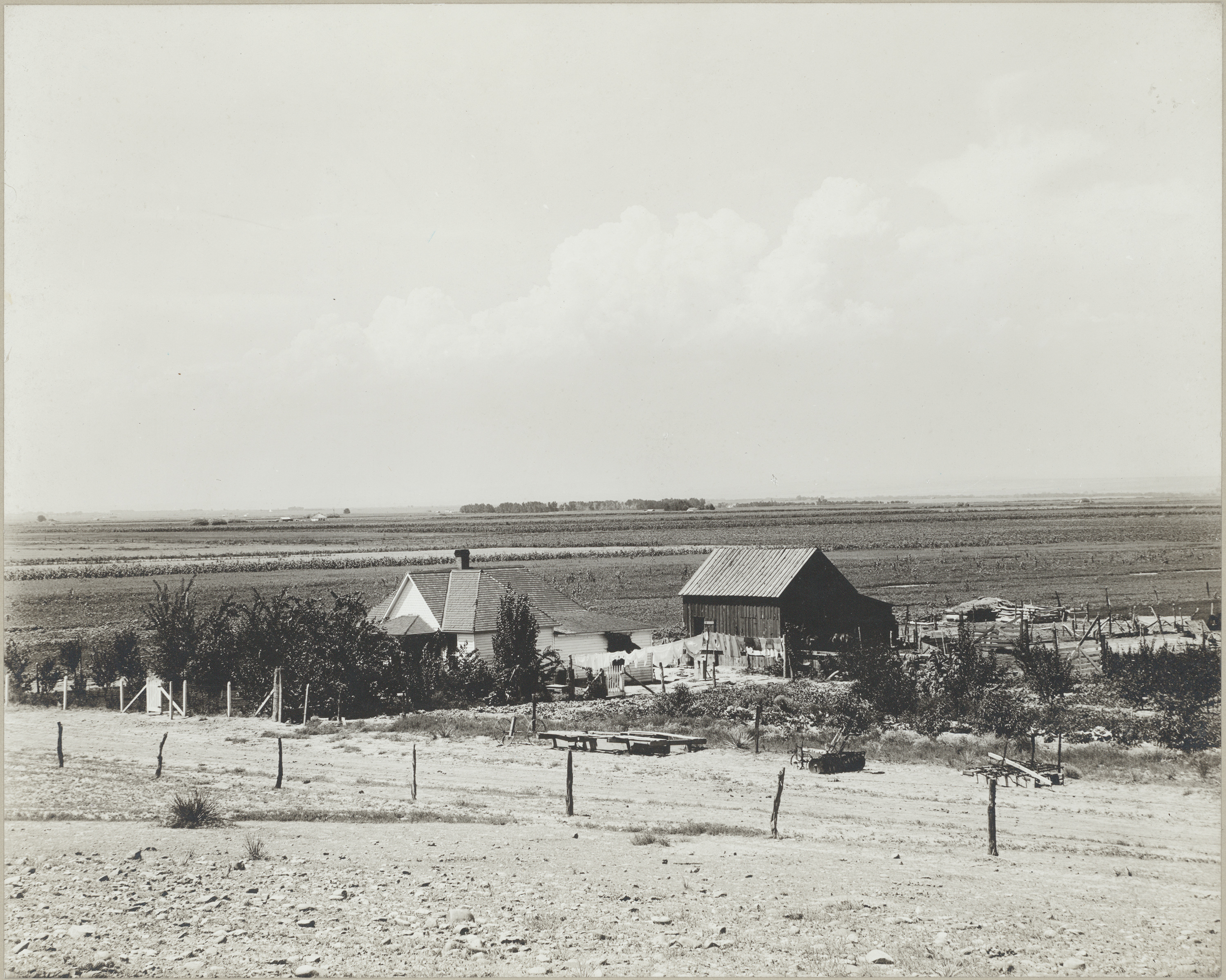
An irrigated farm in Pueblo County, around 1900–1915. Small farms like this, where each family hand-selected which seeds to plant next year and allowed cross-pollination with neighbors’ fields, were key to the development of the thousands of landraces of every crop we still grow today.
It took seven or eight years of saving seed, growing the next crop, and selecting another single plant until Bartolo had a stable, uniform variety. He called it the Mosco, in honor of his uncle. He started to build up seed and shared it with farmers in the early 2000s, and his new variety of chile soon became one of the most popular in the region.
From that one progenitor, Bartolo has continued to select for new or improved characteristics, releasing a hotter variety called the Giadone. There’s also the round Pueblo Popper, as well as some ornamental varieties in the pipeline. As of fall 2025, he had seventy different lines of chiles growing in his garden in Rocky Ford.
“From that one single chile I've made hundreds of selections,” Bartolo said. “I’m always crawling around on my hands and knees, looking at stuff at the ground level. Sometimes the most fascinating things are right in front of you and you just have to stop and look at it. You don't have to go to the Himalayas or the mountaintop to find it; it’s right there, down the row in front of you. That was always my philosophy.”
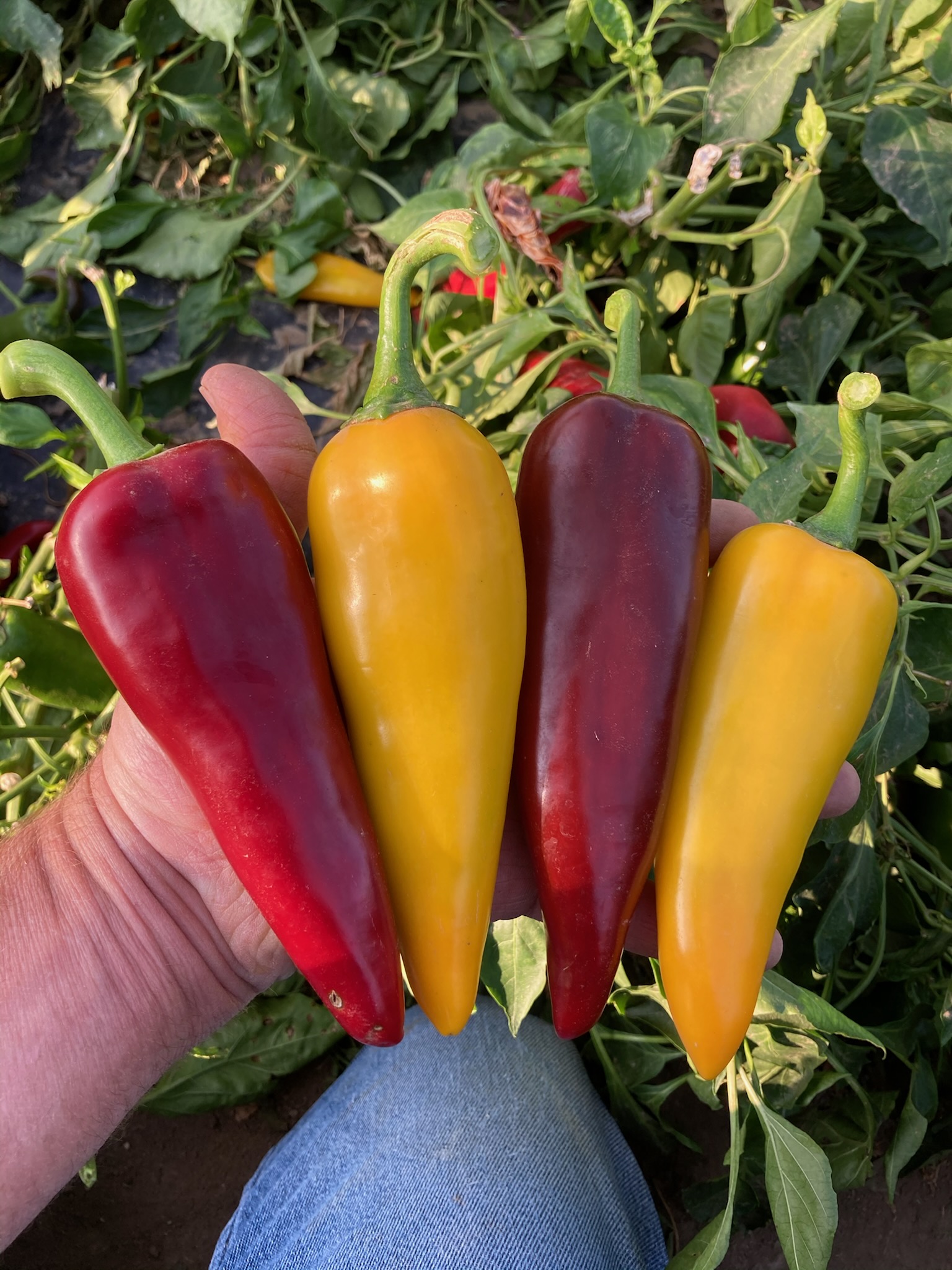
Experimental Pueblo chiles from the home farm of Mike Bartolo.
That eye for detail is what allowed him to identify a single plant with remarkable traits, refining it, nudging the needle a little bit every year, until he had the Mosco—the foundational Pueblo chile in the twenty-first century.
Of course, the lineage of the Pueblo Mirasol goes back even farther.
Cross-Border Roots
The evolution from Mirasol to Mosco and beyond may be the result of Bartolo’s love of plants and that fateful stroll he took in his garden that warm summer of 1992, but where did his uncle’s seeds—the seeds that are the ancestor of almost all modern Pueblo chiles—come from? The history of the landrace that had become a staple of the southern Colorado palate and the Pueblo agricultural community is less clear and often shrouded in history.
Mirasol chiles have been grown in the area for more than a century and have long been a cornerstone of the local culinary experience. As far as Bartolo can trace back, largely through family and other oral histories, the Mirasol started being grown in Pueblo County in the early 1900s. But prior to that, the history of the Mirasol is uncertain, dotted with hints and possibilities.
“Pueblo in itself is a multicultural city where you've got Hispanic culture and Italian and Eastern Europeans coming to work. And then a lot of those traditions got fused and melded together,” Bartolo, himself a descendent of Italian immigrants, said. “With my family, too, they just incorporated these foods. We used the Mirasol chile when we made sausage, and it was the most revered ingredient for this sausage other than the pork itself. It was common on our tables to have pastas and Italian food, but then we also had green chile too, so it was kind of weird to have meatballs and green chile. That's just what we did.”
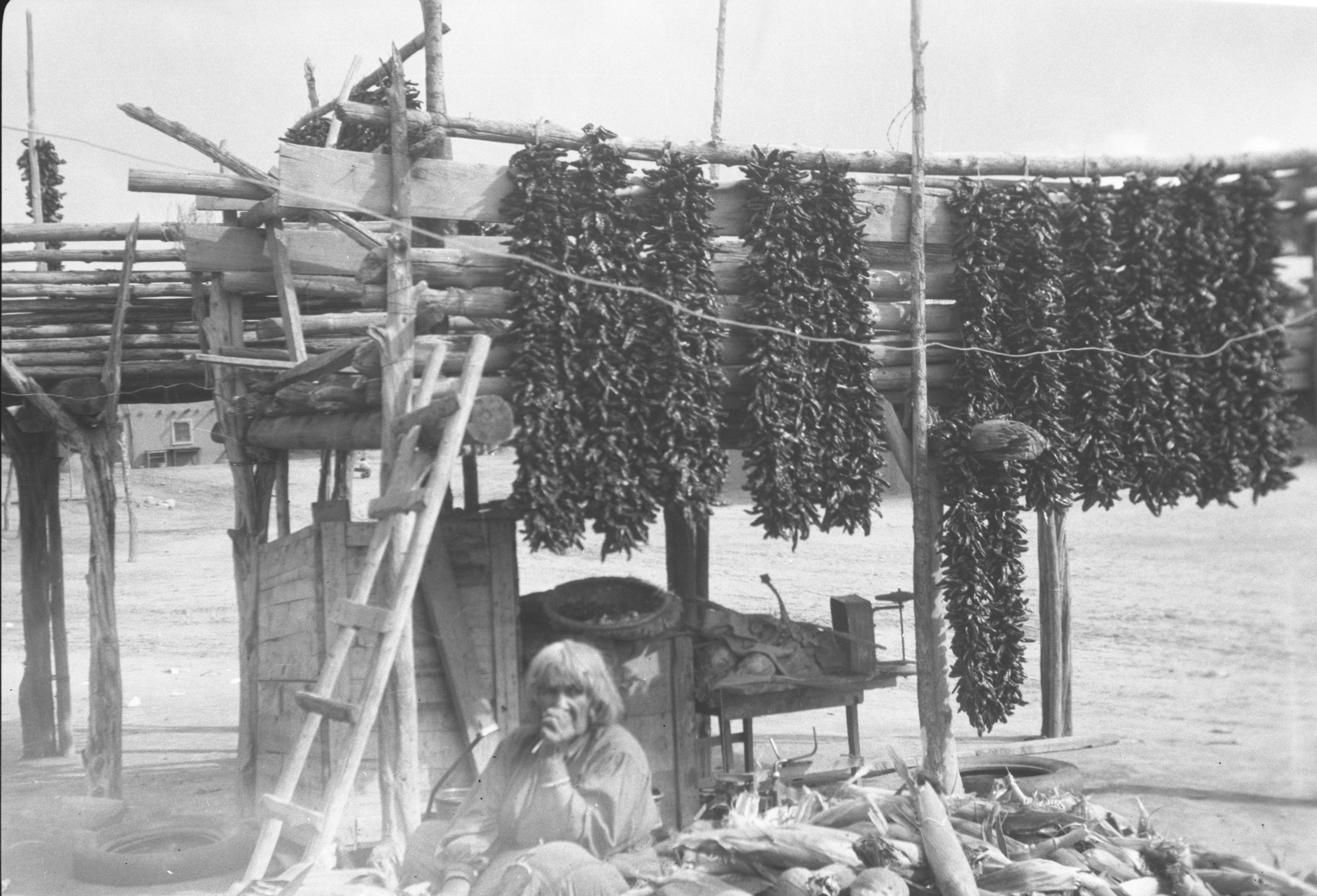
A Puebloan woman sitting in front of ristras of chile peppers, around the late 1800s to early 1900s.
Bartolo had a conversation many years ago with an anthropologist out of Mexico City University, who noted the existence of a very prominent landrace from the Oaxaca region that resembles the Colorado Mirasol chile—suggesting that the Mirasol may have originated far from Colorado, in southern Mexico.
In 2003, Bartolo provided DNA samples of local Mirasol chiles to researchers at New Mexico State University (NMSU), led by Paul Bosland. They found the closest genetic match was indeed a variety from Oaxaca. How the variety leaped from Oaxaca to Pueblo County is a matter of some speculation, and Bartolo emphasized the “gaping holes” in different theories.
One possible avenue is through a legendary figure in New Mexican chile lore.
Fabián García joined the New Mexico College of Agriculture and Mechanical Arts in Las Cruces (now New Mexico State University) in 1906 as a professor of horticulture, later becoming the first director of the college’s agricultural experiment station. García spent decades working to improve and standardize the local chile pepper, releasing many varieties in his decades there. Among them was the predecessor to the modern Hatch chile pepper, which García called New Mexico #9.
Bartolo has seen century-old listings in the Burrell Seed Growers catalog, a Rocky Ford institution that still sells seed, for a plant called the “New Mexico Chile Improved.” He suspects that could be an early name ascribed to the Mirasol chile. He also has noted what appear to be chile pepper plants on the cover of a 1908 publication by García entitled Chile Culture with peppers growing upward—a telltale feature of the Mirasol. Bosland, who oversees the chile breeding and genetics research at NMSU, dismissed this as an “optical illusion.”
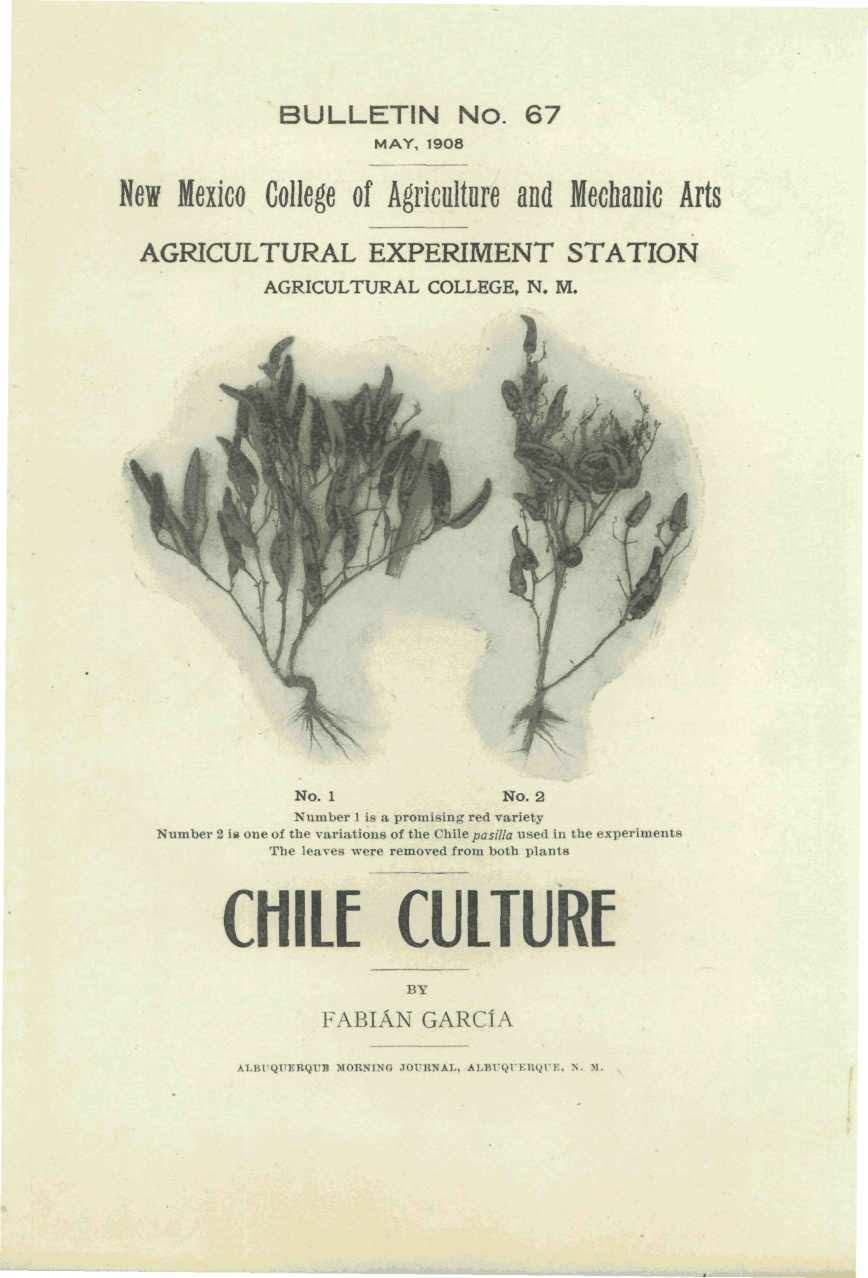
The cover plate of Chile Culture by Fabián García, published in 1908 by the New Mexico College of Agriculture. This short publication was an early investigation into the many varieties of chile peppers in the Southwest, the traditional methods of growing and preparing them, and plans to expand production in New Mexico—and it might be the first historical evidence of the Mirasol variety in the United States.
“The fruits are actually pendant. Someone moved the fruits to the upright position,” he commented.
Due to a lack of continuity in the research at NMSU, Bosland is unable to verify or refute the presence of Mirasol chiles in García’s research. However, the fact that Pueblo’s Mirasol varieties are more closely related to the Oaxacan chiles than to those varieties known to have come out of NMSU’s breeding program suggests that the Pueblo stock might not have originated with García.
Another possible clue may lie in the archives of early Colorado trader and politician Joe Doyle. The Doyle Settlement was founded in 1859 on the Huerfano River, southeast of Pueblo and south of the St. Charles Mesa, where a number of the area's most prominent chile growers are now located. It became home to a mixed community of white, Native, and Hispanic residents. The settlement featured ranching, farming, one of the first flour mills in the state, and a school. It later hosted a post office once Colorado became a US territory.
Bartolo—while underscoring the unreliable, thirdhand nature of the possible Doyle connection—said he had been told by a historian who has since passed away that a report or journal entry from the settlement mentions a chile that grew upward.
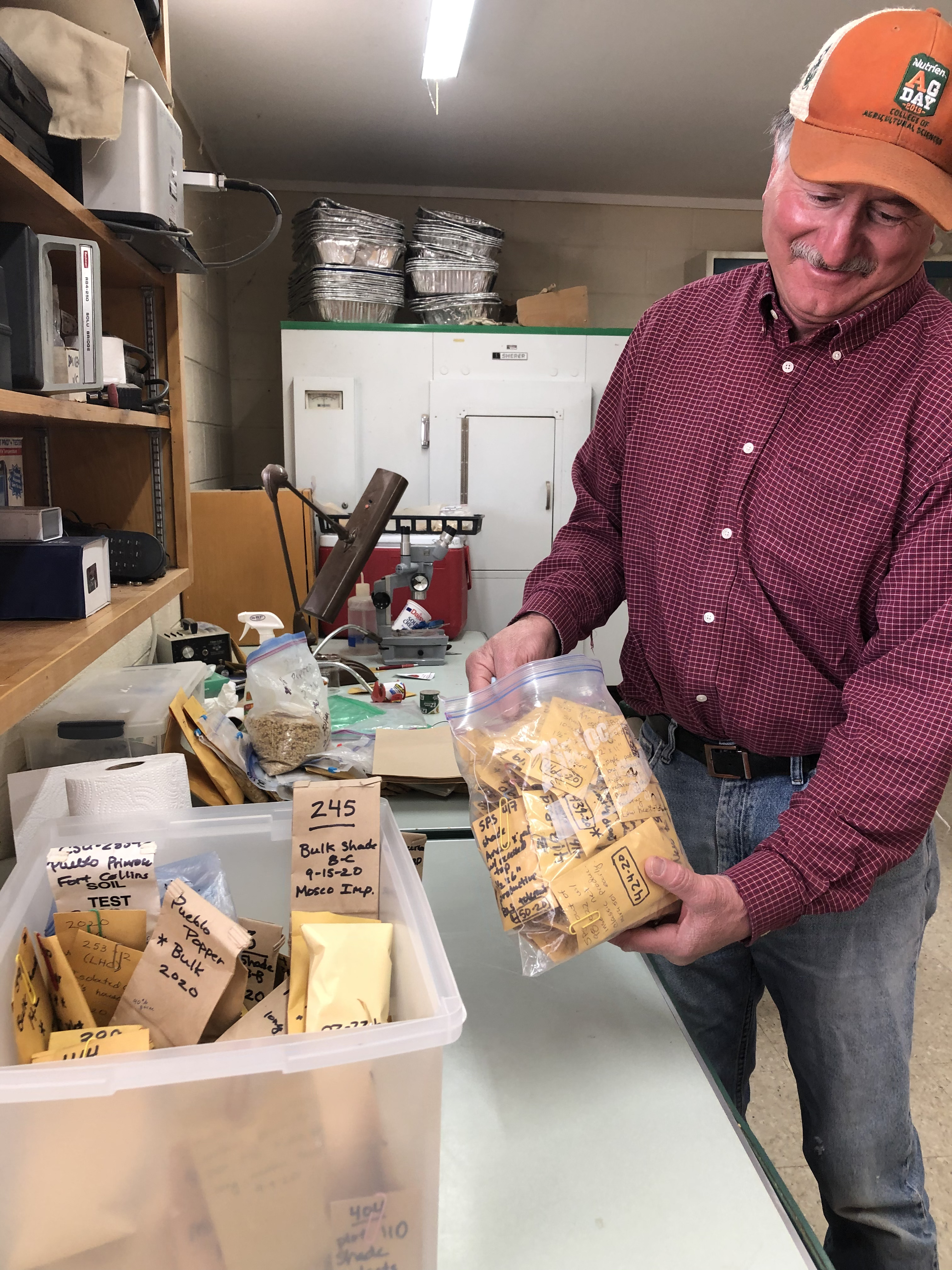
Mike Bartolo in his workshop.
“I don't know if that's the original Mirasol, or there may be other types that grew that way that were brought in from the Santa Fe Trail. It’s hard to say what is true without that documentation,” he said. “I don't doubt that there may be people bringing seed in from who knows where along the Santa Fe Trail, or early settlers or early pioneers in the area growing a chile that may have had that appearance.”
However it arrived, the ancestors of the Pueblo chile made the leap from southeastern Mexico to southeastern Pueblo. Whether through a focused, dedicated research endeavor, tucked away in a migrant worker's pocket, or a happy accident, the Mirasol reached southern Pueblo County, and eventually became something uniquely Colorado.
As People Move, Plants Move
Charles Havlik of NMSU works with the unique landrace varieties in many of the small, traditional Hispanic and Native communities that dot New Mexico—including the famous Chimayo chile. Part of his work involves preserving the traditional landrace chiles that have evolved in various local communities.
Breeders such as Bosland will work to prevent the genes of their trial plants from getting crossed with other chiles, because the chile flowers will both self-pollinate and cross-pollinate. However, Havlik noted the reality of growing crops, especially in a traditional setting, is very different.
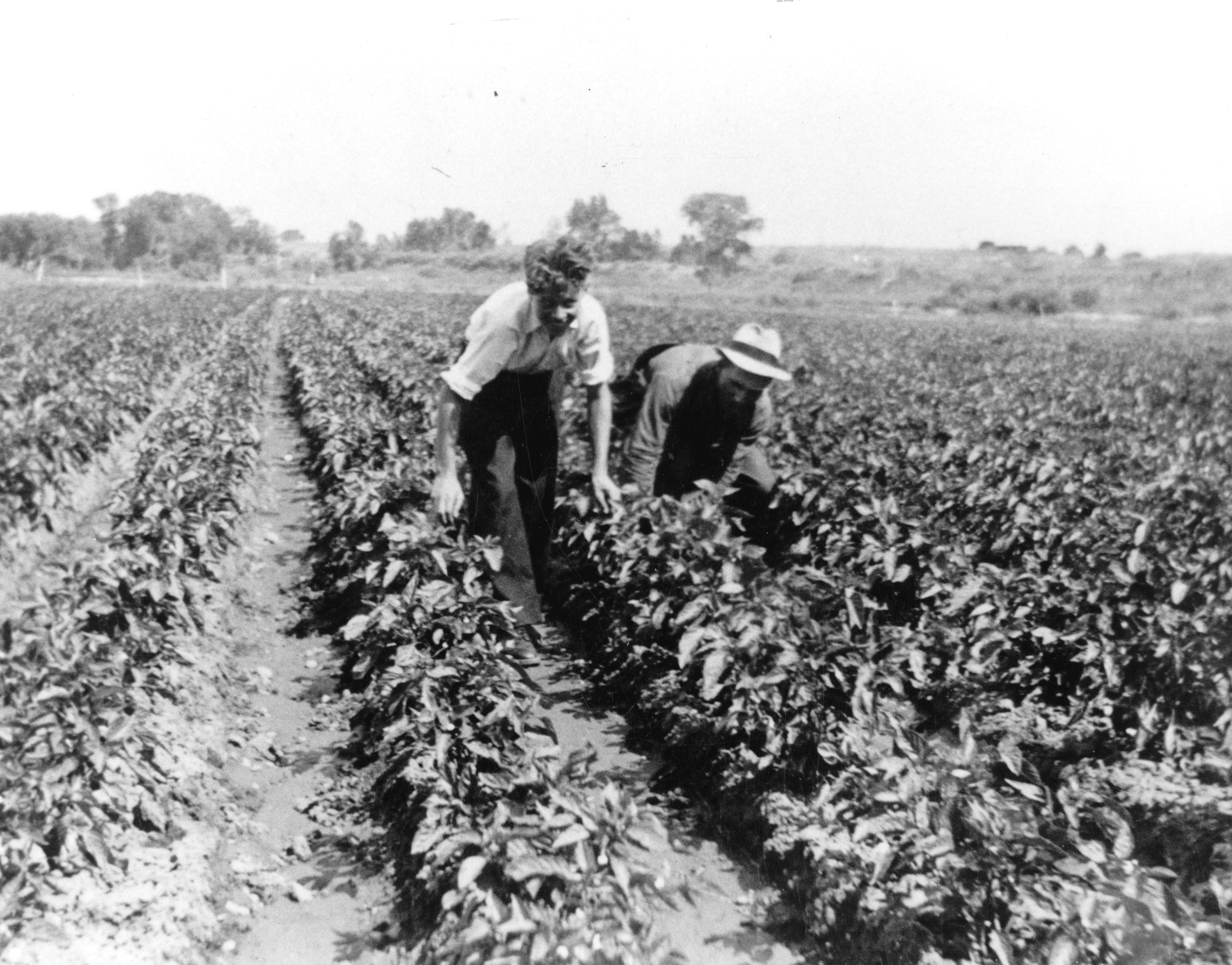
Ray and Rocco Valente picking peppers in their farm plot just outside Denver, about 1937. While the Mosco variety Coloradans know and love today had not yet been developed, landraces local to Colorado were grown, eaten, and sold across the state by people of all backgrounds, including Italian Americans like the Valente family.
“You have to realize that people move and people intermarry and people bring their seeds with them. People trade their seeds with each other,” he said. “It wasn't until recently that people started worrying about seed purity and stuff like that.”
Bartolo noted that the original Mirasol plant he singled out, which eventually led to the Mosco chile, may have been the result of some unrecorded—and unintentional—crossing. “Why that pepper was unique in that population, it probably outcrossed with a jalapeño or something else. So if you looked at it, it might have genetics from who knows where.”
Havlik likes to say that he’s never seen a chile plant point out a border on the map, and southern Colorado and northern New Mexico are very culturally aligned. Nonetheless, he hasn’t seen any strong tradition for upward-growing, Mirasol-type chiles in New Mexico. “They're here and there. They do pop up every now and then, but usually the fruit hangs (down),” he said.
To Dan Hobbs, founder of Pueblo Seed & Food Co., the likelihood of a migrant worker bringing their favorite varieties of chiles and other plants makes the most sense. Hobbs farmed in the same general area as the Doyle settlement and has heard of a Mexican workers village that grew up around the settlement. He acknowledges that the García and NMSU connection is possible but, like Havlik, also hasn’t seen any tradition of Mirasol-type chiles being grown in New Mexico.
“As a seedsman myself, knowing how these seeds travel and trade, I wouldn't be surprised if somebody in Doyle's Mexican (community) there, one of his workers, came up from Oaxaca with a pocket full of seeds and grew them out,” he said. “Seed history is lost in a second, but these things travel around. They get passed from person to person. And there were a lot of people working up there, a lot of Mexicans out of New Mexico and out of Old Mexico.”
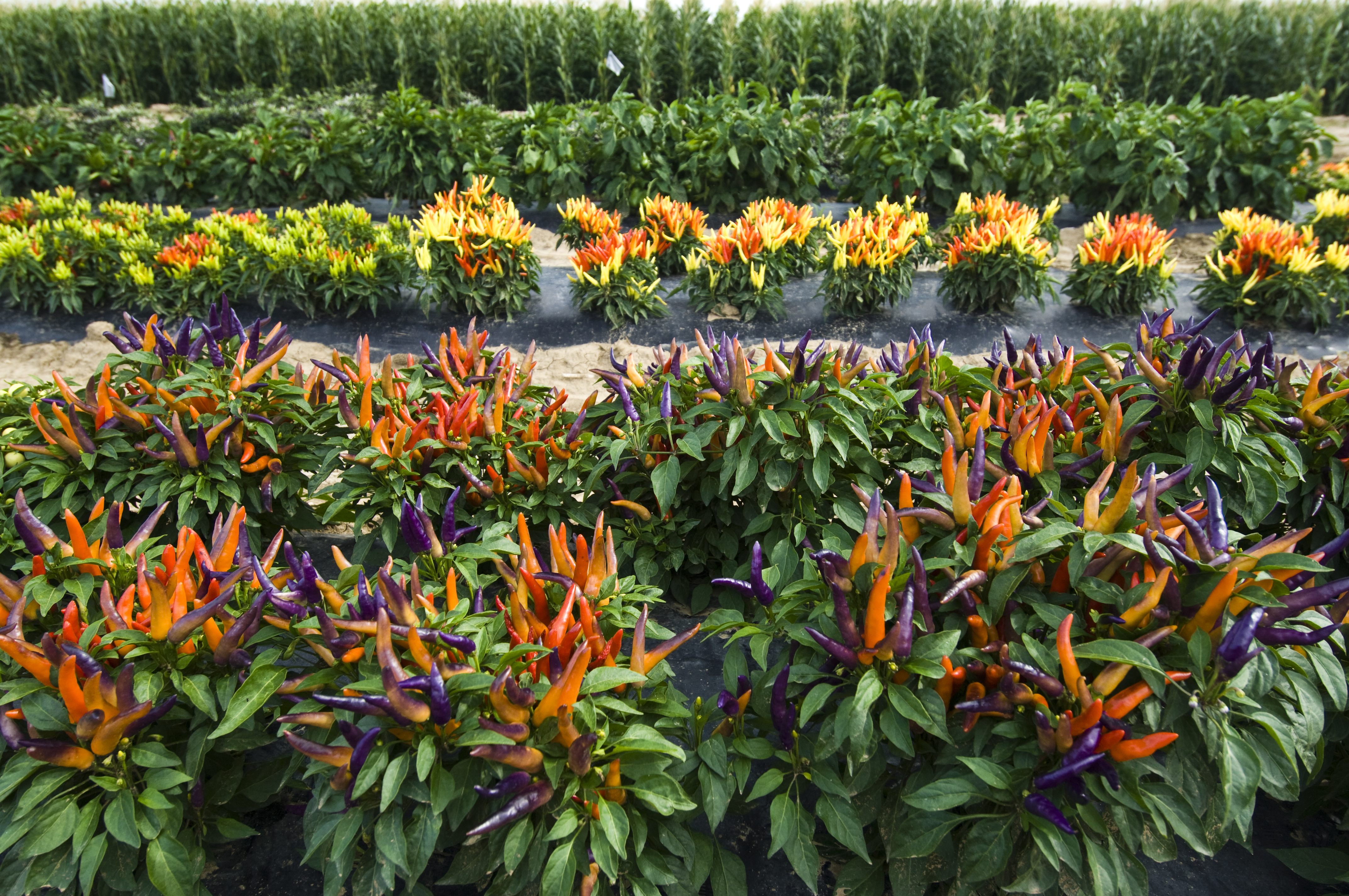
Ornamental chile pepper plants at the Colorado State University Research Farm. These plants display the vibrant variety of chiles.
Hobbs himself brought chile seeds back from Oaxaca a few years ago, one of which is an upward-growing type. He said they don’t call it Mirasol in that part of Mexico, but rather chile parado—the “standing up” chile.
(He noted that the term may make the local Oaxacan women blush, because it can also have a non-food, bedroom connotation.)
Hobbs was familiar with Swanson’s research, including the Mirasol’s ties to Oaxaca, so he asked around during a trip to Mexico in 2020 where he was studying growing and cooking traditions of corn.
“We went to a seed bank right outside of Oaxaca city, and we saw the different accessions of corns and squashes and chiles,” he said. “And then, the cuisine is just so amazing in Oaxaca, so we just kind of ate our way through the city over the course of a week or so, trying different mole sauces and chile recipes.”
He eagerly returned to Oaxaca in spring 2023, and met with farmers to take a deeper dive into chile peppers. He sourced seed for five types of peppers used in various moles—rare heirloom varieties, or chiles Oaxaceños.
One of those varieties is the Chile de Agua, a landrace that has a lot in common with the Pueblo Mirasol. While it ripens from a limey green to orange to red, compared to the Mirasol which doesn’t have an intermediate orange stage, it also grows upwards, reaching towards the sun.
“The stature of the pepper, the length and the width and the fact that it grows upright are all real similar, which led me to theorize that maybe they were related,” Hobbs said. “I don't know if I would go so far as to say the Pueblo chile was descended from that one, but it looks like they're certainly cousins to me. The interesting thing about that Chile de Agua, in the field, is that it matured two weeks faster than the Pueblo, which is really important when you're working in dry conditions.”
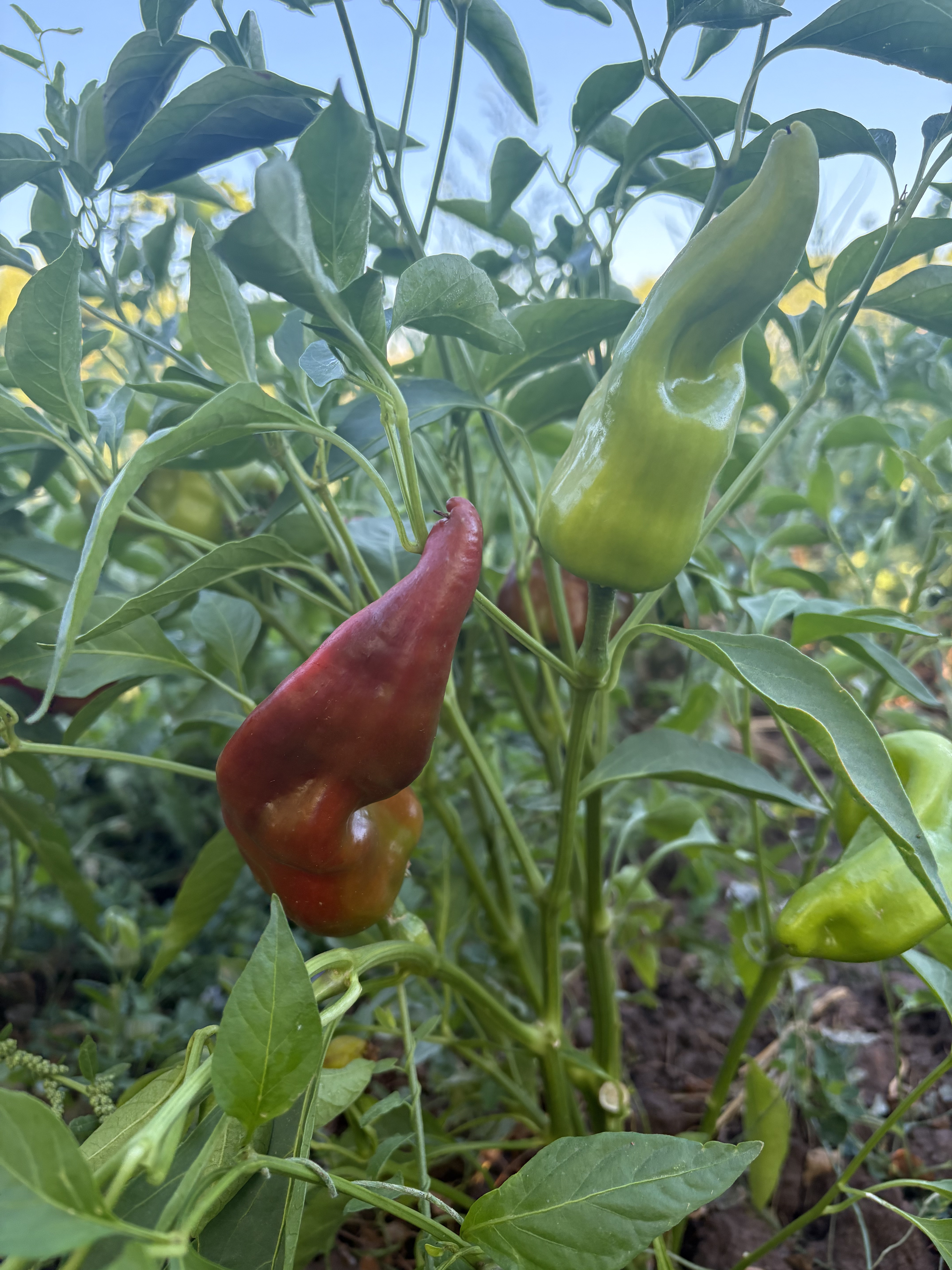
Chile de Agua, brought back from Oaxaca by Dan Hobbs. Like the Mosco variety of Colorado, these chiles grow upwards as if reaching for the sky, showing why this group of chiles was given the name Mirasol.
The Chile de Agua, which Pueblo Seed & Food Co. has started selling seeds for this year, was traditionally planted under dryland conditions. They would go into the ground in June, just before the rains would come, and then race to grow and ripen with only a couple of additional rains. The plants grow a little more “landrace-y,” Hobbs said—thinner flesh, more foliage, occasional stubby, blunt ends like a bell pepper rather than tapered tips.
“The flavors are kind of tropical and citrusy and really unique, and it's a little thinner than a Pueblo chile. So I feel like it's sort of a crossover chile, in that you can roast it but you can also dry it more easily. The Pueblos are just so thick that it's clearly a roasting pepper, it's pretty tough to dry them. Really different than all these chile nativos from New Mexico. They're real thin and you can dry them on your roof top or on ristras. So the Chile de Agua, I think, has the best of both of those.”
There is another type of chile grown in Mexico which is sometimes called Mirasol, but while Pueblo’s Mirasol chiles tend to be roasted, the Zacatecas Mirasol is a thin-fleshed variety bred for drying. Rather, it is known as one of Mexican cuisine’s primary dried chiles, the guajillo. Before modern technology like canning and refrigeration, thinner-fleshed chiles such as these would have been a better fit for preservation, noted Havlik. While dried red chiles are more widely known, green chiles would sometimes be roasted, peeled, and then dried to produce chile pasado, offering a different flavor profile compared to fresh-roasted green chiles or dried red chiles.
Hobbs relocated his growing operation to Cortez about five years ago, and has enjoyed the slow process of starting to adapt some of the Oaxacan stock to southern Colorado. He said almost nobody in that part of the state had experienced Pueblo chiles, and it’s been fun to grow and share it with the community.
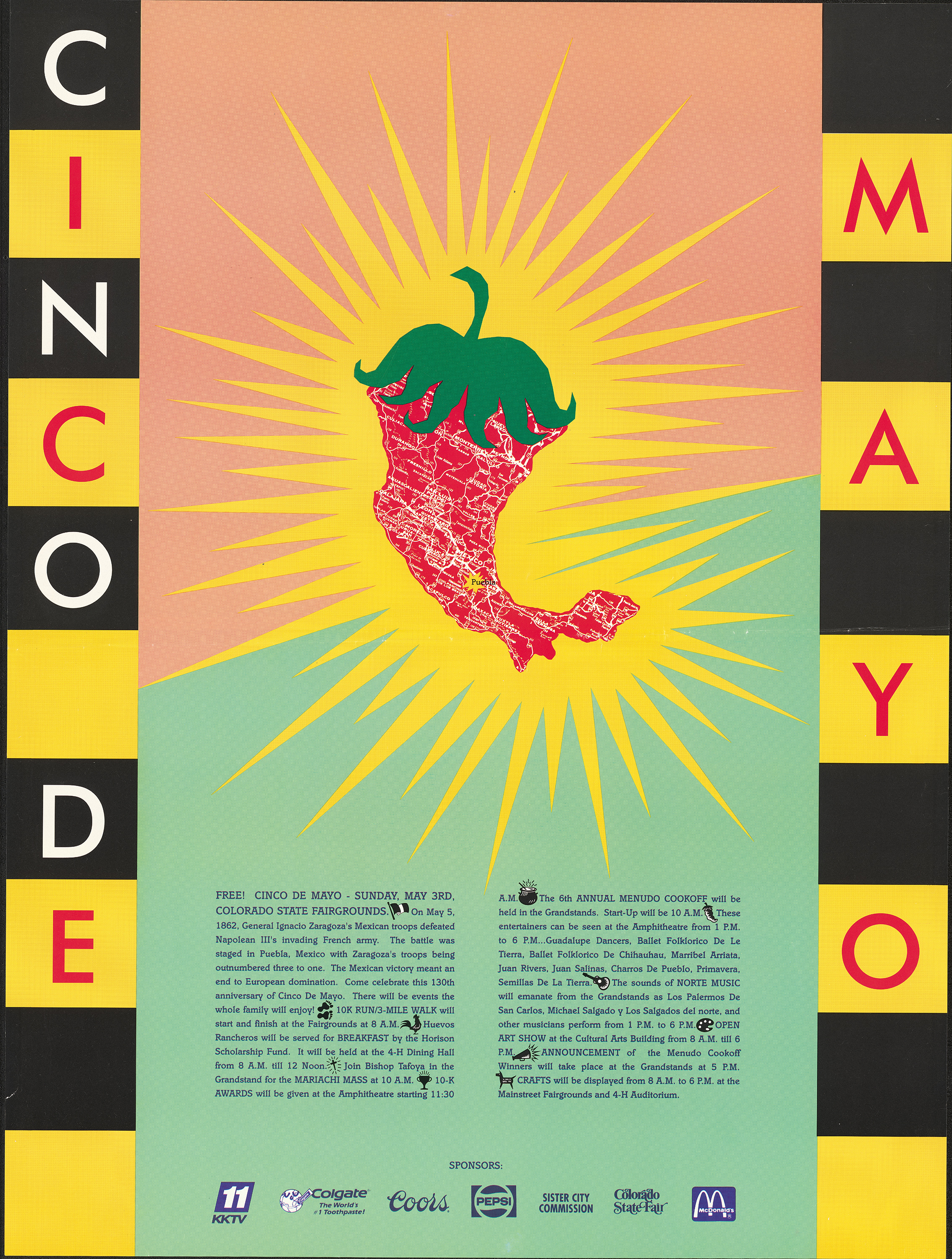
A poster advertising the 1992 Cinco de Mayo celebration in Pueblo, which commemorated the 130th anniversary of the Battle of Puebla. The image of a chile is centered proudly as an icon of Hispano and Chicano culture, and the identity of Pueblo County as a whole.
The green chile rivalry between Colorado and New Mexico has been, at times, heated, but at the end of the day, the Mosco and other Mirasol chiles are simply a different family of plants than Hatch-style green chiles. How they arrived in southern Colorado may still be a matter of speculation, but they’ve grown into a beloved local crop that adds to the overall diversity of the chile palette.
“I have no ill will towards Colorado,” Havlik said. “Dan (Hobbs), if I run across him at the right time, will give me a big bag of his Mirasol chiles. I don't have any complaints. I think (the sense of rivalry) is humorous.”
Bartolo, not an aficionado of spicy food himself, is also one to celebrate the differences rather than try to elevate them into an interstate competition, noting that the Pueblo Mirasol and the New Mexico Hatch are long-diverged—separated genetically by centuries if not a millennium.
“It doesn't make one better than the other. It just makes it different and adds to the whole allure of growing chiles and the affinity we have for them because they're associated with our time and place and our traditions,” he said. “People say, ‘Well, you must like Pueblo chile better.’ No, I just like it all. I think they're wonderful plants. I love the plants and I love the farmers and I love the reasons that it was developed.”
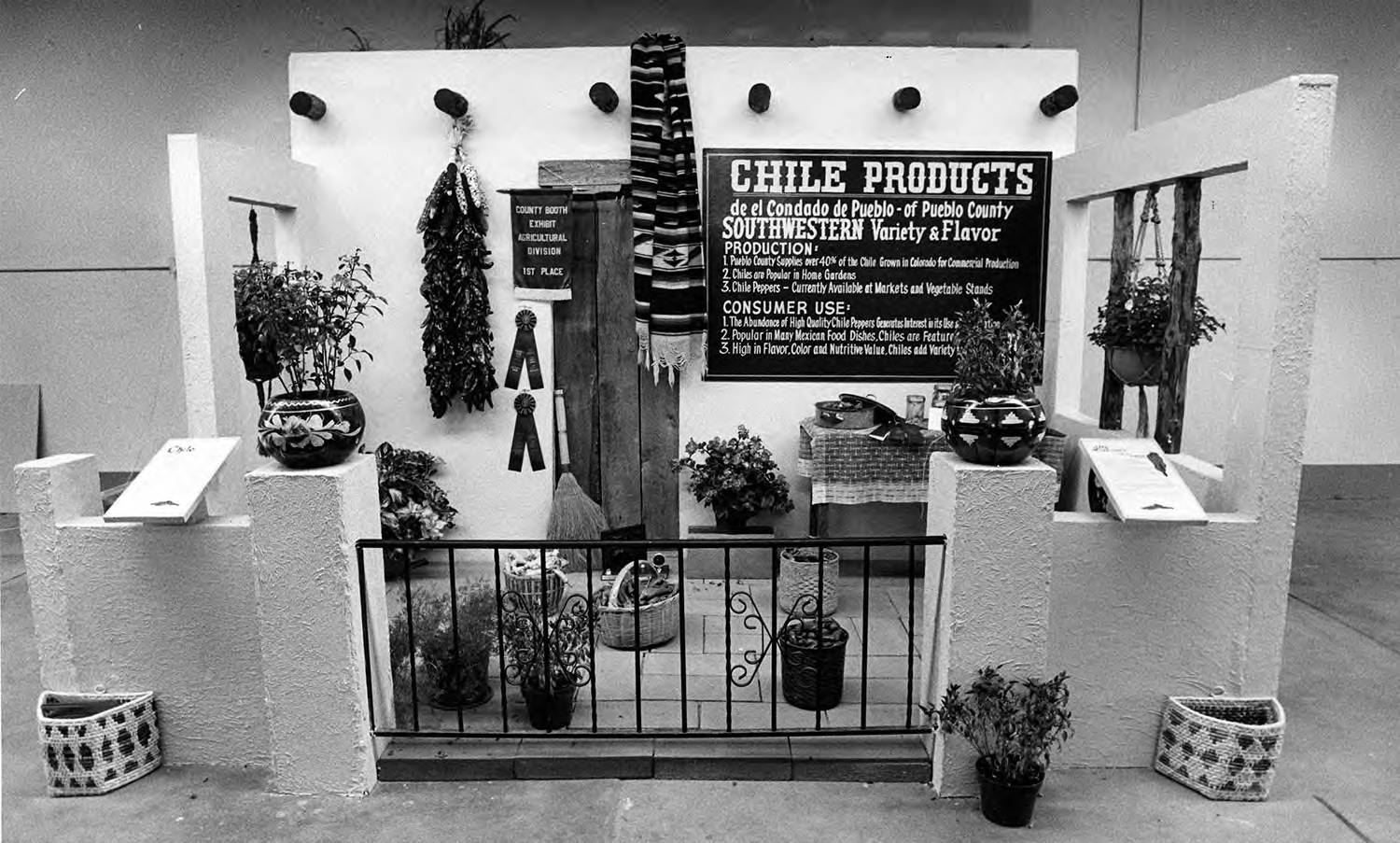
The Pueblo County display at the 1982 Colorado State Fair, proudly promoting the chile products of the county’s farmers.